But don’t worry: There’s only one question, and it’s multiple-guess.
The authors of the U.S. Constitution were greatly influenced by a book called The Spirit of the Laws. It said there were three types of government: republican (including democracy), aristocratic (including monarchy), and despotic.
According to the author, each type of government needs to encourage different qualities in the people who live under it.
A republican government needs to encourage virtue in all of its people. Specifically, that’s civic virtue: The ability to reason clearly about public issues, obey the law, and cooperate for the common good:
“When virtue is banished, ambition invades the minds of those who are disposed to receive it, and avarice possesses the whole community … The members of the commonwealth riot on the public spoils, and its strength is only the power of a few, and the licence of many.”
Aristocratic government also needs to encourage civic virtue, but only in the rulers because only they have political power. The author calls that kind of virtue “honor” to distinguish it from the widespread kind of virtue needed in a republic.
Though the word “aristocracy” literally means rule by the best, in practice, it’s rule by the few: that is, by a small group of privileged elites. In a healthy society, the elites actually are some of the best people, in the sense that they are honest, wise, and virtuous:
“But how are the [elites] to be restrained? … either by a very eminent virtue, which puts them in some measure on a level with the people, and may be the means of forming a great republic; or by an inferior virtue, which puts them at least on a level with each other.”
If a country’s elites go bad, then the country is in danger. It will suffer:
“Ambition in idleness; meanness mixed with pride; a desire of riches without work; aversion to truth; flattery, perfidy, contempt of civil duties … It is exceedingly difficult for the leading men of the nation to be knaves, and the common people to be honest; for the former to be cheats, and the latter to rest satisfied with being only dupes.”
Despotic government is the simplest of the three types. It has no need of virtue or honor:
“As virtue is necessary in a republic, and honor in a monarchy, fear is necessary in a despotic government: with regard to virtue, there is no occasion for it, and honour would be extremely dangerous.”
So despotic governments need to cultivate fear: to keep their subjects in constant terror so that they don’t start thinking too much:
“In despotic states, the nature of government requires the most passive obedience … man is a creature that blindly submits to the absolute will of the sovereign. His portion here, like that of beasts, is instinct, compliance, and punishment.”
All right, it’s time for the quiz. Put away your books. Freddie, give me that cell phone, you know they’re not allowed in class. No cheating. You should make up your own mind. Your own government encourages:
Virtue.
Honor.
Fear.
Pass your quiz papers to the front. Class dismissed.
If you’re swimming, then you’re going someplace. If you’re treading water, then you’re just waiting to drown.
Call me crazy, but I don’t think that waiting to die is a good way to live.
If your life is going to mean something — to you, at least — it has to be about something beyond itself.
That’s one reason why many people today are so anguished. They’ve been taught since childhood that they’re just animals and that their lives don’t mean anything. They believe that morality, justice, love, and truth don’t really exist. They believe that it’s pointless to strive for knowledge because there are only lies: my lies or your lies, take your pick. It’s pointless to strive for improvement because there’s no better or worse, no good or evil: only savage, amoral brutes fighting over who gets the biggest piece of meat from the prey they just killed.
That’s their vision of life, and it drives them mad. They lose all sense of reality because the reality they see is absolutely unbearable.
But that vision is wrong, and we can do better.
The remedy is to stop treading water. Our lives need to have a goal, a worthy goal that helps people and makes the world a better place.
In previous eras, that goal and moral framework were provided by religion: in the West, mainly Christianity and Judaism. But as our wealthy and faux-educated elites have been progressively seduced by their own delusions of omnipotence and increasingly depraved vices, they’ve rejected the religious, historical, and cultural patrimony that had made both their luxury and our societies possible. They replaced our sacred patrimony with: nothing.
So there’s no longer a default framework that we can use to give our lives meaning and purpose. We have to decide for ourselves. How can we know what goals will make our lives worth living?
Everyone will have his or her own unique answers. But our goals should be:
Achievable. Impossible goals are bad not only because they’re a waste of effort, but also because they lead to hopelessness and giving up. It must be at least conceivable that you can achieve your goals. You need not know in advance all the details of how you’ll do it, but you should be able to figure out some general ideas.
Specific. Goals should be specific enough for us to know if we’ve achieved them or not. “I want to live in a nice place” is too vague. But if you say, “I want to live in a beach house in Malibu,” it’s easier to know if you’ve achieved your goal.
Challenging. Goals that are too easy aren’t inspiring and they’re over too fast. Goals should be possible, but not guaranteed. A little bit of uncertainty provides motivation while you work toward the goal, and increases your satisfaction when you achieve it.
Win-win. The best goals are win-win propositions. If you achieve your goal, then that’s great! You won. But win-win goals do a lot of good even if you lose. For example, do you want to qualify for the track team? Then get busy with physical training. Even if you don’t make the team, you’ll be in great shape. That’s an example of a win-win goal.
Morally good. The best goals are the ones that help people and make the world a better place. It’s not always easy to know if our goals can achieve those things. But if they increase human happiness and well-being, don’t cause significant harm, and don’t break any obvious moral laws (e.g., “don’t lie,” “don’t murder”), then they’re at least worth considering.
And finally, there’s a big point that’s different for everyone. Your goals should be:
Inspiring to you. The best goals for you are those that can stir your heart and move your mind to action. Only those goals can imbue your life with meaning and purpose, drawing you forward to the good place that you see ahead in the distance.
Don’t just tread water: swim. There’s treasure on the far shore that only you can unearth.
P.S. Peripherally relevant: today, October 11, is my college girlfriend’s birthday. She joined a cult, I think because she felt her life lacked meaning. The last time I talked to her, she was still in the cult — 20 years later. The cult gave her a sense of meaning and purpose in life that religion and society had failed to provide. I miss her, but I’m happy that she found what she needed. And as cults go, hers isn’t too bad.
Note: With a presidential election coming up, the news media are full of misleading headlines, biased reporting, and less often, outright lies. Here’s how to avoid some of the most common traps. (Originally posted on my other blog in 2018.)
Are the news media corrupt? Most people say “yes.” Leftists point to Fox News and The Wall Street Journal‘s editorial page. Conservatives point to CNN and The New York Times. They believe that such news outlets distort the facts and even lie about them.
Sometimes, that’s true. But there’s more to the story. In the 1990s, I was a newspaper reporter in Washington, DC. I was an accredited member of the U.S. House and Senate Press Galleries, covering Capitol Hill and several federal agencies. I saw from the inside how the news works.
News versus opinion
Most people fail to make an important distinction. Editorial writers, columnists, and televised political commentators don’t report unbiased news. Usually, they don’t even pretend to do it. They’re arguing for their side of a debate.
If you read the editorial and op-ed pages of The New York Times or The Wall Street Journal, then you either know what you’re getting or you’re very naive. The same applies if you watch Tucker Carlson on Fox News or Rachel Maddow on MSNBC. They’re “on your side” of the debate. You want to learn things that reinforce what you already believe. Facts are okay, but you’re mainly looking for reassurance that you’re right.
As a result, there’s nothing dishonest about editorials or commentators arguing their case — as long as they don’t flat-out lie and as long as the other side is free to argue its case, which the tech giants are now trying mightily to prevent. None of it is straight news.
News reporting is different
News reporting is held to a higher standard. Joseph Pulitzer, after whom the Pulitzer Prize is named, said that the three most important qualities of any news article were “accuracy, accuracy, and accuracy.”
My proudest claim as a news reporter was this: That from reading my news articles, no one could discern what I personally believed about the subjects of the articles. I had opinions, but I kept them out of the news.
If I wanted to argue for my viewpoint, I wrote an opinion column. It might surprise you to learn that many other reporters felt the same way. They often agonized about how to present the news fairly and without bias. I attended several conferences about how to report the news professionally but truthfully. It’s not as easy as you might think.
News reporting vs. human nature
A big problem is that news reporters aren’t robots. They’re fallible human beings. Despite their best efforts, human nature sometimes leads them astray.
One week when I was a reporter, there were rumors of a scandal at a certain federal department. In our daily staff meeting, the news editor asked if anyone could find out about it.
I didn’t normally cover that department, but I had a friend who worked there. I volunteered to call him and ask. When I called, he didn’t know anything about the rumors but he agreed to ask around. He later called back to explain that the “scandal” was just an acrimonious turf battle between two groups in the department. What he told me was “not for attribution,” which meant that I could quote him but not identify him by name.
We weren’t close friends, but I knew him fairly well. I knew his wife and children. He was a decent and honest guy. His explanation sounded reasonable, and I wanted to believe it. I checked around a little more, but I didn’t have any other good sources and I thought that I already knew the truth. So that’s what I reported in a news article.
It turned out to be wrong. I misinformed my readers: unintentionally, to be sure, but I did. After I called him, my friend probably went to his own boss to ask about the rumors. In turn, the boss probably asked his boss, who asked his boss, and they all agreed on what to tell the news media. That’s what they told my friend, and he relayed it to me.
The most dangerous media corruption
The most dangerous kind of media corruption doesn’t involve bribery, Russian hookers, or anything like that. It’s dangerous precisely because its origin is innocent. We want to believe in our friends. We want to believe that what’s good for them is also what’s true. We usually see the world in about the same way as they do: similar assumptions, moral beliefs, and feelings about political issues.
Now that news has become largely infotainment, there are plenty of dishonest reporters. Some less-experienced reporters probably have no idea of what “straight news” even is. However, at least half of today’s biased news results from the fact that reporters know the people in the fields they cover. They believe their friends and they don’t want to hurt them. Even with the best intentions in the world, some biased reporting is impossible to avoid.
Getting a balanced perspective
As with buying sandwiches from street vendors, “caveat emptor” (let the buyer beware) is a good motto for reading the news. If you want to know the truth and not just reinforce what you already believe:
Look at a variety of news outlets to get different perspectives. If you read Breitbart all the time, make a point of reading The New York Times. If you watch MSNBC, force yourself to watch some Fox News. Each will tell you things that the others omitted and will give you a different slant on the news. If you combine the opposing slants, they often cancel each other out so you get a more accurate picture of what’s happening.
Don’t read only the headlines. The reporter doesn’t write the headline under which the article is published. Often, headlines give a misleading idea of what the articles say. Sometimes, they even contradict what the articles say.
Watch out for weasel words such as “alleged,” “might,” “possibly,” and “could.” Those are red flags, indicating a conclusion that is not supported by the evidence. Anyone can “allege” anything, but that doesn’t make it true.
Watch out for anonymous sources. Sometimes, anonymous sources tell the truth. Other times, they lie under the cloak of anonymity. Treat all anonymous statements with skepticism, even — or especially — if they support “your side” of an argument.
Read the last few paragraphs. Biased reporters often “bury” inconvenient facts at the ends of articles. That way, people who only read the first few paragraphs get a false impression about what happened. Occasionally, less-biased reporters do it as well. If a scrupulous reporter knows that the editor is biased and won’t allow the mention of certain facts, he or she might bury them at the end, hoping that the editor won’t notice them. I’ve seen several articles like that in The New York Times.
Beware of accusations phrased as questions. Neither “Did Obama order illegal spying on the Trump campaign?” nor “Has Trump sided with Nazis?” tells you anything. They’re questions. But if you’re not paying much attention, your mind will convert them into beliefs that “Obama did” and “Trump has.” That’s why they work as propaganda. You’ll often see that trick used in headlines at the bottom of the screen on cable news shows.
Beware of claims that people said things. Cable news shows often ask guests questions like “What do you think of Mr./Ms. X’s statement that all puppies should be killed?” The guest replies, “It’s just disgusting that Mr./Ms. X hates puppies and wants them dead.” But if you look at the transcript to find out what Mr./Ms. X actually said, nine times out of 10 it’s nothing at all like what the cable news host or guest claimed. (I added this bullet point on 2020-10-07.)
Check links and citations. When internet articles give links to support their claims, don’t just assume that the linked pages say what you’d expect. For example, one article claimed that Covid-19 infection causes lasting damage to bodily organs. As evidence, it linked to another article about autopsies that found damage — in people who had died from Covid-19. In other words, the article was only about the most severe cases. It did not support the claim that Covid-19 causes lasting damage to most people who get it. (I added this bullet point on 2020-10-07.)
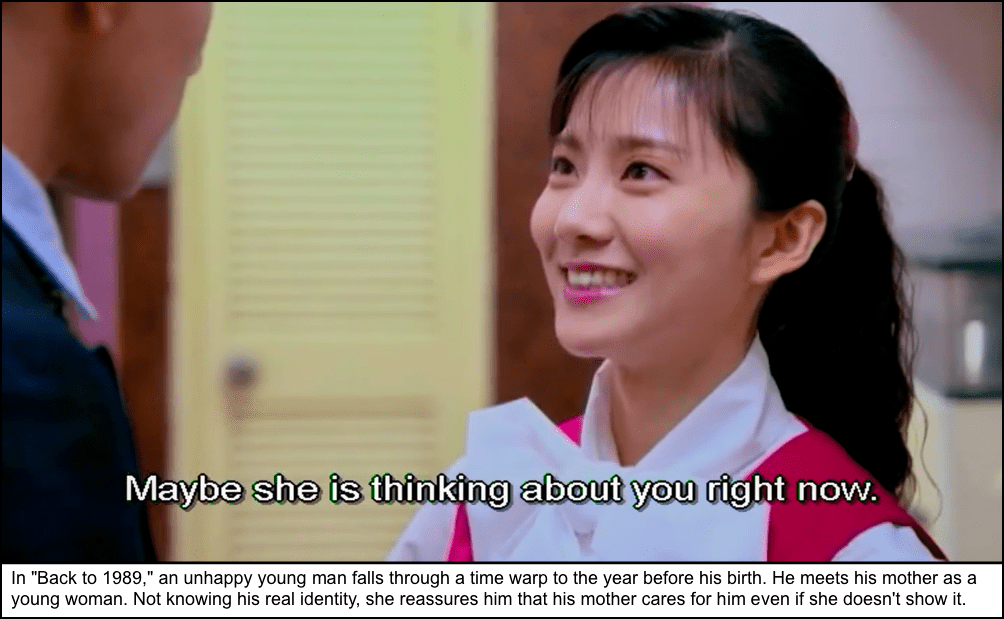
Right now, someone who loves you is thinking about you. Wondering if you’re all right. Wondering if you’re happy or sad. Wondering if now is a good time to give you a phone call just to say “hi.”
Maybe they think you’re busy. Maybe they don’t want to be a pest. But they are thinking about you. They care what happens to you.
If you’re feeling sad and they found out about it, they’d call you right away. And if you’re feeling great and wish you had someone to share your happiness, they’d want to do that, too. Happy is better, but happy or sad, they will stand with you if they can.
We hear a lot about the risks of Covid-19, but not much about the risks of isolation. Loneliness, depression, and all kinds of problems face people who feel cut off from the world. They sit alone at home, and when they go out, it’s not much better. Instead of smiling faces, they see masks. Instead of handshakes, they get hand sanitizer. They’re told to keep their distance. Even when they’re around other people, they still feel alone.
That’s why it’s important to remember that we’re not alone and we do have people who care about us.
Think about it: there are people about whom you care. Have you called them today? Probably not, for the same reasons they haven’t called you. It doesn’t mean you don’t care. If you knew they needed you, you’d call right away. And if they knew you needed them, they’d do the same.
Right now, people who love you are thinking about you. And they hope you’re all right.
It’s a good cause, but focusing on suicide risks missing the point.
The suicide is only the final act of the tragedy.
The greatest tragedy comes earlier, when someone reaches a point in his or her life where suicide seems like the best option.
Despair is the real enemy: the belief that life is intolerably bad and there’s no chance it can get better. That is almost never true.
Everyone, without exception, sometimes encounters suffering and sorrow. The only question is how we are going to respond. If we respond with faith and courage, we can almost always survive our sorrows.
In my family, the only suicide I know about is Vachel Lindsay (1879-1931). He was a popular American poet who toured the country performing his poetry on stage. He spent most of his life in Springfield, Illinois, where a street bears his name. He took his life because of financial problems that overwhelmed him.
I get it. I really do. Sometimes, we feel hopeless and the world seems determined to crush us as painfully as possible. That’s what ultimately killed Vachel Lindsay.
If I could go back in time and talk to him, I’d ask him to tell me about his worries. Just talking with a friend or family member can help put our worries into perspective.
And I’d encourage him to think. Each person has a unique contribution to make to the world: in that sense, we are all irreplaceable. Nobody else can substitute for us.
That also applies to how we treat other people. We are made to help each other. If we aren’t there for them when we should be, they suffer because of it. Our lives aren’t just about us as individuals.
It helps to believe that the world makes sense and that life has a purpose. As the Rebbe Menachem Mendel Schneerson (1902-1994) said:
“Even in deepest despair, faith in G-d gives us the capacity to reconcile and deal with our grief. In a world without G-d, pain and suffering would be fruitless. But with G-d at the helm, even though the pain may not subside, we can accept it as a challenge of life; it motivates us to seek answers, to explore our relationship with G-d, and to grow from the experience.”
He was not a perfect person. He failed often, but he never let it stop him. He kept on going.
And whether he failed or succeeded, he knew who was responsible: He was. Nobody else.
Lincoln taught himself law by reading books that he borrowed. He taught himself land surveying in the same way. He took any work he could find, no matter how humble. He was determined to make something of himself: to live a life that made a difference. And if it was going to happen, it would be up to him to make it happen.
That’s the advice that he gave in 1848 to young lawyers:
“The way for a young man to rise is to improve himself every way he can, never suspecting that any body wishes to hinder him. Allow me to assure you that suspicion and jealousy never did help any man in any situation.”
It’s true that sometimes, people will try to hinder us. But even then, what ultimately happens is still up to us.
Blaming others is a psychological crutch that we don’t need. We can’t control what other people do. We can only control what we do.
If we take responsibility for our own lives, then success is not guaranteed. Like Lincoln, we might still fail sometimes.
But if we don’t take responsibility, then failure is guaranteed. Even if we get what we want, we’ll know that we didn’t earn it. The sweet things will taste bitter in our mouths.
Taking responsibility keeps the sweet things sweet. As they should be.
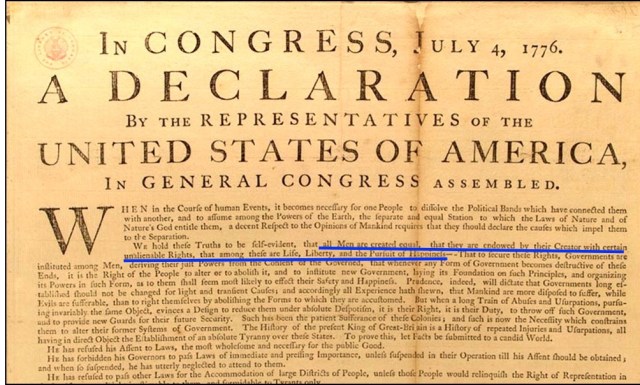
Many recent social conflicts might have been avoided if the American Declaration of Independence had added one simple word.
The Declaration’s second paragraph states the political ideals on which it was based:
“We hold these truths to be self-evident, that all Men are created equal, that they are endowed by their Creator with certain unalienable Rights, that among these are Life, Liberty and the pursuit of Happiness …”
When the Declaration was published, everyone in America’s British colonies knew what the text meant. The population was 90 percent British. They all shared the same culture, assumptions, and world-view. And of course, “men” meant “humans.”
But that word “equal” was too vague. It could mean a lot of things: some true, and some false. It was eventually going to cause trouble.
If we set aside what we are “supposed to believe” about equality and look at the facts, people are obviously not equal.
Some are tall, some are short; some are law-abiding, some are criminal; some are good at playing tennis, some are bad at it. Some are “people who menstruate,” and some are not.
And yet there is a sense in which human equality is true. All people who are smart enough to use language have the same basic human rights and human dignity. In that sense, they are equal. That’s what the Declaration missed: one word. It should have said:
“We hold these truths to be self-evident, that all men are created equal in that they are endowed by their Creator with certain unalienable Rights, that among these are Life, Liberty and the pursuit of Happiness …”
Moral and legal equality are entirely consistent with reality. Equality in other ways is not.
There’s no shame in that. You might even take it as an indirect compliment.
Fake psychics love to have scientists “test” their powers because scientists are easy to fool. Scientists work with observable facts, so they assume that they’re good at detecting fraud. They’re not good at it. They’re terrible at it.
Likewise, propagandists love honest people because they’re easy to fool. Honest people usually tell the truth and think everyone should tell the truth. So they don’t think in terms of trickery. A little misdirection here, a little exaggeration there, a couple of outright lies, and many honest people simply believe what they’re told: Iraqi WMDs, “hands up, don’t shoot,” Russian collusion, and now The Deadliest Plague Ever (Covid-19).
Kekst CNC, a market research firm, did opinion polls in six countries (UK, US, Sweden, Germany, France, and Japan) from July 10-15. In each country, the poll got answers from 1,000 adults who were supposedly representative. The results are plausible but I have not verified them personally. They are consistent with my own observations. Results for one of the questions are shown at the top of this blog post.
In every country, poll respondents wildly over-estimated how many people had Covid-19 and how many people had died from it. In the United States, the average of respondents’ answers was that nine percent of the population had died from Covid-19. That’s 30 million deaths, or one-hundred seventy-nine times the official August 2020 total of 167,000.
That’s what you get from 24/7 fear-bombing by the media and politicians using Covid-19 for partisan advantage. But if you pay attention, you can detect some of the deceptions.
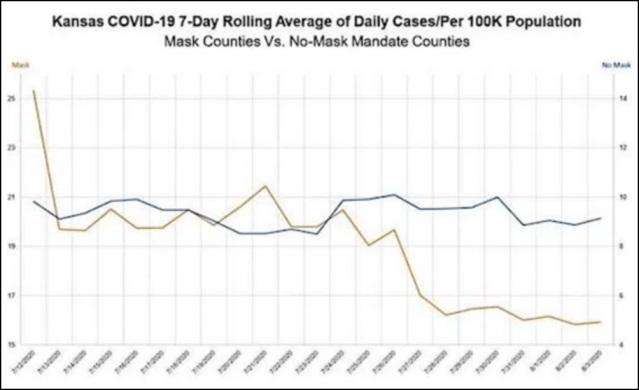
A particularly egregious example came from the Kansas State Department of Health. This graph supposedly shows that wearing masks helps prevent transmission of Covid-19:
Sorry if the image is a little unclear. The original photo of the chart is “for sale,” which implies that it is copyrighted. On the site of The Topeka Capital-Journal, you can see the actual chart from the news conference here. From the chart, you would think that mask-wearing helped a lot to slow transmission of Covid-19.
But look closely: The “mask” line is plotted against the left-side axis, while the “no mask” line is plotted against the right-side axis. The left-side axis goes from 16 to 25, while the right-side axis goes from zero to 14. If you plot the lines against the same axis, you get this:
Masks might help prevent the spread of Covid-19, but the chart doesn’t show it, and is clearly deceptive. Non-mask counties had fewer cases per 100,000 people than mask counties. Nobody could make that “mistake” by accident.
Don’t panic. Stop and think. Read carefully. Follow links and footnotes to see if they really say what the text suggests that they say. If you see words like “might” or “model,” beware: what you’re reading isn’t established fact, it’s spin or speculation.
You can’t go through life never trusting anyone. As a result, sometimes you’ll be deceived. But you can often avoid it. As a former president advised, “trust, but verify.”
“Strange visitor from another planet, who came to earth with powers and abilities far beyond those of mortal men.” — Voiceover from the 1950s “Superman” television show
I’m going to tell you two stories. The first is known to be true. The second might be true.
The story that’s true
John Stuart Mill (1806-1873) was one of the greatest philosophers and economists of the 19th century. He is best known for his book On Liberty, which argues for a society based on individual freedom. By the time he was a teenager, he was already famous as a speaker and writer. But at age 20, he fell into a deep depression:
“All my happiness was to have been found in the continual pursuit of [a free society]. The end had ceased to charm, and how could there ever again be any interest in the means? I seemed to have nothing left to live for.”
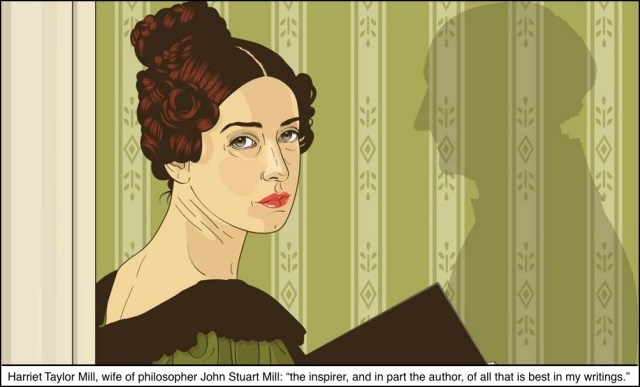
Mill did not recover from depression until four years later, when he met and fell in love with Harriet Taylor (1807-1858). That love restored his zest for life. In the dedication of On Liberty, published after her death, Mill wrote that she was:
“… the inspirer, and in part the author, of all that is best in my writings — the friend and wife whose exalted sense of truth and right was my strongest incitement, and whose approbation was my chief reward … Were I but capable of interpreting to the world one-half the great thoughts and noble feelings which are buried in her grave, I should be the medium of a greater benefit to it than is ever likely to arise from anything that I can write, unprompted and unassisted by her all but unrivalled wisdom.”
Harriet was undoubtedly a remarkable person, though historians aren’t sure that she was as remarkable as Mill thought. What is certain is that without her influence, most of Mill’s greatest works would never have been written.
Lincoln had grown up in poverty, taught himself law, and had in 1834 been elected to the Illinois State Legislature. At the time, he lived in New Salem, Illnois. In 1835, a New Salem woman named Ann Rutledge died at age 22 of typhoid fever.
All of the foregoing is established fact. What comes next might be true.
Some evidence suggests that Rutledge and Lincoln were in love. Local merchant William Herndon said that “Lincoln’s heart was buried with her in the grave.” Eventually, Lincoln recovered from her death and went on with his life:
“But he had changed, and the change endured. Later he married, but Ann Rutledge was the only woman he ever really loved. Her memory exerted a mystic, guiding influence throughout his life.”
In 1890, Ann’s grave received a new tombstone. The inscription said:
Out of me unworthy and unknown
The vibrations of deathless music;
“With malice toward none, with charity for all.”
Out of me forgiveness of millions toward millions,
And the beneficent face of a nation
Shining with justice and truth.
I am Ann Rutledge who sleep beneath these weeds,
Beloved of Abraham Lincoln,
Wedded to him, not through union,
But through separation.
Bloom forever, O Republic,
From the dust of my bosom.
Two kinds of power
The point of those stories is that I think feminists vastly under-estimate the power of women.
It’s because they believe there’s only one kind of power: the kind that men have.
And they believe there’s only one way to exercise power: the way that men do.
It’s not true.
All of us, male or female, have a mixture of masculine and feminine traits.
But each sex has its own special kind of power. Each sex needs the other to reach its full potential.
Masculine power is direct, like swinging a hammer. It can build civilizations.
Feminine power is indirect, like the gentle caress of a breeze. It can make civilizations worth building.
Masculine power acts; feminine power inspires.
Without inspiration, there’s no action. Without action, nothing gets done. Both are needed.
Unless otherwise noted, all posts are copyrighted by N.S. Palmer.
Posts may be reposted on other sites as long as byline, copyright notice, and URL (the-1000-year-view.com) are included. Excerpts may be reproduced with attribution under the fair use provisions of copyright law.







 The Thousand-Year View