Fortunes of War

In the United States, November 11 is Veterans Day, first celebrated in 1919. Back in 1919 it was called Armistice Day, commemorating the 1918 armistice that ended what Americans originally called the European War. When the European War started, Americans wanted no part of it. If European nations wanted to fight each other, then let them: we crossed the Atlantic to get away from that kind of thing.

But the deep state of the time ran a couple of propaganda ops to inflame public sentiment, and the Wilson Administration eventually dragged Americans into what came to be known as the Great War. Ironically, Wilson had been elected president on the slogan that he “kept us out of war,” but despite it all, Americans ended up “over there.”

It’s no longer called the Great War: first, it wasn’t all that great, and it was arguably the beginning of the end for Western civilization. Second, it’s now called World War I because — as many people warned at the time — the June 1919 Treaty of Versailles guaranteed and delivered a World War II. More tens of millions were needlessly killed.

And the wars continue. Our newly-elected president seems less inclined to start wars, but how much he can stop them is in doubt. Apart from the huge amounts of money to be made, the animalistic side of human nature revels in the death and destruction that war brings. Whether we like it or not, we have only a thin veneer of intelligence covering our instinctive savagery. As William James wrote in “The Moral Equivalent of War” (1910):

“Modern war is so expensive that we feel trade to be a better avenue to plunder, but modern man inherits all the innate pugnacity and all the love of glory of his ancestors. Showing war’s irrationality and horror is of no effect on him. The horrors make the fascination. War is the strong life; it is life in extremis; war taxes are the only ones men never hesitate to pay, as the budgets of all nations show us.”

Human nature remains as it always was; only the technologies and excuses have changed. We can hold back the savage tide a little, now and then, but each generation has to start anew on trying to maintain a decent — and peaceful — civilization.

Posted in Life, Political Science, Psychology, Science | Tagged , , , , , | 2 Comments

A Visit to Chinese Church

This morning, I went for the first time to a Chinese-language church service. It’s the first time I’ve been to church on Sunday for a while, because half of my family is Christian and half Jewish. The church service was both encouraging and a little discouraging.

It was encouraging how much I understood and how I was able to talk with the people. Mandarin is a tough language for English speakers, and I’ve still got a long way to go before I’m really proficient.

It was a little discouraging how much I didn’t understand. First, everyone talked fast, but that was expected. Second, the readings (from the Bible’s Book of Esther) were projected on computer screens at the front. Chinese can be written either horizontally (left to right) or vertically (top to bottom). The readings started out horizontal but then unpredictably switched to vertical, back and forth. For someone like me who was already struggling to read the text, it was hard to keep up.

Another hurdle was that Chinese can be printed in either simplified or traditional characters, and the readings were printed in traditional characters. I only know simplified characters. Fortunately, about 80 percent of the characters are the same in both, but the other 20 percent tripped me up a lot. Most of the Chinese people around my city are from Taiwan, which uses traditional characters.

At least the minister spoke loudly and clearly, so he was relatively easy to understand. Dress was very casual; the minister and I were the only ones wearing ties.

Posted in Bible, Christianity | Tagged , , | 2 Comments

Four Deadly Errors

Four deadly errors creep into most debates about social policy. They are the moralistic fallacy, the realistic fallacy, the rationalistic fallacy, and the existentialist fallacy:

  • The moralistic fallacy: morality determines reality. This fallacy assumes that whatever seems morally desirable must be true. If something is undesirable, it must be false. This fallacy is most often committed by the political left.
  • The realistic fallacy: reality determines morality. This fallacy assumes that whatever seems true must be moral. This fallacy is most often committed by the political right.
  • The rationalistic fallacy: if it seems to make sense, then it’s true. This fallacy assumes that whatever seems to make sense must be true, even if there’s no evidence for it. This fallacy is most often committed by college students debating in the dormitory late at night, but others commit it as well. A joke says if you show economists that something works in practice, they object: “Yes, but does it work in theory?”
  • The existentialist fallacy: if you want it to be true, then it is. This fallacy assumes that reality is whatever you want it to be. It is loosely suggested by the philosophy of existentialism, which argues that people must define the meaning of their own lives. It’s also a kind of “get out of jail free” card to justify the other fallacies. For example, it enables 52-year-old men to claim that they are six-year-old girls and make everyone else pretend to believe it.

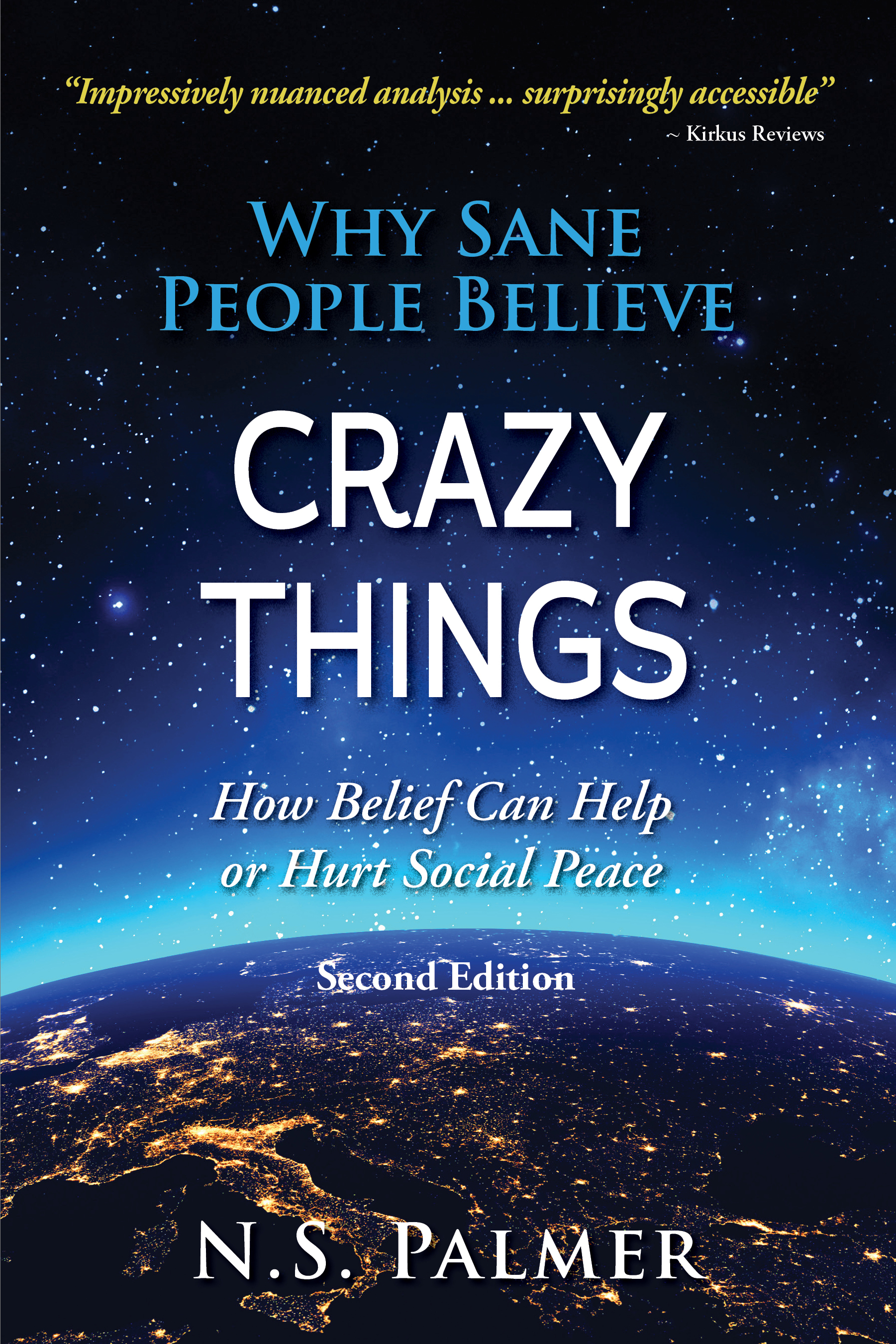
My new book Why Sane People Believe Crazy Things Second Edition helps you spot fallacies so they can’t fool you. Get your copy today!

Posted in Epistemology, Human Relations, Life, Philosophy, Psychology, Society | Tagged , , , | Leave a comment

In Defense of Ugly People

I want to say a word in defense of ugly people. I don’t mean people who are morally or spiritually ugly, but people who just had bad luck in their appearance.

Yesterday in an online discussion, an ugly woman posted her photo. She was unhappy and angry about something. Genetics had dealt her a cruel hand, and there wasn’t much she could do about it.

As for me, I’m probably a 5 out of 10: neither very ugly nor very good-looking. But I’ve known good people of both sexes who were just physically ugly. I always tried to treat them with the same friendship and respect as I did everyone else, and usually succeeded. At least I hope so.

Ugly people don’t “deserve” to be ugly, because nature is neither fair nor unfair. Fairness just doesn’t apply. We all get what we get. But ugly women are especially unlucky. Whether we like it or not, looks matter more in their case than they do for men.

Nobody much cares what men look like as long as we’re neither hideously ugly nor spectacularly handsome. But both men and women do care what women look like.

I once had a blind date with a woman I’d only met on the phone. She was intelligent, witty, and fun. But face to face, I discovered why she’d had to develop such wonderful personal qualities. Yes, she was ugly. Very ugly. I’m both sorry and ashamed to say that I just couldn’t get past it. I’m not a robot.

Some problems can’t be fixed, at least not in 2024. Some human problems can never be fixed. There will always be in-groups and out-groups, and sometimes they will dislike each other. Both individually and collectively, the most we can do is try to minimize the harm and give everyone his or her best chance for happiness.

Posted in Human Relations, Life, Psychology | Tagged , , , , | 4 Comments

Roll the Dice

Common wisdom gives us a lot of contradictory advice. There’s:

  • “Fortune favors the brave.”
  • “Discretion is the better part of valor.”

And there’s:

  • “Look before you leap.”
  • “He who hesitates is lost.”

But I think the best advice comes from the Bible:

“The race is not to the swift, nor the battle to the strong, nor bread to the wise, nor riches to men of understanding, nor favor to men of skill; but time and chance happen to them all.”
— Book of Ecclesiastes 9:11

It’s good to plan ahead. It’s good to set goals. It’s good to believe we are both able to succeed and worthy of success. But we should also remember that “time and chance happen to us all.”

If we win, that’s great! Let’s celebrate. But if we lose, let’s survive, get up, learn from the loss, and do better next time:

“If you can bear to hear the truth you’ve spoken
Twisted by knaves to make a trap for fools,
Or watch the things you gave your life to, broken,
And stoop and build ’em up with worn-out tools …

If you can force your heart and nerve and sinew
To serve your turn long after they are gone,
And so hold on when there is nothing in you
Except the Will which says to them: ‘Hold on!’

Yours is the Earth and everything that’s in it,
And — which is more — you’ll be a Man, my son!”
— Rudyard Kipling, “If”

Courage for life is a key theme of my book Why Sane People Believe Crazy Things Second Edition, now on sale. Get your copy today!

Posted in Bible, Life, Philosophy, Psychology | Tagged , , , , , , | Leave a comment

What Do You Want Out of Life?

To get what you want out of life, you must know what you want out of life.

And even if you know it, you must remember it every day. It must always be in the back of your mind.

Start every morning by reviewing your most important goals and aspirations. And say them out loud. When you say them out loud, it combines reviewing them, hearing them, and doing a physical action (speaking) with them.

Before that, of course, you need to spend some time deciding what you want as your main goals and aspirations.

Some goals will be life-long; others will be short-term, for this month or this year.

Think about what you truly value in life:

  • If you died tomorrow, what would you want to have accomplished?
  • What kind of person would you want to have been?

It’s important to put a due date on goals. A goal without a due date isn’t a goal, only a wish. “I want to lose 10 pounds” won’t motivate you. “I want to lose 10 pounds by December 31” is a real goal.

Your aspirations, on the other hand, are not specific goals. They’re principles you want to follow and habits you want to develop. By reminding yourself of them every morning, you keep your life on track. It helps to have a written list.

One of my written aspirations is “I want to focus on doing good things to achieve my goals.” I say it out loud every morning. Especially now, it’s easy for anyone to get sucked into wasting hours on unproductive and sometimes unhealthy trivia. Having a spoken aspiration every day helps keep the focus on what’s true and important.

So what’s important to you? What do you want your life to be like? How is your life going to matter in a positive way?

Get started today, and remind yourself every day from now on!

How to put beliefs into action is a key theme of my book Why Sane People Believe Crazy Things Second Edition, available now. Get your copy today!

Posted in Life, Psychology | Tagged , , , , , , , | Leave a comment

We Are All Pythagoreans Now

“We are all Keynesians now.”
— U.S. President Richard M. Nixon, 1971

If you took geometry in school, then you probably know the Pythagorean theorem: “in a right triangle, the square of the longest side equals the sum of the squares of the other two sides.”

What you might not know is that Pythagoras inspired a cult called the Pythagoreans. They believed they could explain everything in the world by whole numbers (1, 2, 3, etc.) and ratios of whole numbers (1/2, 3/4, etc.). Even whole numbers themselves could be written as ratios: 1 = 1/1, 25 = 25/1, and so on.

As a result, the Pythagoreans believed that the world was rational (based on ratios).

But early on, they ran into a devastating problem. In a right triangle whose shorter sides are length one, the sum of their squares is two, so the square of the longest side is two. And the length of the longest side is the square root of two, which is not a ratio of whole numbers: in other words, it’s irrational.

They had based their entire philosophy of life on a belief that everything was rational. And there, right in front of them, they saw an example of something that was not rational.

So what did they do? Did they say “oops,” and abandon their philosophy?

Of course not. They still insisted that everything was rational. But they quietly acknowledged that there was this “other thing,” irrational numbers, and they tried not to think about it too much.

We’re all a little like that. We have a mental picture of what the world is like, what people are like, and how things work. We believe in all kinds of things that cynics would say are not true. We believe that people are good more often than not. We believe in obeying the law. We believe that our institutions might be flawed but that they are fundamentally sound. We know there are plenty of cases where our beliefs are wrong, but we’re not giving up on our beliefs.

And there’s good news: We’re luckier than the Pythagoreans. Nobody has to be a decent person, act honestly, and treat other people fairly. But if enough of us hold on to those beliefs and live according to them, we can make them true. A good society is just a society in which most people, most of the time, choose to be good. It’s called an “emergent” property of a society.

The Pythagoreans couldn’t make the world totally rational. That’s impossible. And we ourselves can’t make the world totally good: that’s also impossible. But we can still make it pretty good. Just keep believing in the good and try to live by it.

Living rationally and justly is a key theme of my book Why Sane People Believe Crazy Things Second Edition: How Belief Can Help or Hurt Social Peace. Get your copy today!

Posted in Christianity, Human Relations, Life, Philosophy, Psychology, Science | Tagged , , , , | Leave a comment

You Have a Problem? That’s Good!

Henry Ford (1863-1947) was famous for making cars cheap enough that non-wealthy people could buy them. He revolutionized manufacturing by using assembly-line methods. Instead of having each car made individually by highly skilled craftsmen, he divided the process into simple steps. Each step could be done by moderately-trained workmen along a moving assembly line.

Ford’s positive attitude was a key to his success. If something went wrong, he said “You have a problem? That’s good!” Every problem was a chance to learn how to do better: “What went wrong? What could we have done differently?”

That’s a good attitude to apply in every area of life. When things go wrong, it’s pointless to sulk and feel sorry for ourselves. It’s much more helpful to examine what went wrong and how we can do better.

Many things are outside of our control. Sometimes, we’ll lose even though we did everything right. But we can’t know unless we analyze what went wrong. And we can’t improve unless we decide to learn from our mistakes.

How to learn from our mistakes is a key theme in Chapter 16 of my book Why Sane People Believe Crazy Things Second Edition, now on sale!

Posted in Life, Psychology | Tagged , , , | Leave a comment

Publication Day for Why Sane People Believe Crazy Things!

Today is publication day for the second edition of my book Why Sane People Believe Crazy Things: How Belief Can Help or Hurt Social Peace!

The new edition adds a chapter about the foundations of morality, as well as various other improvements scattered throughout the book.

Here’s a high-level outline:

  • Chapter 1: How to Explain Anything
  • Chapter 2: What Belief Isn’t
  • Chapter 3: What Belief Is
  • Chapter 4: Why Saadia and Maimonides Couldn’t Believe — But Did
  • Chapter 5: Why Spinoza Could Believe — But Didn’t
  • Chapter 6: Why Mendelssohn Changed the Subject
  • Chapter 7: Belief and Biology
  • Chapter 8: What Beliefs Do
  • Chapter 9: How Beliefs Can Be Justified
  • Chapter 10: Plato, Descartes, Thomas Reid, and “The Matrix”
  • Chapter 11: How Beliefs Have Meaning
  • Chapter 12: How the Ineffable Leads to Religion
  • Chapter 13: How Foundational Descriptions Shape Truth
  • Chapter 14: Errors of Postmodernism
  • Chapter 15: The Basis of Morality
  • Chapter 16: Why Be Tolerant?
  • Chapter 17: Building Tolerant Societies
  • Appendix A: Why “Modest Foundationalism” is Circular Reasoning

The book also covers topics such as the mathematical explanation of entropy, the love life of John Stuart Mill, the Ancient Egyptian method for calculating the area of a circle, the nature of truth, song lyrics from “South Pacific,” and Sir Charles Napier’s story of how he saved a widow from being burned on her late husband’s funeral pyre.

If you’re interested in reviewing the book, send an email to tapes.gutsier_0m@icloud.com.

The Amazon ebook page has preview pages for the book so you can see if you like it. Check it out!

https://www.amazon.com/dp/B0DH2V58YF/

Posted in Bible, Christianity, Human Relations, Life, Philosophy, Political Science, Psychology, Science | Tagged , , , , , , , , | Leave a comment

Two Views of Human Rights

Human rights are important: on that, everyone agrees. But that’s about the only point of agreement.

A big problem is that people don’t think about what human rights are or where they come from.

Rights are a claim that we can make on other people, either to do something good for us, or to refrain from doing something bad to us.

They can be legal rights, such as those written into a contract. They can be situational rights, such as entry into a club of which we’re members. Or they can be moral rights, such as the pursuit of happiness. Human rights are a fundamental type of moral rights.

But where do human rights come from? How do we know what they are?

On those questions, there are basically two ways of thinking.

The first way is rationalistic. We simply think about things that are nice to have. If they’re important enough, we declare them to be “human rights.” That’s how we come up with ideas like “the right to medical care” and “the right to a living wage.” Those are definitely nice things. If a society can afford to provide them to everyone, and doesn’t impose unacceptable costs on the people who have to pay for them, then it’s perfectly fine to decide that those are human rights.

But the second way is less rationalistic. It’s more grounded in history and custom. Instead of just thinking abstractly about what would be nice for everyone to have, we look at what our own societies have in fact traditionally considered human rights.

The late Supreme Court Justice Antonin Scalia made that point in a 2012 lecture about the U.S. Constitution’s First Amendment. The First Amendment does not, Scalia said, guarantee simply “freedom of speech.” Instead, it says something more specific:

“The First Amendment does not say that government shall not abridge freedom of speech. It says that government shall not abridge ‘the freedom of speech’ — that is, the freedom of speech which was the understood right of Englishmen.”1

In other words, he wasn’t talking about an abstract right, derived from philosophy: he was talking about a specific right based on history and culture:

“Thus, there are several types of speech unprotected by the First Amendment because the Framing generation never understood them to fall within ‘the freedom of speech’. Libel is one of them. Another is obscenity … incitement to violence and ‘fighting words’ …”2

Those two understandings of human rights neatly parallel the two main reasons for the American Revolution. Some of the colonists thought, with Thomas Jefferson, that they were fighting for abstract rights based on philosophy. Others thought they were fighting to regain the historical “rights of Englishmen” that Parliament and the king had denied to them.

Any society, or any person, can adopt either view of human rights with equal justification. But the historical approach has a practical advantage. If we think our rights are based on custom and tradition in our own society, then we will not be tempted to think that they apply equally well in different societies halfway around the world. We need not “go in search of monsters to destroy,” as President John Quincy Adams warned in 1821.


  1. “The Freedom of Speech” in The Essential Scalia, p. 92. New York: Penguin Random House, 2020. ↩︎
  2. Ibid. ↩︎

Posted in Human Relations, Philosophy, Political Science, Psychology, Society | Tagged , , , | Leave a comment