Ending the Violence, Part 1

My latest blog post for The Jerusalem Post:

“The road to disaster is paved with pleasant illusions, and the way to deal with evil is not to ignore it,”1 advised Abraham Joshua Heschel.

The English philosopher Francis Bacon wasn’t Jewish, but he said much the same thing: “Nature, to be commanded, must be obeyed.”2

As Jews and people of goodwill, we want to “command” a goal that is both simple and seemingly impossible: A world of peace. An end to hatred and bloodshed. A cessation of injustice.

However, to have even partial success — and partial success is the best we’re going to get — we must know what we’re up against. What is the nature that we have to obey in order to command such a result? What are the facts we must overcome?

Someday, the Messiah might arrive and set everything right. Maybe he will change human nature. Until then, we’re on our own. We have to try.

As of 2015, there were about 7.3 billion people on Planet Earth. There were about 20,000 different ethnic groups. There were about 20 major religious groups. Most of them dislike each other. Many of them hate each other and try to kill members of other groups when it is possible. This week’s Palestinian terrorist attacks are only the latest tragic examples.

To say it’s because of yetzer hara (the evil inclination) doesn’t help much. That just means people do bad things because they want to do bad things. We need to know why they want it and why they think it’s all right to act on that desire.

Three causes are most important: Kin selection, territoriality, and lack of empathy. Religious belief has an indirect role.

After those causes have produced their results, three additional factors come into play:

  • External conflict with other societies promotes internal harmony and cohesion within societies.
  • Political leaders are not saints, and they have incentives to act in their own interests (“public choice“) even at the expense of the group’s interests. They can rationalize such actions.
  • Reducing and minimizing conflict, hatred, and bloodshed requires leadership on both sides of a conflict. The external conflict/internal cohesion principle means that reduced conflict has internal costs for each society. The public choice principle means that political leaders must often act against their own narrow self-interests (in terms of which they see the world) for the larger interests of the group.

Kin Selection

Kin selection is an evolutionary mechanism that makes us tend to trust, help, and cooperate with people whom we see as our genetic relatives. It also makes us tend to distrust and attack non-relatives who might compete with us and our families for food, living space, and mates. Biologists have observed kin selection behavior in animals as different as insects, birds, and mammals, including humans and lower primates.

Of course, helping relatives and fighting non-relatives requires animals to know which are which. Animals (including humans, unconsciously) use appearance, behavior, familiarity, and location to identify their relatives.3 They assume that if other animals look and act like them, they are relatives — just as in humans, for example, Joe Junior looks and acts like his father, Joe Senior. If the others are already familiar or in the right location (such as a bird’s nest, a synagogue, or a mosque), then it also activates the biological tendency to help and cooperate. In humans, it increases empathy toward the apparent relative.

Encountering apparent non-relatives has the opposite effect: it activates the “fight or flight” response, preparing the animal to attack or run away. In humans, these responses occur at a biological level before they ever reach the conscious mind. They are the root of racism and other evils:

“When black and white Americans were flashed pictures of the other race, their amygdalas, the brain’s center of fear and anger, activated so quickly and subtly that the conscious centers of the brain were unaware of the response …”4

The good news is that to varying degrees, learning and positive experiences can help about 84 percent of people override their fear-aggression responses:

“When contexts were added — say, the black was a doctor and the white his patient — two other sites of the brain integrated with the higher learning centers, the cingulate cortex and the dorsolateral preferential cortex, lit up, silencing input through the amygdala.”5

Territoriality

From insects to humans, animals tend to view certain areas as their own. They fight non-relatives of the same species who stray into their territory. For example, male wasps attack other males in their territory and try to mate with females who enter. Chimp siblings form groups to patrol their group’s territory, attacking alien chimps that intrude. Humans show the same kind of behavior:

“Territoriality became a defining characteristic of human behavior deep in prehistory, and the basic impulses to expand territory and power through team aggression have not diminished over the last 5,000 years …”6

Hamas demonstrates both kin selection and territoriality:

“Hamas will never recognize the Israeli occupation, and confirms that Palestine from the Jordan River to the Mediterranean is an Arab, Islamic country …”7

Note how the terrorist group talks in terms of “our” territory, “our” team, defined by ethnicity and religion.

On the other side of the conflict, many Israelis agree with former British Prime Minister Winston Churchill:

“It is the primary right of men to die and kill for the land they live in …”8

(To be continued in Part 2.)

Works Cited

Churchill, W. (1956), A History of the English-Speaking Peoples. Dodd Mead & Co., New York.

Heschel, A.J. (1955), The Insecurity of Freedom. Farrar, Straus and Giroux, New York. Kindle Edition.

Jardine, L. and Silverthorne, M., editors (2000), Francis Bacon: The New Organon. Cambridge University Press, Cambridge, UK.

Potts, M. and Hayden, T. (2010), Sex and War: How Biology Explains Warfare and Terrorism and Offers a Path to a Safer World. BenBella Books, Dallas, TX. Kindle Edition.

Slater, P. and Halliday, T. (1994), Behaviour and Evolution. Cambridge University Press, Cambridge, UK.

Wilson, E. (2012, The Social Conquest of Earth. (p. 61). Norton Publishing, New York.

Footnotes


  1. Heschel, A.J. (1955), loc. 2098. 
  2. Jardine, L. (2000), p. 33. 
  3. Slater, P. and Halliday, T. (1994), p. 209. 
  4. Wilson, E. (2012), p. 61. 
  5. Ibid, p. 62. 
  6. Potts, M. and Hayden, T. (2010), P. 366. 
  7. Braun, C., “On its anniversary, Hamas vows to ‘keep its weapon directed at the Israeli occupation only,” The Jerusalem Post, December 15, 2015. 
  8. Churchill, W. (1956), Vol. 1, p. 27. 
Posted in Judaism, The Jerusalem Post | Tagged , , , , , , , , , , , , , | Leave a comment

Moral Patterns and Moral Decisions

Gestalt-Patterns

My new blog post for The Jerusalem Post:

Some things in life are simple. Some aren’t. In fact, a lot of them aren’t.

That’s a problem, because we always want things to be simple. And if they aren’t, then we still try to see them as being that way.

It’s not just intellectual laziness. Our minds automatically prefer things that are simple and symmetrical, whether they are political ideas, scientific theories, melodies, or geometrical shapes.

In the 20th century, Gestalt psychology explored how we find patterns in information, even if the patterns aren’t really there. Pattern-finding is one reason that our memories are often unreliable. If a past event didn’t make sense to us, then when we remember it, we unconsciously impose a pattern so that it makes sense in retrospect.

Moral situations are often too complex to fit into simple patterns or be solved by simple moral principles. Consider Genesis 22’s story of the binding of Isaac. Abraham thinks that God is talking to him:

“Take your son, your favored one, Isaac, whom you love, and go to the land of Moriah, and offer him there as a burnt offering …”

One version of the moral lesson is simple: “God told Abraham to kill Isaac, and Abraham had to obey God.” Another simple reading was given by the philosopher Immanuel Kant (1724-1804):

“Abraham should have replied to this putative Divine voice: ‘That I may not kill my good son is absolutely certain. But that you who appear to me are God is not certain and cannot become certain … For a voice which one seems to hear cannot be Divine [if it commands] what is contrary to moral law. However majestic or supernatural it might appear, one must regard it as a deception.”1

Both sides miss the moral complexity of the situation. What if it really was God talking? Then Abraham had a moral duty to obey. At the same time, however, he had a duty to disobey because he couldn’t know for sure that it was God talking, and the consequences were horrendous.

The point of that story, and of others like it, is that moral decision isn’t always simple. It requires more than just logic: it also requires feeling, imagination, and courage. The story doesn’t give us a simple answer. Instead, it challenges us to think about the problem for ourselves. How would we feel? What would we do? What would we say to God?

You can base your moral reasoning on obeying rules (deontology), on producing good results (utilitarianism), or as Genesis 22 suggests, on imagining what a good person would do (ideal observer theory). Only the third approach recognizes the often heartbreaking difficulty of moral choice, letting us engage both logic and feeling.

That’s why God gave us both intelligence and conscience. It’s why He often doesn’t give us the answers. He gives us the questions, and He expects us to figure out the answers for ourselves.

Works Cited

Frank, D. et al, editors (2000), The Jewish Philosophy Reader. Routledge, London, UK.

Footnotes


  1. Frank, D. et al (2000), p. 42. 
Posted in Epistemology, Judaism, Philosophy, The Jerusalem Post | Tagged , , , , , , , | 2 Comments

For Hanukkah, Free Yourself

Menorah-01r1
My latest blog post for The Jerusalem Post:

What’s the most important freedom?

During Hanukkah, we celebrate religious freedom. That kind of freedom is vital. But it’s not the only kind, or even the most important.

When modern people talk about freedom, they’re usually talking about political freedom. That kind of freedom means they can do whatever they want as long as they don’t harm others or grossly violate the moral norms of society. But it’s not the most important kind of freedom, either.

What could be more important than religious or political freedom?

Ask a simple question: What makes the other kinds of freedom valuable and meaningful?

The answer is: freedom from ourselves. It’s freedom from the dictates of our own selfish and egotistical desires.

Freedom to do as we choose isn’t enough. Unless we choose wisely, such freedom can do more harm than good — to us, to our people, to our societies, and to our world.

Choosing wisely sometimes means acting against our natural impulses. It means letting go of the wants, wants, and more wants that try to dominate our lives in a consumerist culture. It means letting go of grudges and petty jealousies. Most difficult of all, it means letting go of our obsession with “what’s mine,” and trying to work for a good that belongs to all of us. As A.J. Heschel said:

“Freedom is liberation from the tyranny of the self-centered ego … He who sets out to employ the realities of life as means for satisfying his own desires will soon forfeit his freedom and be degraded to a mere tool. Acquiring things, he becomes enslaved to them; in subduing others, he loses his own soul.” 1

Ironically, the only freedom worth having comes when we submit to moral and natural law. If we ignore what’s right, then what we produce will be morally, psychologically, and spiritually harmful. If we ignore what’s true, then what we produce won’t be what we expected:

“Growth in rationality means being increasingly laid under constraint by rational law. But surrender to such necessity is the open secret of freedom. Spinoza adds that it is also the secret of happiness.” 2

To make the most of Hanukkah, resolve to free yourself:

  • From judging other people. You don’t know what’s in their hearts.
  • From worrying about other people judging you. They might judge you fairly, unfairly, or not think about you at all. In any case, you can’t control what they think. Don’t waste your time worrying about it.
  • From the belief that your happiness depends on material things. Happiness comes from living morally and productively.
  • From obsessing about the past. It’s done. Learn what you can learn from it, but focus on the present and future.
  • From bad habits. Replace them with good habits. Your mind, just like nature, abhors a vacuum. If you stop doing one thing, you must put something else in its place or you’ll go back to your old ways.
  • From comparing yourself to other people. There will always be people who have it a little better than you or got a lucky break. But there are also plenty of people who have it worse than you and didn’t get the lucky breaks you did.

You are who you are. Make it the best you can be. Only then will you know true freedom.

Works Cited

Blanshard, B. (1962), Reason and Analysis. Open Court Publishing, LaSalle, IL.

Heschel, A.J. (1955), The Insecurity of Freedom. Farrar, Straus, and Giroux, New York. Kindle edition.

Footnotes


  1. Heschel, A.J. (1955), loc. 139. 
  2. Blanshard, B. (1962), p. 78. 
Posted in Jewish Philosophy, Judaism, The Jerusalem Post | Tagged , , , , , , | Leave a comment

Law, Tradition, and “Stare Decisis”

The-Unfolding-Tradition-cover-01r1

My latest blog post for The Jerusalem Post:

Should Orthodox Judaism ordain women as rabbis? The Rabbinical Council of America recently said no, but not based on Jewish law. Instead, it was in deference to tradition:

Due to our aforesaid commitment to sacred continuity, we cannot accept either the ordination of women or the recognition of women as members of the Orthodox rabbinate … The RCA views this event as a violation of our mesorah (tradition) …” 1

Other conflicts between law, tradition, and modernity are similar. Should Judaism welcome gay, lesbian, and transgender individuals? At a less controversial level, should Orthodoxy permit driving on the Sabbath? What about permitting ebook use on the Sabbath, as I personally wish it would?

I can’t give you the answers to all of those questions. As President Obama remarked in a different context, they are “above my pay grade.”

However, I can tell you that the argument from tradition is not just a debating tactic used by opponents of change. Tradition really matters, both when the issue is Jewish law and when it is only a matter of settled custom. Tradition makes a difference in people’s lives.

The problem goes beyond Orthodoxy and beyond our present era. Zechariah Frankel (1801-1875), one of the founders of Conservative Judaism, stormed out of the Frankfurt Rabbinical Conference of 1845 because the Reform movement proposed abandoning Hebrew in worship. He identified the dilemma we still face:

“Maintaining the integrity of Judaism simultaneously with progress, this is the essential problem of the present.” 2

In secular law, the relevant doctrine is called “stare decisis” (pronounced “stah-ray duh-see-sis”). It advises us to stand by earlier court decisions unless (a) they are flawed, or (b) society has changed so much that they obviously no longer apply:

“The burden of proof is always on the one who wants to change the law, rather than the one who wants to continue what it has been in the past.” 3

So the presumption is to follow established law or tradition unless there is a strong reason to reject them. Sometimes the reason is clear, as in the U.S. Supreme Court’s Dred Scott ruling (1857) that African Americans could not be American citizens. Other times, the situation is ambiguous because there are benefits and moral arguments on both sides.

But why should that be? What’s so good about tradition?

In isolation, nothing. But people plan their lives, invest their emotions, and form a sense of self and community on the expectation that things will not change too much or too fast. To reverse long-established traditions has costs for individuals and the community. In secular law, costs are usually economic, but the same considerations apply:

“When the Court is deciding whether to overrule a precedent, it must confront the extent to which stakeholders have relied on the precedent in organizing their behaviors and understandings. That calculus is an integral part of protecting the legitimate expectations of those who live under the law.”4

Shared beliefs, practices, and traditions also unite people, fostering group identification and loyalty to each other. Those shared factors are a reason that the Jewish people have survived through the millennia while mighty empires have disintegrated and disappeared.

Big changes in law or tradition, even if they’re entirely justified, weaken that bond between us. Then you end up with Orthodox Jews who deny that Reform Jews are really Jewish,5 and Reform Jews who think the Orthodox still live in the 16th century. As sociologist Robert Nisbet observed:

“Society, Burke wrote in a celebrated line, is a partnership of the dead, the living, and the unborn. Mutilate the roots of society and tradition, and the result must inevitably be the isolation of a generation from its heritage, the isolation of individuals from their fellow men, and the creation of the sprawling, faceless masses.”6

By all means, let’s change traditional practices when needed. But let’s not assume we can do so without cost. “Stare decisis” is a wise starting point for our decisions.

Works Cited

Dorff, E. (2011), The Unfolding Tradition: Philosophies of Jewish Law. Aviv Press, New York.

Nisbet, R. (2011), The Quest for Community. ISI Books, Wilmington, DE. Kindle Edition.

Footnotes


  1. “RCA Policy Concerning Women Rabbis,” Rabbinical Council of America, October 30, 2015. 
  2. Quoted in Dorff, E. (2013), loc. 1190. 
  3. Dorff, E., loc. 1206. 
  4. Kozel, R., “Stare Decisis as Judicial Doctrine,” Washington and Lee Law Review 67:411, p. 418. 
  5. Kershner, I., “Israeli Minister Says Reform Jews Are Not Really Jewish,” The New York Times, July 7, 2015. 
  6. Nisbet, R. (2011), loc. 799. 
Posted in Jewish Philosophy, Judaism, The Jerusalem Post | Tagged , , , , , , , , , | 2 Comments

Orthodoxy, Truth, and Half-Belief

Talmud-01r1

My new blog post for The Jerusalem Post:

People who have a secular worldview often wonder how Orthodox Jews can believe what they do: for example, that the Torah is literally true, that God commanded all the mitzvot, or that the Creator of our vast universe chose our people as His own.

Secular people are especially puzzled by Modern Orthodox Jews, who simultaneously embrace science, modernity, and the Jewish tradition. How can they do it? Why do they do it?

The reasons aren’t obvious, but they aren’t irrational, either.

Reason #1: Half-Belief

The first reason is the phenomenon of “half-belief,” discussed by philosopher H.H. Price in his book Belief (1969, George Allen & Unwin, London):

“We quite often say of another person that he half-believes such-and-such a proposition though he does not wholly believe it.”

A more accurate phrase might be that “… he does not always believe it.” In the contexts where a half-belief is helpful, we believe it wholly. In other contexts, we don’t believe it at all.

For example, I have a lucky tie. I wear it on important occasions, and because it’s lucky, it gives me extra confidence. That extra confidence brings me good luck. When the occasion is over, I put the tie back in my closet and return to my usual belief that there’s no such thing as luck.

Reason #2: Truth Depends on Context

The second reason is that truth is always relative to a particular description of the world and set of assumptions about it.

For example, does 1+1=2? Yes, certainly — if you’re using base 10. If you’re using base 2, as computers do, then 1+1=10. By describing the number system differently, you change which statements in it are true or false.

Another example: Do the planets move in smooth elliptical orbits around the sun? Yes, certainly — if you’re using a Copernican-style model of the solar system. If you’re using a Ptolemaic model — which works but is a lot more complicated — then the planets move in “epicycles” along their orbits around the earth.

The Jewish tradition gives one description of reality. Modern science gives a different description. What is true relative to one might not be true relative to the other. Judaism helps us find meaning and purpose in life. Science helps us understand and control physical reality. Beliefs that are useful in one context are not useful in the other, and vice versa.

But isn’t science the only “correct” way of looking at the world? No. Both Judaism and science give pictures of the world that are incomplete, and each has its own purpose. They are not really inconsistent; only different.

Reason #3: Consequences Matter

The third reason is that belief can be justified by factors other than logic and empirical evidence. This idea is a “tough sell” because most people have a very simplistic notion of what belief is and what it does. But if you think about it for a moment, you realize that beliefs do a variety of things for us. They help us:

  • Predict physical or interpersonal events so we can respond correctly.
  • Announce our membership in groups, such as the Jewish people.
  • Comfort us in times of difficulty.
  • Strengthen us in times of challenge.
  • Express our loyalty and support.

Logic and evidence are relevant to the first item, but not to the others. When beliefs have different functions, they are justified in different ways. When beliefs have multiple functions, they’re justified (or unjustified) in multiple ways, and then you must decide which way is the most important.

If you’re building an airplane, you need beliefs from an engineering textbook instead of from the Jewish tradition. If you’re trying to make a moral decision, you need beliefs from the Jewish tradition instead of from an engineering textbook. The purpose and results matter.

The Bottom Line

So that’s it. First, we can half-believe things, so that we believe them in some contexts but not others. Second, what’s true depends on how we describe the world. And third, how we describe the world depends on our purpose, which determines the beliefs that are helpful and good in a particular context.

That’s why the Jewish tradition and modern science are both true and both helpful: each in its own context with its own purposes.

Posted in Jewish Philosophy, Judaism, Modern Orthodoxy, Philosophy, The Jerusalem Post | Tagged , , , , , , , , | Leave a comment

What Is Faith in God?

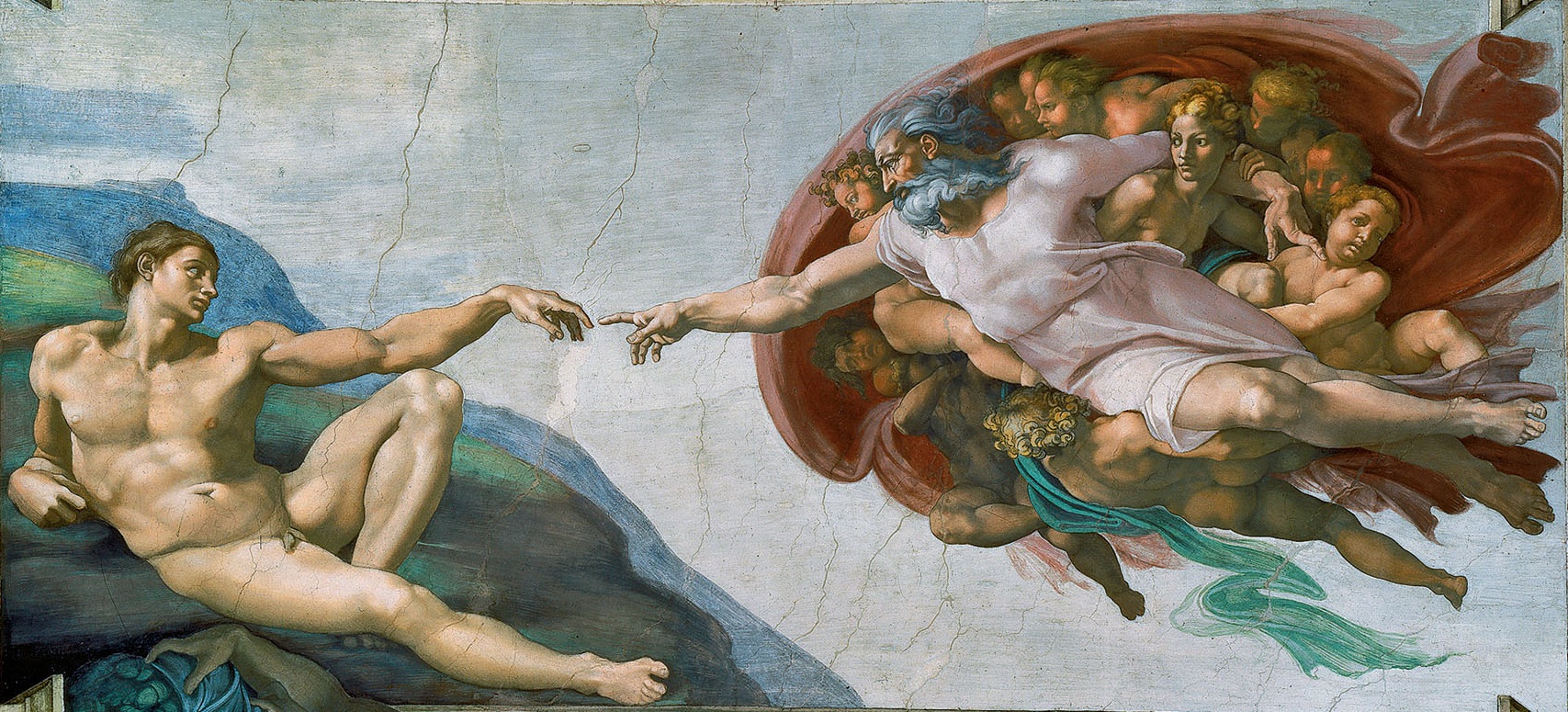
Creation-of-Adam

What does it mean to have faith in God?

It’s not a simple question.

Lately, I’ve been wrestling with The Tenacity of Unreasonable Beliefs, a book that tries to analyze religious belief from a psychological perspective.

The author, Solomon Schimmel, grew up in Orthodox Judaism but lost his faith in the literal truth of the Torah. He ponders how he believed and why. He sees faith as primarily as an emotion:

“Faith in God, for example, usually refers to a sense of trust and confidence in God’s protection, or wisdom, or caring. It is primarily an emotion …” 1

But the emotion has factual implications:

” … the most obvious one being the idea or assertion that there is such an entity as God who has certain attributes.” 2

He asks how a person who trusts in God knows that there is a God. His answer: 3

  • Upbringing: “He might believe in God because he was raised to believe that there is a God.”
  • Experience: “He might have had certain personal experiences that he interprets as evidence for God.”
  • Authoritative texts: “He might come to believe in the existence of God because he accepts certain religious texts as sources of truth.”
  • Authoritative people: “He might believe in God because he accepts the wisdom and authority of certain individuals, such as religious leaders or theologians, who affirm that God exists.”
  • Theological arguments: “He might believe that there are firm logical proofs for the existence of God.”
  • Personal meaning: “He might find that only by believing in the existence of God does his own existence have any meaning or purpose.”

All of those require us to know what we mean by “God.” However, Schimmel says:

“In all of these cases of belief in God, there is either an explicit or an implicit assertion or proposition to the effect that God exists.” 4

Without a definition of “God,” we don’t have a proposition. All we’ve got logically is ” — exists.” No evidence can prove or disprove it because it’s not a statement: it’s just a blank followed by a verb.

If we define “God” anthropomorphically, as a finite being who lives in the universe but is immortal and more powerful than humans, it solves the logical problem. But it makes the statement “God exists” obviously false, even according to the Jewish sages.

If we describe “God” as an infinite spirit of goodness that transcends both the universe and our understanding, the belief is no longer obviously false. But then it’s not at all clear what the belief means, since we admit at the outset that we don’t understand what we’re saying.

It seems to me that Schimmel and most other religious skeptics are trapped by an unrealistically narrow concept of what belief is and what it does. They think that belief is only about making assertions, such as “the book is on the table.” If belief is only assertion, then the only justification for a belief is evidence — logical or empirical — that what it asserts is true. As a result, religious skeptics make faith more cognitive than it really is.

Skeptics admit that belief does other things. Schimmel, for example, says that:

“My own moral and ethical values have been deeply shaped by certain core values and teachings of Orthodox Judaism …” 5

He thinks that belief can have negative consequences as well. However, since he thinks belief is only about making assertions, he is forced to discard positive results of belief as irrelevant. In a curious inconsistency, he does not in the same way discard negative results of belief: he thinks that negative results are arguments against a belief. However, that’s almost certainly an unconscious side effect of his skeptical view.

The main point is that belief does, in fact, do other things than just make assertions. It forms character and moral values. It provides people with a sense of identity and place in the universe. It promotes social cohesion and cooperation. It gives emotional comfort in times of difficulty, and gives courage to overcome the difficulties.

A string of words that we admit we don’t understand, such as “God exists,” cannot do us much good as an assertion. But such a belief can have meaning in other ways than simply pointing to a fact. It can point to shared values, moral behavior and social harmony. Then, the belief’s good or bad results become its justification or lack thereof.

Beliefs that are unreasonable by normal empirical standards can be quite reasonable by other, more pragmatic standards. But as long as skeptics remain trapped by a narrow view of belief and its functions, they won’t be able to see that.

Works Cited

Schimmel, S. (2008), The Tenacity of Unreasonable Beliefs: Fundamentalism and the Fear of Truth. Oxford University Press, Oxford, UK.

Footnotes


  1. Schimmel, S. (2008), loc. 230. 
  2. Ibid, loc. 231. 
  3. Ibid, loc. 233. 
  4. Ibid, loc. 237. 
  5. Ibid, loc. 177. 
Posted in Epistemology, Jewish Philosophy, Judaism, Philosophy | Tagged , , , , , | 4 Comments

Costs, Benefits, and Beliefs

Moses-on-Mount-Sinai-01

By N.S. Palmer

I’m puzzled.

No worries. It’s my normal state.

I’m revising the draft of my book Belief, Truth, and Torah. I want to make it engage more fully with arguments from one of our professors at Hebrew College, Solomon Schimmel.

Dr. Schimmel’s own book, The Tenacity of Unreasonable Beliefs, tries to analyze why Orthodox Jews believe in the literal truth of the Torah (the first five books of the Bible). The central belief he discusses is that God dictated the Torah word-for-word to Moses at Sinai, which he calls “TMS” (Torah to Moses at Sinai).

If TMS is true, then it follows that everything in the Torah is also true — literally true, except in places where it’s obviously meant allegorically, poetically, or figuratively.

Dr. Schimmel wants to know why Orthodox Jews believe TMS. Relevant historical and archaeological evidence either doesn’t exist or seems to contradict it. In spite of that, the belief is held not only by ultra-Orthodox Jews, but also by Modern Orthodox Jews who embrace science, as well as by Muslims and Evangelical Christians.

A Psychological Look at Belief

What puzzles me is not that Dr. Schimmel finds the belief peculiar, but why he, of all people, should find it so. He says he looks at the belief:

“As a psychologist interested in the workings of the mind, and in the relationship between beliefs and emotions.” 1

So Dr. Schimmel avows that he is looking at the belief as a psychologist, not as a theologian or philosopher of religion. That’s what puzzles me.

First, a minor point: To look at certain beliefs “as a psychologist” risks unconsciously assuming in advance that they are unjustified — and that, well, “you must be nuts” to hold them. Schimmel doesn’t make that mistake. He states explicitly that he thinks the beliefs are unjustified, so his assumption is out in the open. Paragraph 1, Chapter 1 declares that people hold those beliefs:

” … in the face of overwhelming evidence and logical arguments against such a proposition.” 2

I still suspect that lurking in the back of his mind is the thought that “you people must be nuts.” However, if it leads him to make particular arguments, the arguments will stand or fall on their own merits.

Now we get to my main source of puzzlement: Dr. Schimmel is a psychologist. He knows as part of his vocation that when people believe things, it’s almost always for a reason. It might not be a logical reason. It might not be a reason you would give in an archaeology class. It might not make sense to anyone else. But it’s still a reason.

More importantly, it can be a good reason or a bad reason. The idea that reasons can only provide justification if they are based in a conventional scientific worldview is as narrow-minded as the idea that they have to be based on the Bible.

All Beliefs Are Not Alike

All beliefs are not alike. Suppose I believe that the world is basically good, and even unpleasant experiences will eventually work out for the best. That belief might help me cope more effectively with the inevitable difficulties of life. It has no specific factual implications because I’ve immunized it against them. If something bad happens, then I believe either that it will work out well in the long run, or that it wasn’t really bad in the first place: perhaps it challenges me to do better or to improve myself.

My belief does not require me to do anything harmful to myself or others. It gives me a way to frame my life experiences in a positive and productive way.

Just like TMS, belief in the goodness of the universe has its costs. When I encounter misfortune, I must do extra mental work to reconcile it with my general belief in happy endings. The costs would exceed the benefits only if my belief prevented me from acting to remedy misfortune when it occurred.

The essential point is that it doesn’t matter if I can prove my belief is correct. I can’t prove it; nor can anyone else prove it’s false. It doesn’t matter if there’s evidence against it. I’ve decided in advance that my belief takes priority, and that I will interpret evidence to fit my belief. Questions of proof ignore costs and benefits that can, on balance, justify beliefs.

Foundational and Interpretive Beliefs

The reason for this odd situation is that some beliefs are general and foundational. Our worldview has to start somewhere: we can’t interpret anything based on nothing. Belief in the goodness of the universe, like TMS, is general and foundational. It is an interpretive belief, not a factual one. It’s something we assume a priori. Its job is to help us make sense of our lives and our other beliefs. If it works, it’s justified. If it doesn’t, it’s not.

As a result, such beliefs are less descriptions of anything than they are prescriptions for how to interpret other beliefs and experiences. The most important criteria by which to judge them are not truth and falsity, but usefulness or the lack of it.

The case would be quite different if I believed that I could jump off the top of a building and fly. That belief has action implications that would make my life, like summer’s lease in the Shakespeare sonnet, “have all too short a date.” 3

Beliefs in a Biological Context

It seems to me that Dr. Schimmel goes wrong at the very beginning: ironically, the same place where he thinks the Orthodox go astray.

The Orthodox start with a belief in TMS, which determines their view of everything that comes after it. Dr. Schimmel starts with a belief about belief, which exerts an equally powerful influence on everything he says afterward. With W.K. Clifford 4 and most of the rest of the world, he believes:

  • That belief’s only legitimate purpose is to make assertions, and
  • As a result, belief’s only legitimate justification is appeal to logic and empirical evidence.

He recognizes that belief has other benefits and costs, but he doesn’t seem to think that the benefits matter when logic and evidence seem clear:

“There are many rewards and positive reasons for ‘believing.’ Beliefs uphold hold a value system and bond a community. They also provide, for some, an ‘escape from freedom’ — the freedom, often fraught with anxiety, of having to use one’s own intelligence to make fundamental existential decisions …” 5

However, such benefits are irrelevant if belief’s only important job is to assert matters of empirical fact and logic. Given such a restricted notion of belief, it follows almost by definition that empirical evidence and logic are the only ways to justify beliefs. Anything else is illegitimate.

However, if we see belief in a biological context — as a form of human behavior that confers an evolutionary advantage — then other forms of justification become relevant. When we decide if beliefs are justified, we may consider more than just evidence for what they seem to assert. We may also consider their value in uniting communities, providing rules of conduct, and promoting psychological health.

That’s where the popular concept of belief goes wrong — because it is less useful 6 for evaluating beliefs than a more expansive definition that includes more criteria.

If beliefs can serve purposes other than making assertions, then some beliefs can be used mainly for asserting things while other beliefs are used mainly to achieve other goals, such as social cohesion or moral encouragement.

Justification of beliefs is not only about logical or empirical proof. It’s also about costs and benefits. And sometimes, beliefs aren’t about what they seem to be.

Works Cited

Clifford, W.K. (1999), The Ethics of Belief and Other Essays. Prometheus Books, Amherst, NY.

Schimmel, S. (2008) The Tenacity of Unreasonable Beliefs: Fundamentalism and the Fear of Truth. Oxford University Press, Oxford, UK. Kindle edition.

Footnotes


  1. Schimmel, S. (2008), loc. 46. 
  2. Ibid, loc. 43. 
  3. Shakespeare, W., Sonnet 18: www.shakespeare-online.com/sonnets/18.html
  4. Clifford, W.K. (1999) advocated this view of belief, and since then, it has influenced almost every discussion of the ethics of belief. 
  5. Schimmel, S. (2008), loc. 694. It’s worth mentioning that existential decisions, by definition, cannot be settled by logic and evidence. 
  6. Definitions can generally not be proven or disproven. They are simply more or less useful. 
Posted in Jewish Philosophy, Judaism, Modern Orthodoxy, Philosophy | Tagged , , , , , , , , | Leave a comment

Logical Results, Lived Faith

Two-Books

Logic gives us good answers, but is there something the answers miss?

At Hebrew College this semester, I’m taking a class whose assignments include Torah readings, Jewish philosophy, and “midrashim” — that is, ancient rabbinic commentaries on various issues. Midrashim range from legal interpretation (midrash halachah) to stories (midrash aggadah) that explain aspects of our history, faith, and sacred texts.

A few weeks ago, our assignment was to analyze midrashim about the creation of the world. My background is in mathematics and philosophy, so I put on my logical hat and went to work. My answer was something like this:

  • The midrashim’s goals are to answer questions X, Y, and Z: For example, did God create the world ex nihilo or from pre-existing matter?
  • The midrashim make this argument.
  • The midrashim make that argument.
  • The midrashim make another argument.
  • The midrashim sometimes argue by analogy and include fictional scenes. They sometimes contradict each other.

The professor remarked that I had given “a very un-midrashic” analysis. And he was right. I had given a Greek-philosophy answer to a Jewish-faith question.

Logic Has Its Limitations

What’s wrong with philosophy and logic? Not a thing, as long as we remember their purpose and limitations.

The purpose of logic is to give us clear answers as a guide to action. Whether we’re trying to define “justice,” design an airplane, or decide what to believe, logic helps us.

But logic also has its limitations. To give clear answers, it pays attention only to the facts that are relevant to our problem. It “abstracts” from the real situation by ignoring everything else.

Life is messy. It’s inconsistent. It has details that get lost in the process of abstraction.

Consider the story in Genesis 22 of the binding of Isaac:

“Some time afterward, God put Abraham to the test. He said to him, ‘Abraham,’ and he answered, ‘Here I am.’ And He said, ‘Take your son, your favored one, Isaac, whom you love, and go to the land of Moriah, and offer him there as a burnt offering on one of the heights that I will point out to you.”1

Abraham does not object. His response is essentially, “Yes, boss,” and then he prepares to kill his son as ordered. Genesis says nothing about his motivation, his thoughts, or why he acts the way he does.

For his part, Isaac seems unaware that anything is amiss. After binding Isaac onto the altar — an act against which the story says nothing of Isaac’s resistance — Abraham raises the knife and is about to kill his son when an angel tells him to stop.

A Logical Analysis

A logical analysis tries to address the story’s problems and answer its questions. Judaism arose in a context where pagan religions believed in gods who needed the food that they got from sacrifices. God does not need food, but early Judaism absorbed the idea of sacrifices from its surroundings. There was no need to sacrifice Isaac or anything else.2

The moral question is hard to answer but fairly clear. Does Abraham have an absolute duty to obey God no matter what He commands? And more poignantly, does Abraham have an absolute duty to obey a voice he hears that might or might not be God speaking? As the philosopher Immanuel Kant observed:

“Abraham should have replied to this putative Divine voice: ‘That I may not kill my good son is absolutely certain. But that you who appear to me are God is not certain and cannot become certain … However majestic or supernatural it may appear to be, one must regard it as a deception.'”3

Kant analyzed the story of the binding of Isaac in the same way as I analyzed the midrash about the creation of the world: by focusing on a few points and ignoring the rest. As a result, Kant’s answer is clear and logical, but lacks the nuance and heartbreak of real, lived experience — whether of Abraham’s or of ours.

The Midrashic approach

Contrast that with the midrashic approach. Instead of taking things out of the story, the midrashim put things in.

One midrash explains what Abraham thought. A second midrash echoes the Book of Job: Satan talks God into testing Abraham, then tries to talk both Abraham and Isaac into disobeying God. A third midrash narrates a scene in which Abraham tells Isaac about God’s command:

“So suspecting what was intended, [Isaac] asked ‘Where is the lamb for the burnt offering?’ Abraham replied, ‘The Holy One has chosen you.’ Isaac said, ‘If He has so chosen, my life is given to Him …'”4

Unlike Kant’s logical analysis, the midrashim engage with real life in all of its ambiguity and uncertainty. Instead of giving us a clear answer, they challenge us to think about Abraham’s predicament for ourselves and to find our own solutions. How would we cope with an intolerable situation that required great personal loss and morally dubious actions?

Logic uses incomplete information to give us results we can use. The midrashim use more complete information to show us a portrait of life we can live. And without that life, the results are meaningless.

Works Cited

Braude, W., translator (1992), The Book of Legends (Sefer Ha-Aggadah). Schocken Books, New York.

Brettler, M. et al, editors (2014), The Jewish Study Bible, second edition. Oxford University Press, Oxford, UK. Kindle edition.

Frank, D. et al, editors (2000), The Jewish Philosophy Reader. Routledge, London, UK.

Muffs, Y. (2005), The Personhood of God. Jewish Lights Publishing, Woodstock, Vermont.

Footnotes


  1. Brettler, M. et al (2014), loc. 2008. 
  2. Muffs, Y. (2005), p. 29: “In Mesopotamia, as we have seen, the ultimate concern of the gods is the food provided by the temple cult.” 
  3. Frank, D. et al (2000), p. 42. 
  4. Braude, W. (1992), p. 41. 
Posted in Jewish Philosophy, Judaism | Tagged , , , , , , , | Leave a comment

Facing Up to Evil

The devisings of man’s mind are evil from his youth …
— Genesis 8:20

On October 1, multiple terrorists shot a rabbi and his wife who were in the car with their four children. On October 3, a lone terrorist killed a man walking near the Western Wall with his wife and two children, who were wounded. On October 4, a lone terrorist killed a 15-year-old at the Western Wall. And the attacks have continued.

Each day, more attacks. Each day, more innocents killed. The victims are usually not soldiers. They are fathers, mothers, teenagers, children. They are walking, on bicycles, on buses, in cars. Just living their lives. No threat to anyone. The threat is to them.

The terrorists do not seem to be organized. For the most part, they are young — over half under 20 — and are not members of terrorist groups. If the attacks were organized, they would be easier to stop.

In the face of such evil, it’s easy to give in to anger or despair. Neither is helpful. Both in Israel and in the diaspora, we should keep in mind what we can do and what we can’t do.

What We Can’t Do

There are some things we can’t do. Because they are outside of our control, we should try not to worry about them:

We cannot control government policy.

As individuals and private citizens, we only indirectly influence what our governments do. We should try to make our opinions known to those in authority, but we should not agonize emotionally about what they decide.

Perhaps the Israeli government should take Machiavelli’s advice that “it is safer to be feared than to be loved;” or perhaps more conciliation is needed. In either case, we are not the ones who will make that decision.

We cannot change human nature.

Almost all biological creatures are territorial, and they get aggressive when they feel that their territory is threatened. Human beings are no exception.

Both Israelis and Arabs believe that the land of Israel and the Temple Mount are theirs by right. Unless they compromise, conflict is inevitable. The question of who has the better claim is not the issue. Each side believes it has the better claim, and is not going to change its mind.

We can wish that everyone would be peaceful and reasonable, but it’s not going to happen. Wishing for what can’t happen is a waste of time.

We cannot control what other people decide to do.

We control only what we decide to do. Worrying about what other people should do is pointless. They will do whatever they do. We should focus on what we are going to do. As long as we are trying to do the right things, we are taking care of what we can do. What others do is up to them. We hope that they will make the right decisions.

What We Can Do

There are also some things we can do. They are not easy, but they will help us, our people, and our societies:

We can stay rational.

Terrorist attacks try to provoke an emotional and unproductive response. Hatred clouds our judgment and increases the probability that we will do the wrong things.

We can accept that life always involves risk.

It is impossible to reduce that risk to zero. We should not let fear of terrorism rule our lives.

We can try to treat all people with respect and consideration.

As long as other people don’t pose a threat, they are entitled to the same respect and consideration as anyone else. If we assume that all members of other ethnic or religious groups are our enemies, and we treat them that way, then the terrorists have succeeded.

But: We can exercise reasonable caution.

We have a higher duty to protect our families from being killed than to protect a stranger’s feelings from being hurt.

Let’s try to treat everyone fairly, but not at the expense of our own safety. If we think we might be in danger, or if a situation just doesn’t feel right, then we should take steps to protect ourselves, either by withdrawing or alerting the authorities. If we can do it without causing offense, that’s better; but we shouldn’t risk death to avoid hurting someone’s feelings.

Hillel advised, “That which is hateful to you, do not do to your neighbor.”

We should follow that advice whenever it’s reasonably possible. But Hillel also said, “If I am not for myself, who will be for me?”

Posted in Judaism | Tagged , , , | Leave a comment

Seeing Life in Context

Planets2013

As I said the morning prayers today, I realized something: That act sets a context for my whole day.

No matter what happens to me today — good, bad, or indifferent — the prayers remind me that it’s not all there is. The events of our lives occur in a larger context: a benevolent reality guided by a benevolent God.

Both science and religion provide context for our lives, but in different situations and for different purposes. Both start by making observations, then tell stories to explain them. They test the stories by making further observations. The difference is in what kind of stories they tell and what kind of observations they make.

Consider a scientific example: You’re an astronomer in the year 1845. You observe odd irregularities (“perturbations”) in the orbit of the planet Uranus. You tell a story:

There is an undiscovered planet outside the orbit of Uranus. Its gravitation pulls Uranus slightly out of its predicted path. Based on Uranus’s deviations from its orbit, the undiscovered planet should be in location (x,y,z,t).

A year later, in 1846, someone finds the unknown planet exactly where you said it would be. Your story is confirmed.

Or consider a religious example: You’re driving and another car crashes into you. Your car is damaged but you are unharmed. You tell a story:

God wants me to learn a lesson from this experience. Was I paying enough attention? Should I have noticed the other car moving erratically?

You decide that you might have avoided the accident if you had paid more attention to the other driver’s behavior. You found a lesson. Your story is confirmed. And it’s helpful. It encourages you to drive carefully.

In both cases, you used a form of abductive reasoning:

“Abductive reasoning involves constructing general principles as explanations for particular events, such that if the principles are true, the event or phenomenon in question is explained.”1

Your reasoning went like this: “I observed event Y. If story X were true, then that would make Y happen.” You then go looking for X, and if you find it, your story is confirmed. In the scientific case, you found a planet; in the religious case, you found a lesson.2

Different Contexts

The main difference between scientific and religious stories is their purpose. Science tells stories about the observable world that help us understand and control things. Technical jargon aside, scientific stories are “in the vernacular” of normal language. We understand them easily.

Religion tells stories about transcendent reality to help us find meaning and joy in our lives. Unlike scientific stories, which are based in reality as we perceive it, religious stories can seem logically meaningless when we look at them carefully.

Consider the story about the car accident. A critic might say: “Seriously? You think that the Creator of the universe wanted to remind you to drive carefully? Are you nuts?”

In reply, you might give a more sophisticated explanation of your story. You might invoke metaphor. You might point out that it’s useful to take a positive attitude and learn from experience.

But in the aftermath of the car accident, such an abstract explanation doesn’t provide you with what you need. It doesn’t help you make sense of what happened. Your original story was better. It’s an example of what cognitive scientist Jason Slone calls “theological incorrectness:”

“While religious believers produce theologically correct ideas in situations that allow them the time and space to reflect systematically on their beliefs, the same people can stray from those theological beliefs under situational pressures that require them to solve conceptual problems rapidly.”3

Why tell religious stories?

Why tell religious stories at all? Because an ineffable and transcendent reality doesn’t provide a context that helps us face the challenges of life. We need something more immediate and comprehensible.

The “meaningless” stories of religion actually are meaningful, but their meaning amounts to “Don’t worry. There’s more than this.” We all need that, though different people need different kinds and amounts.

People who are scientifically oriented can sometimes find enough context in the austere and beautiful working of physical laws and their mathematical relationships. When atheist biologist Richard Dawkins looks at what we might call “the majesty of creation,” that’s the kind of grandeur he sees, and it’s enough for him to feel that life makes sense.

People who are spiritually inclined look at the same facts as Dawkins, but see them as evidence of something more: of a transcendent goodness just beyond the limits of their sight. They know it’s there: they can almost smell it, but they can’t quite see it. So they put their faith in something they can’t explain. They tell simplified stories about it to bring it into their lives at a practical level, to provide the context that they need.

The English writer Alexander Pope (1688-1744) put it very well:

“What future bliss, He gives not thee to know, But gives that hope to be thy blessing now.”4

Works Cited

Pope, A. (2012), Essay on Man and Other Poems. Dover Publishing, Mineola, NY. Kindle edition.

Slone, J. (2004), Theological Incorrectness: Why Religious People Believe What They Shouldn’t. Oxford University Press, Oxford, UK. Kindle Edition.

Footnotes


  1. Slone, J. (2004), loc. 142. 
  2. Confirmation is not the same thing as proof. Proof makes it totally certain that a story is true. Confirmation only makes it more probable that the story is true. 
  3. Slone, J., op cit, loc. 59. 
  4. Pope, A. (2009), loc. 514. 
Posted in Epistemology, Jewish Philosophy, Judaism, Philosophy | Tagged , , , , | Leave a comment