What Do You See?

Rorschach-01b

Look at the ink blot. What do you see?

The ink blot is used in what’s called a “Rorschach test.” The picture is supposed to be neutral, and not to look like anything in particular. What you see in it depends on how your mind works, on your emotions, and on the images in your subconscious. Sometimes, the Rorschach test can help a therapist identify psychological problems or give you a clean bill of health.

A lot of the Tanakh is like a Rorschach test: What you find in it is what you bring to it. Consider a few examples:

  • Genesis 2:21-23: God creates woman from a side of man, and the man then names the woman.
  • Genesis 3:16: God punishes the woman for tempting Adam with the forbidden fruit.
  • Genesis 22:1-2: God orders Abraham to kill his son Isaac as a sacrifice.

Historically, many readers of the Bible considered women inferior to men, so they saw Genesis 2:21-23 as justifying women’s subordinate status. Likewise, they saw Genesis 3:16 as explaining labor pain and suggesting that women were inherently wicked:

“Not only is Eve associated with sin; her creation is viewed as secondary and, by implication, of lesser importance.”1

Modern readers do not share such assumptions, so they do not interpret those passages in the same way. Like people in past centuries, what we find in it is what we bring to it.

Likewise, Genesis 22’s story of the binding of Isaac has bothered and baffled readers for millennia. God commands Abraham to sacrifice “your son, your favored one, Isaac, whom you love.” Abraham essentially replies, “Yes, boss,” and prepares to kill his son. He doesn’t even push back against such an insane order.

What kind of God gives an order like that? What’s God’s objective: to test Abraham’s obedience? To provoke Abraham to argue with God, as he did in Genesis 18 on behalf of people in Sodom and Gomorrah?

At the end, God stops Abraham from killing Isaac. Was the story meant to dramatize the ancient Israelites’ rejection of the pagan cults’ rituals of child sacrifice?

Or is the story, as a Hebrew College classmate of mine called it, a “Kobayashi Maru test,” a no-win scenario in which all the available solutions are bad? Is the point of the test to reveal Abraham’s true character, and how he will react to a morally intolerable command?

At the very least, it’s a Kobayashi Maru story for us, since we can with equal justice believe either that it’s just a legend with no particular point, that it encourages absolute obedience to God, or that it’s deliberately paradoxical to make people think for themselves.

Many of the stories in the Tanakh are unclear — and in fact, that is what makes them helpful. They are sufficiently complex and ambiguous that we can read into them whatever moral lessons we think are important, and we can find evidence for our interpretation of the text. In different eras, we have drawn evolving moral guidance from them, most recently with a focus on equal rights and equal treatment for women.

If the stories were completely clear and straightforward, we couldn’t do that. They might be long forgotten. As Emil Fackenheim said:

“What modern Jew could possibly fancy himself hear what Abraham heard and not reject it?”2

We know with reasonable certainty that the Tanakh was assembled from multiple sources, including traditional stories, legends, and “etiological tales” that tried to explain why things were the way they were.

How we interpret a story depends partly on what kind of story we think it is and why we think it’s there. It also depends on our assumptions as individuals and as members of a society.

If you just wanted to teach a specific lesson, you might write “Obey God no matter what He says or how unreasonable it seems.”

But if you wanted to make people think about an issue and try to decide it for themselves, you might tell them an ambiguous story whose exact point isn’t clear. That would force them to confront and grapple with the issues on their own, without relying on you to give them a “cheat sheet” with the answers.

Kobayashi Maru stories, which are open to multiple interpretations, can be adapted for the religious, moral, and political needs of the era in which we read read them. People who read them 100 years from now will learn things from them that we don’t see. The same applies to stories like the Garden of Eden and the creation of Eve, which explained past social realities but now require fresh interpretations.

We can’t understand God any more than the ancient Israelites did. But to the extent that we understand Him at all, He is a spiritual principle of justice and love who adapts His teachings to the needs of our time.

Works Cited

Frank, D., editor (2000), The Jewish Philosophy Reader. Routledge, London, UK.

Meyers, Carol (2012), Rediscovering Eve: Ancient Israelite Women in Context. Oxford University Press, Oxford, UK. Kindle Edition.

Footnotes


  1. Meyers, C. (2012), p. 62. 
  2. Frank, D. (2000), p. 42. 
Posted in Bible, Jewish Philosophy, Judaism | Tagged , , | Leave a comment

Faith Lost and Faith Found

The-God-I-Believe-In

Why do some people lose their faith, while other people find it?

It’s not because of differences in intelligence or education. Atheists and theists are often equally smart and educated. Orthodox Jewish Israeli physicist Gerald Schroeder and Evangelical Christian geneticist Francis Collins are at least as smart and well-educated as British atheist biologist Richard Dawkins.

What makes the difference? We might get a clue from looking at examples of people who lost their faith, and others who found it.

One person who lost his faith was Solomon Schimmel, one of our professors at Hebrew College. He grew up in an Orthodox Jewish family, believing:

“… that God has literally authored and revealed a ‘sacred scripture’ that is inerrant and infallible, and that this ‘sacred scripture’ is absolutely authoritative for all of humankind.”1

Even as a boy of 13, Schimmel was uneasy about the idea of God choosing the Jewish people. When he went to university, encountered critical Biblical scholarship, and studied skeptics such as the philosopher David Hume, his shaky edifice of belief fell apart:

“In a flash, the traditional viewpoint and all of the apologetic defenses of it that I had constructed over the years appeared untenable and indefensible on rational grounds. The alternatives, existentially bleak as they appeared to be (and maybe are), were so much more convincing. The experience was emotionally wrenching, because it removed the meaning structure of my life.2

Schimmel was angry at teachers who he felt had misled him, and at the unethical behavior of some leaders at his yeshiva. He worried about how his Orthodox family and friends would react to his loss of faith.

Of course, Jews aren’t the only people who lose their faith. Bart Ehrman, a professor of religious studies at the University of North Carolina, lost his faith in Evangelical Christianity for similar reasons. Like Schimmel, he grew up believing in the literal truth of the Bible, even memorizing some books of the New Testament. But as a university student, he struggled with nagging doubts:

“My strong commitment to the Bible began to wane the more I studied it. I began to realize that rather than being an inerrant revelation from God, inspired in its very words, the Bible was a very human book with all the marks of having come from human hands: discrepancies, contradictions, errors, and different perspectives …”3

Also like Schimmel, Ehrman suffered from his loss of faith:

“I left [Christianity] kicking and screaming, wanting desperately to hold on to the faith I had known since childhood and had come to know intimately from my teenaged years onward. But I came to a point where I could no longer believe.”4

What about people who went in the other direction — from unbelief to belief? I’m one of those people, but a more eminent example is world-famous Talmudist Adin Steinsaltz, the famous Jewish philosopher and Talmudist. Raised in a secular family, he was agnostic, studying science and mathematics — all just like me. He planned to be a physicist. He found his Jewish faith “when he began to doubt his own doubts:”

“My move was prompted by a basic lack of belief in the tenets of the secular world in which I lived … [to understand] the world instead of following the general view. I felt the need to think for myself.”5

Thinking for himself led Steinsaltz to the realization that there was more to the world than scientific knowledge:

“You want to see the glory of God, something tangible, and the text says, all these things are ephemeral and incidental. The highest point you can reach is the absolute void, the emptiness, the stillness. From there comes a voice … You perceive it standing against the Infinite.”6

Great Expectations

Because Schimmel and Ehrman grew up with a literalist reading of the Bible, they didn’t wonder if “God gave the Torah to Moses” was true in the same way as “Joe gave the book to Sarah.” And when they eventually started to wonder, their doubts were devastating. They lost their faith.

However, Steinsaltz and I both knew from the start that if “God gave the Torah to Moses” was true, it was true in a different way from ordinary empirical beliefs like “Joe gave the book to Sarah.” We knew that to find its truth, we had to look outside our normal scientific world.

Both Schimmel and Ehrman demanded too much of their faith. They wanted religious beliefs to be true in an ordinary, empirical way.

Steinsaltz realized, just as I did, that the empirical world did not explain itself and that there had to be more. But he also realized that the “more” was transcendent, incomprehensible by our normal concepts, and without specific empirical implications. He realized that religious beliefs were true in a way different from that of empirical beliefs.

Works Cited

Ehrman, B. (2009), God’s Problem. HarperCollins Publishers, New York. Kindle Edition.

Haberman, J., editor (1994), The God I Believe In. The Free Press, New York.

Schimmel, S. (2008), The Tenacity of Unreasonable Beliefs: Fundamentalism and the Fear of Truth. Oxford University Press, Oxford, UK. Kindle edition.

Footnotes


  1. Schimmel, S. (2008), loc. 58. 
  2. Ibid, loc. 133. 
  3. Ehrman, B. (2009), p. 3. 
  4. Ibid, p. 3. 
  5. Haberman, J. (1994), p. 239. 
  6. Ibid, p. 242. 
Posted in Bible, Christianity, Jewish Philosophy, Judaism, Modern Orthodoxy | Leave a comment

Who Is Your Enemy?

Who is your enemy?

One of my friends said that she must have done something right this year, because she had acquired more enemies. Winston Churchill, who was Britain’s prime minister during World War II, would have agreed:

“You have enemies? Good. That means you’ve stood up for something, sometime in your life.”

However, I also remember my grandfather. He was a gentle man with a book-lined study, a smoking pipe, and — in his desk drawer — a bag of peanut M&Ms for a certain nerdy grandson. He was never financially successful, but he was honest, loved, and respected by everyone who knew him. My father said that when he died, “he had no enemies, and that was a kind of success.”

What does it mean to have an enemy?

Is it just someone with whom you disagree? Whose material interests conflict with yours? Who tries to harm you?

I’d argue it requires more than that. It requires emotional commitment on both sides: a desire to destroy the enemies’ welfare, happiness, or even their lives, and a determination to destroy them if possible.

“It sounds like a lot of work,” as a movie character said.1

The Dead Sea Scrolls give a classic example of that kind of thinking about enemies, and what often motivates it.

The scrolls describe the beliefs of the Essenes, an ancient Jewish religious sect at Qumran. According to the Community Rule (also known as the Manual of Discipline), members of the sect:

“[Must] love all the sons of light, each according to his lot in God’s design, and hate all the sons of darkness, each according to his guilt in God’s vengeance.”2

The “sons of light” are members of the sect. Who are the “sons of darkness”? They’re not Romans, Egyptians, or Babylonians. The sons of darkness are other Jews who are not members of the sect.

The Essenes didn’t much like Romans, Egyptians, Babylonians, or other non-Jews, but they didn’t hate them with a burning passion. It was other Jews who were not members of the sect that were perceived as “other” and singled out for special hostility.3

To hate others as our enemies is to view them not as people, but solely as threats and targets. Sometimes, as in war, that’s unavoidable. Most of the time, however, it’s unnecessary and unhelpful. It prepares us both physically and emotionally to act in ways inconsistent with the rest of our tradition. The Book of Exodus tells us:

23:4: When you encounter your enemy’s ox or ass wandering, you must take it back to him. When you see the ass of your enemy lying under its burden and would refrain from raising it, you must nevertheless raise it with him.4

And of course, there’s Hillel‘s famous advice:

“That which is hateful to you, do not do to your neighbor. This is the whole of the Torah. The rest is commentary.5

Even the pre-biblical Gilgamesh story gets it right when it advises the wild man Enkidu:

“Make yourself an enemy to your anger.”6

If others hurt us or frustrate our goals, we can recognize them as adversaries without hating them. Sometimes, we might not even think ill of them. Just like us, they have their own goals, and they believe their actions against us are justified.

However, when we declare them to be our “enemies,” we often hurt ourselves more than we hurt them. First, we chain ourselves to them with bonds of hatred. Second, we let emotion distort our judgment, and we become unable to see them as they really are. Third, we devote thought, energy, time, and resources to negative, destructive ends instead of focusing on our own positive goals.

So in the coming year, make a simple commitment: Eliminate your enemies.

That doesn’t mean doing anything to anyone unless they attack you first. It means changing your attitude about life, the world, and other people. It means remembering that God created all of us, even those who hate us:

“Begin the morning by saying to thyself: I shall meet with the busybody, the ungrateful, arrogant, deceitful, envious, unsocial. All these things happen to them by reason of their ignorance of what is good and evil. But I who have seen the nature of the good that it is beautiful and of the bad that it is ugly, and the nature of him who does wrong … I can neither be injured by any of them, for no one can fix on me what is ugly, nor can I be angry with my kinsman, nor hate him.”7

Works Cited

Brettler, M. et al (2014), The Jewish Study Bible, second edition. Oxford University Press, Oxford, UK.

Gardner, J., translator (1984), Gilgamesh. Vintage Books, New York. Kindle edition.

Long, G., translator (1937), The Meditations of Marcus Aurelius Antoninus. Harvard Classics, Volume 2, P.F. Collier & Son, New York.

Vermes, G., translator (2004), The Complete Dead Sea Scrolls in English. Penguin Books, New York. Kindle edition.

Footnotes


  1. “Easy A” (2010). 
  2. Vermes, G. (2004), loc. 2259. 
  3. Biology inclines living creatures to be hostile toward others who might compete with them and their families for resources. For more information, see Haidt, J. (2010), The Moral Animal, Vintage Press, New York. 
  4. Brettler, M. (2014), loc. 6250. 
  5. “Hillel,” MyJewishLearning.com. 
  6. Gardner, J. (1984), loc. 1744. 
  7. Long, G. (1937), p. 199. 
Posted in Jewish Philosophy, Philosophy, The Times of Israel | Tagged , , , , , , | Leave a comment

In Praise of Sloppy Thinking

By N.S. Palmer

People of faith get a lot of unfair criticism for sloppy thinking.

It’s not that we don’t do it: we do. Everyone engages in sloppy thinking, even scientists, atheists, and Nobel laureates.

It’s not because of laziness or stupidity.

It’s because sloppy thinking isn’t always bad. Sometimes, it’s efficient. And that’s a good thing.

Here’s an example that an atheist might call sloppy thinking:

“God gave the Torah to Moses at Sinai.”

Viewed only from a logical point of view, that belief is incoherent. Its subject and verb (“God gave …”) refer to transcendent realities that are beyond our comprehension. The rest of it refers to ordinary realities: a book (the Torah), a man (Moses), and a mountain (Sinai). Therefore, the two parts of the belief don’t connect with each other and cannot form a logical statement.

Most people realize there’s a problem, but they still talk about the belief as if it were simple and straightforward:

“While religious believers produce theologically correct ideas in situations that allow them the time and space to reflect systematically on their beliefs, the same people can stray from those theological beliefs under situational pressures that require them to solve conceptual problems rapidly.”1

If you ask people to explain their religious beliefs, such as “God gave the Torah to Moses at Sinai,” they often give you sophisticated answers:

  • No, they don’t believe that God sat on a rock and dictated the Torah to Moses.
  • Yes, God is a transcendent, infinite, and incomprehensible spirit, and Moses received his prophetic inspiration in ways we don’t grasp.

But in everyday reasoning, the very same people use a much more primitive version of the belief. They act as if God were a normal, finite being, with a physical body, Who talked to Moses in the ordinary way.

Why?

Let’s look at a simpler belief: “A dog is a mammal.”

Really? What kind of dog? There are 339 recognized breeds of dog. Is the dog big or little? Puppy, or grown? And what kind of mammal is it?

You didn’t think about those things? Sloppy. Very sloppy.

Don’t feel bad. You didn’t think about those things because you didn’t need to think about them. They weren’t relevant.

Consider another example: “To solve a quadratic equation, you can use the quadratic formula.”

If you took algebra, you know that the belief is true. Do you remember what the quadratic formula is?

You don’t? Sloppy. Very sloppy. But not relevant. Your belief is true even if you can’t remember the formula.

The point is this: Words, phrases, and concepts are like handles.

By holding the handles, we can manipulate large amounts of information to solve problems, but we avoid getting bogged down in irrelevant details. Even if the underlying details are incomprehensible or inaccurate, the handle can still work.

Suppose that a man finds a lost wallet containing several hundred dollars in cash. He wants to decide on the morally correct course of action.

He imagines God as a white-robed father figure in the sky, Who gave the Torah to Moses at Sinai and Who prescribed a demanding moral code. What would the father figure want him to do? Naturally — that is, supernaturally — God would want him to do the honest thing and return the wallet.

The man is not trying to do theology: he’s trying to solve a practical problem. For him to “go full Maimonides” about God’s nature would mean he never gets around to returning the wallet. Instead, he imagines a quick, highly inaccurate, indubitably primitive image of an infinitely good God to tell him what to do. And he gets the answer he needs.

If you cornered the same man in a theology class, he might give you a sophisticated philosophical explanation; but that’s a different context with a different purpose. In that situation, it’s just as unhelpful for him to use a primitive father-figure image as it would be to use a theological explanation of God in trying to decide about a lost wallet.

In each case, the thinking he does is appropriate for the problem he is trying to solve, and his thinking is efficient in solving it.

The handles are justified by their results. As long as mental shortcuts and anthropomorphic imagery are not confused with the more complicated realities that they represent, they are a helpful tool in reasoning.

So don’t feel bad about your sloppy thinking. If you do it right, you’re being efficient. You’re solving the problems you need to solve. Well done.

Works Cited

Slone, D.J. (2004), Theological Incorrectness: Why Religious People Believe What They Shouldn’t. Oxford: Oxford University Press.

Footnotes


  1. Slone, D.J. (2004), loc. 59. Kindle edition. 
Posted in Jewish Philosophy, Judaism, Philosophy, The Times of Israel | Tagged , , , , , | Leave a comment

What We Owe to Past, Present, and Future

What do we owe to people who lived in the past and are now dead?

What do we owe to people now living? What do we owe to people in generations yet to come? And perhaps most important: What is the best way for us to fulfill those obligations?

We live in a time of rapid change — in technology, society, moral attitudes, government, and religion.

Whether the changes are good or bad, their reality and speed are undeniable. Their speed alone is disorienting: As soon as we get used to one new regime, learn its accepted and forbidden terminology, and start to recover from our shock at its reversals of long-established practice and belief, we find ourselves thrown headlong into yet another iteration in the relentless forced march of “progress.”

The destination of all that progress is a little vague, and there’s a reason: We are not marching toward something, but away from something. We are marching away from our own past, from our own heritage, from our own identities.

We are taught that all which came before was benighted, bigoted, and evil, and that we must as fast as possible escape from it into a promised, stress-free utopia of niceness. The details of the utopia are unclear and constantly in flux, as utopian fantasies always are. Modern Orthodoxy founder Samson Raphael Hirsch observed in 1854, albeit with a certain amount of rhetorical hyperventilation:

“Here you have the protagonist of the religion of progress. See how he dances on the graves of your forefathers, how he drags out their corpses from their graves, laughs in their faces and exclaims to you: ‘Your fathers were crude and uncivilized; they deserved the contempt in which they were held. Follow me, so that you may become civilized and deserve respect!'”

Hirsch adds:

“The Divine word which until then had inflexibly prohibited many a desire and demanded many a sacrifice, henceforth became the heavenly manna which merely reflected everybody’s own desires, echoed their own thoughts, sanctified their aspirations, and said to each one: ‘Be what you are, enjoy what you fancy, aspire to what you will … the more you progress, and the more you cast off old Jewish customs, the more religious and acceptable to God you will be …'”

What complicates the situation is that at least some criticisms of our past have merit.

Society has always treated some groups of people unfairly, and those people have legitimate complaints. That led Samuel Holdheim, a leader of Reform Judaism and one of Hirsch’s aforementioned progressives, to make a contrary observation:

“The time has come when one feels strong enough vis-a-vis the Talmud to oppose it, in the knowledge of having gone far beyond it. One must not with every forward step drag along the heavy tomes and, without even opening them, wait for some innocent remark, therewith to prove the foundations of progress.”

And even more starkly:

‘The Talmud speaks with the ideology of its own time, and for that time it was right. I speak from the higher ideology of my time, and for this age I am right.”

A Perfect Society with Imperfect People?

What the apostles of progress fail to realize is that it’s impossible to create a perfect society with imperfect people. All societies treat some people unfairly, both in ways that hurt them and in ways that help them. The question is not: Will there be unfairness? There will be. The question is only: Unfair to whom, how much, and how bad?

No matter what social and religious institutions or customs we have, some people will be unhappy about them. That’s just human nature. Attempts to create a perfect society always end in attempts to crush and destroy those who disagree with the perfectionists’ vision of the good. Such attempts create more injustice and evil than they remedy.

Moreover, attempts to create a perfect society suffer from the same intellectual arrogance as rigid orthodoxy. Just as the ultra-Orthodox demand that no one change anything unless it fits their interpretation of the Torah, so our modern reformers demand that everyone change everything to fit their interpretation of social justice.

As Hirsch wrote, defending the status quo:

“‘Orthodox’ Judaism does not know any varieties of Judaism … It knows only Judaism and non-Judaism.”

On the other side, we see the same inflexible arrogance in Holdheim:

“I speak from the higher ideology of my time, and for this age I am right.”

No doubt. No open-mindedness. “I am right.”

The thought “I might be wrong” would never occur to either of them.

Is it possible that there could be different but equally valid viewpoints about some issues? And even when there aren’t, should we sometimes just leave people alone to be wrong, as long as they leave us alone to be right? Extremists of all persuasions answer no: Figuratively or literally, unbelievers must be put to the sword.

Short of the Messianic era, we are stuck with imperfect societies, laws, and institutions. The only question is how to maximize the welfare and rights of the majority while protecting as much as possible the welfare and rights of minorities.

Which imperfections are morally tolerable, and which not? To answer that no imperfections are tolerable is to declare war on humanity and human nature, because it is from those sources that the imperfections originate. That particular war has been declared, rages even now, and the destruction it wrought is all around us.

How People Identify Themselves

Keeping things as they are has costs. So does changing things. Facts by themselves cannot tell us which costs are most important, but a look at the facts can help us make that decision.

People form their sense of self in three main ways: intellectually, emotionally, and morally.

  • Intellectually, we form our sense of self by statements: I am a man. I am a Jew. I am a parent. I am married. My ancestors were slaves in Egypt. The concepts in such statements define part of our identity. If you demand that everyone redefine the concepts, you demand that they redefine themselves. That is a cost to them. The cost might be justified to achieve a greater good for someone else, but it’s still a cost.
  • Emotionally, we form our sense of self by what we perceive, say, do, and the contexts in which those things occur. Shared beliefs, rituals, and prayers are part of that. We follow them throughout our lives, from youth to old age and death: they become part of who we are. Changing those things might be justified, but it puts emotional stress on people who haven’t intentionally hurt anyone. It has a cost.
  • Morally, we form our sense of self when we worship, follow the law, or follow customs such as kissing the ground when we arrive in Israel. We form it when we do things in much the same way as our ancestors in centuries past and our fellow Jews around the world. That creates a bond between us, across the generations and across the oceans. We are one people. Changing our beliefs, rituals, laws, prayers, and customs disrupts that bond. It divides and weakens us. It might be justified, but it has a cost.

What We Owe

What do we owe to the past?

We owe loyalty and honor to those who came before us; who remained true to our faith and suffered for it; who fought for justice on behalf of all people, not only us; and who helped to create the modern world we now enjoy. One way to express that loyalty and give that honor is to share with them the religious beliefs and practices for which they lived and died, and to change those things only when the moral or intellectual necessity is clear.

Far from abandoning the Torah and Talmud, as Holdheim suggested, we need to reinterpret them with our best moral and religious understanding for our own era. Just as no one in 1787 imagined the U.S. Constitution would one day mandate recognition of gay marriage, and no one in 1850 imagined the Talmud would authorize female rabbis, we can adapt our tradition to modern sensibilities when it makes sense and overwhelming majorities support it. By doing so, we keep faith both with our forebears and with the moral and religious needs of people today.

What do we owe to the present?

We owe fairness, consideration, and kindness to all people — even if it’s sometimes difficult, when all things are considered, to know exactly the right way to give it. We should make changes when a majority agrees that they are clearly needed, and not merely to appease the interest groups that shout the loudest. We should also remember that too much change, too fast, disrupts lives and causes unhappiness. If change is required, we should make it slowly and carefully — redressing injustice but with minimal disruption to the lives of innocent people.

What do we owe to the future?

To the future, we owe a society, a system of beliefs, and customs of behavior that are simultaneously moral, rational, faithful to our tradition, and consistent enough with human nature to be sustainable. As our ancestors gave us a legacy of devotion, courage, faithfulness, study, and intellectual honesty, so we owe at least that to the generations after us.

The future is yet to be determined. Let us, in our generation, be determined to make a future in which both our ancestors and our descendants can take pride: pride in who they are, pride in what they inherited from us, and pride in what they pass on to their own future.

Posted in Jewish Philosophy, Judaism, Modern Orthodoxy | Tagged , , , , , , , , | Leave a comment

All People Are Equal — Mostly

All human beings are equal. Let’s agree on that.

But we must add a qualification:

All human beings are equal in the morally relevant sense.

They might or might not be equal in other ways.

Let me tell you about Pete, my best friend in high school. We were both on the rifle team. Every day that the firing range was open, I was there practicing. I got very good, and I qualified at the highest level. But I never got as good as Pete, who never practiced. He was a natural shooter.

Or let me tell you about Bill, a friend in college. He could talk to women — effortlessly, charmingly, and successfully. He wasn’t particularly good-looking, nor was he even particularly smart in the way that I’m smart. But he could do things I couldn’t do.

Or let me tell you about one of my younger brothers. He’s good with money. From the time he was about seven, I borrowed money from him at interest rather than get it interest-free — with a stern lecture — from our father. I can do calculus, number theory, and linear algebra, but I can’t balance a checkbook. I never could. My brother can do things I can’t do.

We are all equal in the morally relevant sense that we have the same human rights and human dignity. But we are unequal in many other ways.

That said, it’s better to avoid talking about unequal abilities. If we can’t avoid it, we should do it very carefully.

The main reason is simple consideration for others. My friend Pete never said that he was a better shooter than I was. We both knew it, but for him to say it might have hurt my feelings. Likewise, my friend Bill never mocked my social ineptitude. My brother gives me financial advice and doesn’t belittle me for needing it.

When we talk about equality, we must do so with respect for two things:

  • We must respect the facts.
  • We must respect the people whom our statements might affect.

In addition, we must avoid doing a very harmful thing:

  • We must not draw unwarranted conclusions based on the facts.

Lots of people are better than I am at lots of things. But that gives them no special rights over me, nor does it diminish my inherent dignity and worth as a person.

Lots of people are worse than I am at lots of things. But that gives me no special rights over them, nor does it diminish their inherent dignity and worth as people.

Here are the ways in which all people are equal:

  • They all have the same basic human rights. Whether they have human rights simply in virtue of human nature, or because they are all children of God, they all have the same human rights.
  • They all have the same basic human dignity. Uniquely among biological creatures we know, human beings are self-aware. They not only have experiences, but at a second level, they are aware of themselves having the experiences. That self-awareness gives them what I call “reflexive self-value.” Whether we value their lives and welfare or not, they still have human value to themselves. Their value and dignity as people are inalienable — as in the U.S. Declaration of Independence‘s phrase “unalienable rights” — because they continue to exist no matter what anyone else thinks or does.
  • There are things we may not morally do to them. Their human rights and human dignity surround them with a “moral force field” that forbids us to cause them avoidable harm or suffering, even if we think it’s to our advantage.
  • There are things we must morally do for them. Because they have reflexive self-value, their lives are important no matter what we think about them. Their welfare matters. We can choose to be good people or bad; but if we choose to be good people, then we accept certain obligations to our fellow human beings. If they need our help, and if we can give it in a reasonable way, then we should.

It’s not always easy to apply these principles. For example, consider the case of “illegal immigrants,” “undocumented workers,” or whichever term you prefer. They came to the United States in violation of the law. Echoing the title of a book by Israel’s Meir Kahane, U.S. presidential candidate Donald Trump says “they must go.”

For the sake of argument, assume the worst: illegal immigrants are a social burden. They commit more crime than American citizens. They use tax-supported social services and force cash-strapped institutions to hire interpreters while skimping on other priorities. And they take jobs that Americans definitely would do if they could get them.

Even if all that is true, illegal immigrants are still human beings. They have human rights and human dignity. There are certain things you morally can’t do to them. There are certain things you morally must do for them.

However, you have the same obligations to American citizens, who were here first and whose welfare is hurt by illegal immigrants. What should you do? If you know a clear-cut moral answer, then you’re wiser than I am. (That gives you no special rights over me, except that I have to wash your car once a month.)

Abstract principles are easy. Real life is a lot more challenging.

Thank God we all have human rights. At least we’re all equal in that way.


Copyright 2015 by N.S. Palmer. May be reproduced as long as byline, copyright notice, and URL (www.ashesblog.com) are included.

Posted in Philosophy | Tagged , , , , , | Leave a comment

Choosing to be Chosen

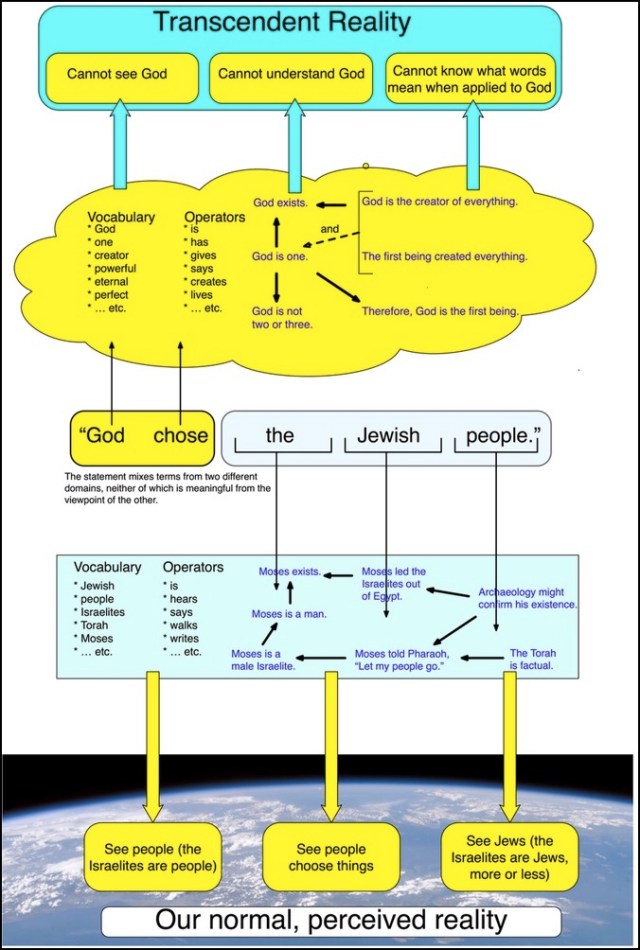
Mixed-Domains-02b1r

In most creation myths, an essential part of creating is to divide things from each other, thereby bringing order from chaos.

In Genesis, God divides light from darkness, the waters above the firmament from waters below the firmament, and the dry land from the water. In the Theogony story from ancient Greece, Chaos exists first, followed by Earth, the Underworld, and Love, all of whom divide the universe. Similar tales appear in all cultures.1

Likewise, to “choose” our people means to create something new: to divide various peoples from each other, thereby bringing order from chaos.

It doesn’t matter if our ancestors were chosen simply as one people among many in the ancient Near East, as a nation of priests, or as a training ground for future Nobel laureates.2 When chosen — whether by God, by Moses, or simply by themselves — they became something new and different from what had existed before.

Chosenness in Historical Context

Surprisingly – or perhaps not – our Jewish notion of being a “chosen” people is not unique in the context of Ancient Near Eastern religions.

The idea is surprising because in our era, we are the only religious group to make such a claim explicitly. Other groups make similar claims, such as Christians’ claim to be God’s “elect” and Muslims’ claim that their faith supersedes both Judaism and Christianity – but Jews are the only religious group claiming to have been chosen by God. We give many different interpretations to the claim, but we do make it.

The idea is unsurprising because, like almost all religious traditions, Judaism was influenced by other religions in the area where it arose. As Dr. Reuven Firestone notes:

Every national unit seems to have had its own national goddess or god … One particular feature of religious life in the ancient Near East is that all believers were ‘chosen’ by their national gods …3

Thus, for example, the Moabites were chosen by Kemosh, Ammonites by Milkom, Philistines by Dagon, and Tyreans by Ashtoret. On the other side of the Mediterranean, Athena was the patron goddess of the Athenians. All those gods, including the god of the ancient Israelites, were conceived anthropomorphically, like humans but more powerful. Members of each national group believed that given appropriate incentives, sacrifices, and flattery, the gods would bless them with good luck, fertility, and success in warfare.

What differentiates Judaism from the other religious traditions of people “chosen by a god” is that we Jews still exist as a distinct group. We have lasted long enough for our concept of divinity:

  • To change in number, from polytheism (worship of multiple gods) to monolatry (worship of one god but belief in other gods), and finally to monotheism (worship of one god and belief that no other gods exist).
  • To change in description, from a finite, human-like warrior god of one nation to the transcendent, incomprehensible creator of the entire universe. This moves from anthropomorphic to abstract monotheism.

The covenant between Israelites and God, described in Deuteronomy, is similar to vassal state treaties imposed by the Hittites on conquered countries. Most scholars believe the authors of Deuteronomy either copied or were influenced by the Hittite treaties, which adds another link between the ancient Israelites’ chosen status and the historical context in which they lived.4

Chosenness in the Jewish Tradition

Explicit references to our chosenness are not abundant. Contemporary writer Joseph Telushkin speculated about the reason:

Perhaps out of fear of sounding self-righteous or provoking anti-Semitism, Jews rarely speak about chosenness, and Maimonides did not list it as one of the Thirteen Principles of the Jewish Faith.5

Prominent Jewish philosophers seldom discuss the issue. Saadia Gaon does not discuss chosenness in his Book of Beliefs and Opinions.6 Judah Halevi argues that Jewish chosenness is connected to a mission of informing the world about God. We are commanded:

… to clearly witness that the world has a King Who watches and directs it, Who knows both great and small, rewarding the good and [punishing] the wicked … So that today the entire civilized world acknowledges that God is eternal, and that the world was created. They look upon the Israelites and all that happened to them as a proof of this.7

Maimonides does not address the issue directly. In Chapter 10 of Talmud Sanhedrin, he wrote that Moses:

… was the chosen one of all mankind, superior in attaining knowledge of God to any other person who ever lived or ever will live. He surpassed the normal human condition and attained the angelic.8

However, since Maimonides thought that God was incomprehensible and that prophecy was inspiration through natural processes, his references to chosenness must be taken as metaphorical.

The most offbeat interpretation was given by Sigmund Freud, who speculated that Moses was an Egyptian monotheist who himself chose the Israelites to receive his monotheistic religion after it was rejected by Egyptian polytheists:

Moses’ active nature conceived the plan of founding a new empire, of finding a new people, to whom he could give the religion that Egypt disdained … Perhaps he was governor of that border province (Gosen) in which perhaps already in the Hyksos period certain Semitic tribes had settled. These he chose to be his new people.9

At Hebrew College, our own Prof. Arthur Green suggested a middle ground between Halachic and ethical-cultural ideas of chosenness by covenant:

The special love of God for the Jewish people, the descendants of Abraham, stands within the context of our berit or covenant with God … That love is, on the one hand, unconditional and, on the other hand, entirely conditional, dependent upon the job we do as bearers of God’s love-message to the world.10

Meaning and Performative Statements

Discussions of religious issues such as chosenness usually neglect to consider what such statements actually mean or what functions they perform.

Statements about people and earthly events belong to the “empirical domain.” They refer to things we can see and experience. If I say “the dog is brown,” it’s meaningful because my hearers have seen dogs and brown things.

Statements about God, on the other hand, refer to a transcendent, incomprehensible being about whom — if we believe Maimonides — we can say nothing literally. A statement like “God is good” belongs to the transcendent domain, and Maimonides would warn that neither “is” nor “good” mean the same applied to God as they do when applied to us.

Within each domain, words, beliefs, and behavior are connected to other elements within the same domain. They are meaningful relative to each other. However, they are unconnected to the corresponding elements in the other domain. The elements in each domain are meaningless in the other domain.

That causes obvious problems for beliefs that combine elements from both domains.

As long as we conceived God as a finite, human-like being who lived in the universe but did not transcend it, the belief that “God chose the Jewish people” made logical sense even if it was based on myth. It said that God, a finite being who lives in the world, chose (in the same sense as a human would choose) the Jewish people. It is an empirical-domain statement. It might be false but it is not meaningless.

However, when our concept of God changed into that of a transcendent Creator, we kept the words of our belief and lost the meaning.

Instead of being an empirical-domain statement, it now had two terms from the transcendent domain (“God chose”) and three from the empirical domain (“the Jewish people”). Since neither part of the statement is meaningful relative to the other part, it is nonsense — but, as the 20th-century philosopher Ludwig Wittgenstein called it, “important nonsense.”

Exactly how is it important? In the 20th century, we learned that we use words and statements for more than just asserting things. We also use them to make what the philosopher John Searle calls “performative utterances.”11 Among other things, we use them to:

  • Signify our membership in groups.
  • Express loyalty to people or groups.
  • Encourage ourselves and others.
  • Mark our status within a group.
  • Signify that we are moral people.

When we state beliefs held by all members of our group, we signify to the group that we are a member and not an “other.” We signify that we are loyal. We are one of them. We are not a threat. That applies almost regardless of the content of the belief. Similarly, when we state beliefs that command moral behavior, we encourage in ourselves and others a tendency to engage in that behavior.

Choosing to be Chosen

The statement that “God chose the Jewish people” has no coherent literal meaning, so we must look elsewhere for its significance.

Most Jews today understand chosenness as based on a covenant with God, however they interpret that, and even if they don’t believe in God. The covenant enjoins them to behave morally, to promote justice, and to observe the Jewish law (however we interpret it).

When we say “God chose the Jewish people,” we are urging others and trying to encourage ourselves to:

  • Live morally,
  • promote justice,
  • defend the rights and welfare of the Jewish people, and
  • follow the elements of the Jewish tradition that we find true and helpful.

In practical terms, the belief that “God chose the Jewish people” is more important as a moral commitment than as a hard-to-interpret theological statement.

On earth, it’s our moral commitment that matters. We choose that.

Works Cited

Brettler, M. (2005), How to Read the Bible. Jewish Publication Society, Philadelphia.

Firestone, R. (2008), Who Are the Real Chosen People? Skylight Publishing, Woodstock, Vermont.

Green, A. (1999), These Are the Words. Jewish Lights Publishing, Woodstock, VT.

Jones, K., translator (1939), Moses and Monotheism by Sigmund Freud. Amazon Digital Services, Seattle, WA.

Morrison, C., editor et al (2015), The Kuzari by Judah Halevi. Amazon Digital Services, Seattle, WA.

Rosenblatt, S., translator (1948), The Book of Beliefs and Opinions by Saadia Gaon. Yale University Press, New Haven, CT.

Searle, J. (1969), Speech Acts. Cambridge University Press, Cambridge, UK.

Sproul, B. (2013), Primal Myths. HarperOne, New York.

Telushkin, J. (2010), Jewish Literacy. Harper Collins, New York.

Twersky, I. (1972), A Maimonides Reader. Behrman House, Springfield, NJ.

Footnotes


  1. For an excellent survey and analysis, see Sproul, B. (2013). 
  2. Jews are 0.2 percent (one-fifth of one percent) of the world’s population but win 22 percent of the Nobel prizes. “5 Reasons Jews Win So Many Nobel Prizes,” Jewish Journal, October 9, 2013. 
  3. Firestone, R. (2008), loc. 326. 
  4. Brettler, M. (2005), loc. 1219. 
  5. Telushkin, J. (2010), p. 567. 
  6. Rosenblatt, S. (1948). 
  7. Morrison, C. (2015), loc. 1148. 
  8. Twersky, I. (1972), loc. 5594. 
  9. Jones, K. (1939), loc. 364. 
  10. Green, A. (1999), loc. 1056. 
  11. Searle, J. (1969), loc. 469. 
Posted in Jewish Philosophy, Judaism, Philosophy | Tagged , , , , , , , , , , , | Leave a comment

What Must We Believe?

Guide-of-the-Perplexed

By N.S. Palmer

Are certain beliefs required to be a Jew in good standing?

Moses Maimonides says yes. Moses Mendelssohn says no. (And yes. And no. Mendelssohn was all over the map on that issue.)

Among religious Jews, Maimonides is known for The Mishneh Torah, which systematizes and codifies Jewish law. But almost everyone knows about the Thirteen Principles of the Jewish Faith he listed in his introduction to Talmud Sanhedrin, Chapter 10.

Maimonides’s principles include the belief that God exists, that He is one, incorporeal, eternal, and the only proper object of worship. There are eight other principles. He says:

“If a man gives up any one of these fundamental principles, he has removed himself from the Jewish community. He is an atheist, a heretic, an unbeliever … We are commanded to hate him and to destroy him.1

That certainly sounds like they’re required beliefs. But a couple of odd things are going on with them.

The first odd thing is that most Jews have never and will never hold the beliefs exactly as Maimonides describes them; nor would most people even understand what he’s talking about.2

Consider his explanation of the first principle, belief in God:

“There is an Existent complete in all the senses of the word ‘existence.’ He is the cause of all existence. In Him all else subsists and from Him derives. It is inconceivable that He not exist, for should He not exist the existence of all else would he extinguished, and nothing could persist.”3

As an aside, some people might detect a hint of Spinoza’s pantheism in that passage: “In Him all else subsists and from Him derives.” If you read both Maimonides and Spinoza carefully, it’s interesting to try to find the differences between them apart from the fact that Maimonides was loyal to Judaism and Spinoza was (with some justification) hostile.

The second odd thing is that by Maimonides’s own philosophy, neither he nor anyone else is capable of believing in God. In The Guide of the Perplexed, he says that belief is

“… the affirmation that what has been represented is outside the mind just as it has been represented in the mind.”4

So to believe anything, we must be able to represent it accurately in our minds. But according to Maimonides, we can’t do that with God:

“His essential attributes, may He be exalted, in the existence of which they believe, must not be like the attributes of other beings … Similarly the terms ‘knowledge,’ ‘power,’ ‘will,’ and ‘life,’ as applied to Him, may He be exalted, and to all those possessing knowledge, power, will, and life, are purely equivocal, so that their meaning when they are predicated of Him is in no way like their meaning in other applications.”5

But Maimonides in fact believed in God, and he even insisted on it as an essential belief of Judaism. Was he simply contradicting himself?

No. He was equivocating.

The answer came six centuries later from Moses Mendelssohn. As much as Spinoza, Mendelssohn believed in Enlightenment-era rationalism, but like Maimonides, he was loyal to Judaism and the Jewish people.

When an anonymous writer challenged him to defend Jewish beliefs and implicitly to attack Christian beliefs, Mendelssohn knew it wouldn’t change anyone’s mind but would provoke hostility on both sides. So he made a bold move: He denied that Judaism had any required beliefs:

Judaism knows of no revealed religion in the sense in which Christians understand this term. The Israelites possess a divine legislation—laws, commandments, ordinances, rules of life, instruction in the will of God as to how they should conduct themselves in order to attain temporal and eternal felicity. Moses revealed to them propositions and prescriptions of this kind in a miraculous and supernatural manner, but no doctrinal opinions, no saving truths, no universal propositions of reason.”6

Partly, Mendelssohn was just evading a debate that he didn’t want to have. It makes no sense to follow Divine commands unless you believe there’s a Divine who issued them. If you think you’re following God’s law, then you logically must believe in God. And Mendelssohn was no dummy. He knew exactly what he was arguing.

But Mendelssohn’s position makes a lot more sense when we look at it in light of Maimonides’s predicament six centuries earlier. He thought that belief was mental representation, and we couldn’t do it with beliefs about God. He also thought we were obliged to believe in God. And he thought that he did believe in God. So did Mendelssohn — who thought, revealingly, that Judaism had no required beliefs, only required actions.

If Maimonides and Mendelssohn couldn’t mentally believe in God — because it was impossible — then what could they do? They could state their belief in words derived from the Torah, follow the law, and respect the rabbinic tradition — in other words, they could act in certain ways.

So they were both right, even if Maimonides was equivocating and Mendelssohn was ducking an argument.

Belief in God does not require us to comprehend the incomprehensible. If that were true, nobody would believe in God and we’d all be Richard Dawkins.

It requires only that we live and behave by our best understanding of God and the laws He has given us. It requires that we act honorably, with love and justice, with due respect for our tradition, with humility before the Divine mysteries we cannot understand, and with loyalty to the Jewish people. The angels can do no more.

Works Cited

Gottlieb, M., editor (2011), Moses Mendelssohn: Writings on Judaism, Christianity, and the Bible. Brandeis University Press, Waltham, MA.

Pines, S., translator (1963), The Guide of the Perplexed. University of Chicago Press, Chicago.

Twersky, I., editor (1972), A Maimonides Reader. Behrman House, Springfield, NJ. Kindle Edition.

Footnotes


  1. Twersky, I. (1972), loc. 5646. 
  2. Maimonides was not much of an egalitarian: He thought that the mental powers of most people were “indubitably either like domestic animals or like beasts of prey.” Pines, S. (1963), p. 372. 
  3. Twersky, I., loc. 5571. 
  4. Pines, S., p. 111. 
  5. Ibid, p. 115. 
  6. Gottlieb, M. (2011), p. 81. 
Posted in Epistemology, Jewish Philosophy, Judaism, Modern Orthodoxy, Philosophy, The Times of Israel | Tagged , , , , , , | Leave a comment

Maimonides and Keeping the Commandments

Joe-rewards-daughter-01r1

By N.S. Palmer

“God rewards those who perform the commandments of the Torah and punishes those who transgress its admonitions.”1

The Jewish sage Maimonides called that an essential tenet of our faith. But there’s something a little odd about it. Consider another belief that looks similar:

“Joe rewards his children if they get good grades and punishes them if they get bad grades.”

The second belief implies that certain things happen: If Joe’s children get good grades, he rewards them — possibly with a trip to Disneyland. If they get bad grades, he punishes them — possibly by taking away their smartphones and making them use gigantic antique phones from the 1990s.

If the rewards or punishments don’t happen, then the belief isn’t true.

What about the first example, that “God rewards those who perform the commandments of the Torah and punishes those who transgress them”?

If some people perform the commandments and apparently don’t get rewarded, while others transgress the commandments and apparently don’t get punished, are we going to say that the belief isn’t true?

No, we’re not. The belief is true. But it’s true in a different way than the belief about Joe and his children.

Our first clue is that we know it’s true in advance of observing anything, and we insist on its truth no matter what we observe. Whatever it is, it’s not a belief like “Joe rewards his children” that can be proven false.

Our second clue is related to the first. We use ordinary beliefs to predict reliably what will happen in the world. I believe that if I start from home and drive south on College Avenue, I will arrive at the grocery store. I can see the store, walk inside, and buy groceries. My belief helps me act successfully to achieve my goal.

But if I perform the commandments, I can’t predict reliably what will happen in the world. I might get run over by a bus in the next five minutes. If I transgress the commandments, then I might get a cushy government job, lots of money, and live in luxury to an advanced age.

So it’s a puzzle. Several approaches are available.

Approach 1: Believe it’s true

One approach is to take the belief as an ordinary factual statement. According to Maimonides, people who take that approach “accept the teachings of the sages in their simple literal sense … They believe that all sorts of impossible things must be.”2

In the Bible, Job’s friends take this view. They think that if Job suffered misfortune, then he must have done something bad to deserve it.

There are other options. They could think that Job’s misfortune is somehow a good thing. They could think that Job’s reward will arrive at some unknown point in the future, perhaps when the Messiah comes or in the world to come. Or they could just close their eyes and pretend his misfortune isn’t occurring.

Maimonides himself thought this approach was partly right, since he believed that keeping the commandments promoted mental, spiritual, and physical health. But he didn’t believe that it would result in worldly rewards of other kinds.

Approach 2: Believe it’s false

Another approach interprets the statement in the same way, but rejects it as false because it’s inconsistent with human history and our own life experience. According to Maimonides:

“The second group is also a numerous one. It, too, consists of persons sons who, having read or heard the words of the sages, understand them according to their simple literal sense and believe that the sages intended nothing else than what may be learned from their literal interpretation. Inevitably, they ultimately declare the sages to be fools …”3

Spinoza falls into that group, as do many modern secular Jews.

Approach 3: Believe it’s metaphorical

The third approach is to assume that Jewish sages and the Torah do not always speak literally:

“When you encounter a word of the sages which seems to conflict with reason, you will pause, consider sider it, and realize that this utterance must be a riddle or a parable.”4

If “God rewards the good and punishes the wicked” is obviously false as a statement about life on earth, then by Maimonides’s reasoning, it must be a riddle or a parable.

Beliefs are tools

To solve the riddle, let’s look at belief in a broader context.

Beliefs are tools. We hold beliefs because they’re helpful to us somehow. Just like tools in a household toolbox, we use different kinds of beliefs to do different things. We use one kind of belief to get to the store; another to feel good about ourselves; another to encourage moral behavior; and still another to feel secure because the universe makes sense.

The belief “God rewards those who perform the commandments …” has no obvious factual meaning corresponding to the words it uses. It’s an “interpretive belief:” not a statement about the world, but about how to interpret other statements.5

It helps us declare our faith that there is a moral order in the universe, and commit ourselves to live by that order. It helps us endure the misfortunes that sometimes afflict everyone’s life.

Works Cited

Twersky, I., editor (1972), A Maimonides Reader. Behrman House Publishers, Springfield, NJ.

Footnotes


  1. Twersky, I. (1972), loc. 5634. 
  2. Ibid, loc. 5409. 
  3. Ibid, loc. 5433. 
  4. Ibid, loc. 5459. 
  5. In philosophical jargon, it’s a meta-statement. 
Posted in Epistemology, Jewish Philosophy, Judaism, Modern Orthodoxy, Philosophy, The Times of Israel | Tagged , , , , , , , , , , , | Leave a comment

Words, Order, and Tisha B’Av

Destruction of the First Temple, painting by Francesco Hayez. Credit: Wikipedia.

Destruction of the First Temple, painting by Francesco Hayez. Credit: Wikipedia.

By N.S. Palmer

One of Judaism’s deepest beliefs, says Rabbi Jonathan Sacks, is “that God is to be found in words, that these words are to be found in the Torah …”1

That’s right in one way, but wrong in another.

Words are how we organize the world and make sense of our experience. To name something is to limit it, to divide it from other things. That’s why God’s first acts in the Book of Genesis are to divide things from each other: light from darkness, land from water, and units of time from each other. By doing so, He transforms chaos into order.

Historically, people have thought that names had some magical connection with what they named. To have someone’s name was to have power over that person. It’s one reason we do not utter the most holy name of God: to say the name would imply that we can limit God, circumscribe Him with our language and our concepts. We have no such power or authority, and we rightly refrain from claiming it.

Therefore, I suggest a clarification of Rabbi Sacks’s statement: We can find God in the words of the Torah, but not in the words themselves. Those words represent God as we understand Him, which isn’t much. God Himself — the Ayn Sof — lies beyond the words, beyond the order that we, through language, impose on our world to mitigate chaos.

You must look for God not in the words, but in the spaces between words; in the stillness between breaths; in the moments between moments. You will not understand what you find there, because no finite being can understand the infinite. But you will find God there. And He will speak to you, in soft tones, just a whisper, for which you must listen carefully in the silence. He will speak to you of love, and truth, and trust. Especially trust, because He knows that in this world, trust is one of the hardest things for small creatures like us to sustain. You can trust God even though you cannot understand Him.

But you have thus far trusted me to get to the point, so I must not let you down.

With words, we impose patterns on reality. Sometimes, the patterns are a good fit. Sometimes, they’re not. When that happens, we either must alter the pattern to make it fit the reality, alter the reality to make it fit the pattern, or alter what we say about the reality to make it fit the pattern. All three, I want to emphasize, are morally defensible strategies depending on the circumstances and the results.

Which brings us to Tisha B’Av. For non-Jewish readers, “Tisha” means “nine,” “be” means “in,” and “Av” is the name of the calendar month.

On Tisha B’Av, the ninth day of Av in the Jewish calendar, we mourn the destruction of the First and Second Temples, as well as several other tragedies that have befallen our people. It is interesting in a number of ways, not least in the fact that the tradition surrounding it is a four-tiered story whose truth resides in its results rather than in its foundations.

Tier 1: Time

In the world itself, there is simply time. There are no minutes, hours, days, weeks, months, or years. They do not exist. We make them up, including Tisha B’Av. Through our words, we impose our clock and our calendar on reality to help us make sense of life and to do things in a productive sequence. That’s Tier One of the story: Numbered days and years. Named months.

Tier 2: Pattern

Tradition says that at a recurring time we’ve named, Tisha B’Av, several great tragedies have befallen our people. They started in 1313 BCE with the Israelites’ failure to trust in God during the Exodus, for which they had wander 38 more years before entering the Promised Land.2

After that, the First Temple was destroyed by the Babylonians on Tisha B’Av in 423 BCE, and the Second Temple was destroyed by the Romans on the same date in 70 CE. On Tisha B’Av in 1290 CE, our people were expelled from England, while in 1492, we were expelled from Spain.

Of course, there are messy details. As far as archaeology can determine, the 1313 event is a legend. The First Temple was destroyed in 586 BCE instead of 423 BCE as claimed by the Talmud. Since the rabbis got the year wrong, the precision with which they identified the month and day is suspect at best. In England, there were only about 2,000 Jews, and our departure was mostly peaceful. In Spain, the expulsion edict came on March 31, which wasn’t Tisha B’Av, though the deadline for leaving was.

What seems to have happened is that the rabbis writing the Talmud3 knew the Second Temple was destroyed on Tisha B’Av, but they weren’t sure exactly when the First Temple was destroyed. In their view, it would have made sense for both to be destroyed on the same date, and they could find some basis for that guess, so they assumed it was true and wrote it into the Talmud. Some other events kind of fit the pattern and kind of didn’t, but with a little effort, the rabbis managed to shoehorn them into it as being on the same date.

Tier 3: Explanation

Why does Tisha B’Av seem like such an unfortunate day? Explanations are in short supply, but some Orthodox rabbis say that “it’s clearly a day set aside by God for suffering.”4 They might be right, but it’s far from obvious why the Creator of the universe would choose a particular date from an arbitrary human calendar for such a thing.

Tier 4: Results

The results of observing Tisha B’Av are more fortunate than the events it remembers. In synagogue, we read from the Biblical Book of Lamentations. It’s a heart-rending account of the horror, suffering, and moral devastation that attended the destruction of the First Temple.

To contemplate such events is to experience the pain of one’s own people across the millennia. It is to grow in solidarity with them and with our contemporaries. It is to grow in compassion for the suffering of all God’s children everywhere. And it is to grow in our resolve to bring more love and justice into the world.

“A story told by English Jews, perhaps apocryphal, tells of a prominent nineteenth-century British politician who was walking near a synagogue on Tisha B’Av and heard wailing coming from inside. He looked in and was informed that the Jews were mourning the loss of their ancient Temple. Deeply impressed, the politician remarked, ‘A people who mourn with such intensity the loss of their homeland, even after two thousand years, will someday regain that homeland.'” 5

And it came to pass.

Works Cited

Sacks, Rabbi Lord Jonathan (2000), A Letter in the Scroll. Free Press, New York.

Telushkin, Joseph (2010), Jewish Literacy, second edition. Harper Collins, New York.

Footnotes


  1. Sacks, J. (2000), p. 39. 
  2. “What Happened on the Ninth of Av,” Chabad.org. 
  3. The Babylonian Talmud was completed in about 600 CE, while the Jerusalem Talmud was completed in about 450 CE. 
  4. “What Happened on the Ninth of Av,” Chabad.org. 
  5. Telushkin, J. (2010), p. 669. 
Posted in Jewish Philosophy, Judaism, Modern Orthodoxy, Philosophy | Tagged , , , , , , , , , , | 1 Comment