Have Happy Relationships in 2019

Human beings are social animals. To be our best selves, we need other people.

But those relationships demand work, patience, and understanding.

How can you make your relationships as happy as possible in 2019?

Think about three things: You, the other person, and the relationship itself.

You

The philosopher Bertrand Russell (1872-1970) observed that “most people are about as happy as they make up their minds to be.”

If it’s raining, at least it’s not cold. If it’s cold, at least you have a warm home. And if you’re alive, you almost always have a chance to make tomorrow better than today.

You often can’t control external events in the world. But you can control your attitude toward them.

With very few exceptions, you can choose to be happy. You can focus on the good instead of the bad.

By all means, deal with the bad; but don’t let it define you, your life, or your relationships.

Instead, you take control and define them yourself. You have that power.

The other person

In the first flush of love (or even just friendship), it’s easy to idealize the other person. And that’s fine, as long as you season it with a dash of realism.

Even if you’re both wonderful people, you’ll sometimes have conflicting priorities. You’ll sometimes annoy each other. You’ll sometimes say things you don’t mean and later regret.

Accept the other person as a real human being, who has flaws and sometimes makes mistakes.

Learn to work around the flaws and forgive the mistakes.

And don’t mind-read. You don’t know what the other person’s private thoughts are. If you need to know, ask. But don’t stew in anger over what you believe without evidence.

The relationship

The only relationships with no problems are the trivial ones. The reason they have no problems is that we don’t care  much if they work out or not.

Our most important relationships have problems precisely because we care about them so much. They can bring us joy but they can also wound us.

Happy relationships aren’t problem-free: they’ve just learned to accept and resolve their problems.

In October 1730, American Founder Benjamin Franklin published some “Rules for Marriage” that apply to relationships generally. Paraphrased:

  • The best way to have a good friend or good spouse is to be one yourself.
  • Don’t try to manipulate people. Treat them with respect.
  • Don’t expect trouble-free happiness — “nor promise yourself felicity without alloy, for that’s impossible.”
  • “Resolve every morning to be good-natured and cheerful that day.”
  • “Deny yourself the trivial satisfaction of having your own way” if it’s going to cause a big argument. Relationships involve give and take. Sometimes you take, and other times you give.

Check out my new book Why Sane People Believe Crazy Things: How Belief Can Help or Hurt Social Peace. Kirkus Reviews called it ” a thoughtful consideration of torrid intellectual disputes.”
Posted in Human Relations, Life, Psychology | Tagged , , , , , , , , , | Leave a comment

Create a Better Life in 2019

Want to create a better life in 2019?

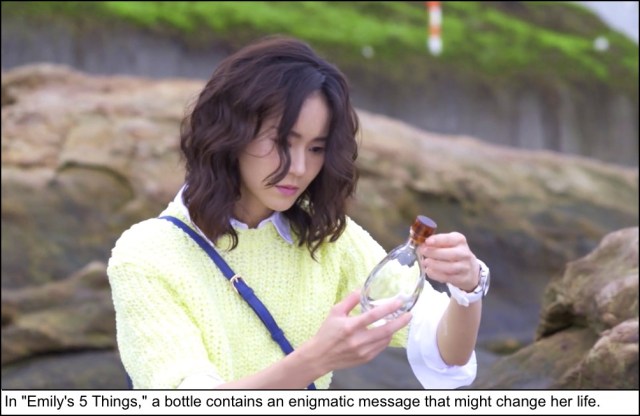
In “Emily’s Five Things,” a Taiwanese television series, Emily finds a bottle at the beach. It contains a paper with an enigmatic message:

  • Be Yourself
  • Reconcile
  • Bid Farewell
  • Go Home
  • Rewind

The letter also warns that if she doesn’t do those things, she’ll die. After having a nightmare later that night, she starts to believe it.

Sure, it’s kind of a hokey setup, but it’s got a couple of good lessons to teach.

Emily starts to ponder the message. How is she not “being herself” — i.e., true to her own deepest convictions? With whom does she need to reconcile, and to what should she bid farewell? Where’s home? And how on earth should she “rewind?”

As she tries to discern the meaning, Emily starts to make connections and get insights. She realizes things about her life that, at some level, she already knew.

That’s one of the ways to be creative. If looking at things in the usual way isn’t getting you where you want to go, then look at them in a different way.

The messages in the bottle all seem meaningful. But that can mask how the trick really works.

You know many things without knowing that you know them. The philosopher Michael Polanyi called it “tacit knowledge.”

If you try to reach that tacit knowledge through your mind’s front door, you often can’t do it. Using the front door is the way you normally think. You need to find a side door.

Psychotherapists sometimes use a variation on the technique. If a patient doesn’t know how he or she feels about something, a therapist might ask, “Well, if you did know, what would you say?”

In Emily’s case, it’s not the specific messages that matter. What matters is that the messages make her think about her life in new ways. She finds the side door that leads to her tacit knowledge.

That’s one way that the Bible and other sacred documents work. Believers are sure that the text contains the answers to their questions. So they think about the text until they find the answers that they needed.

Sometimes, the answers are there in the text. But just as often, the answers are in the believers themselves — hidden in their tacit knowledge. The text just provided the side door to find it.

But as side doors go, Emily’s Five Things are a good place to start: Be yourself, reconcile, bid farewell, go home, and rewind.

How do those ideas apply to you? And how can you put them to work in 2019?

It’s your life, so you’re the only one who knows. Even if you don’t know you know.


Check out my new book Why Sane People Believe Crazy Things: How Belief Can Help or Hurt Social Peace. Kirkus Reviews called it an “impressively nuanced analysis.”

Posted in Human Relations, Life, Psychology | Tagged , , , , , , , , , , , | Leave a comment

Embrace the Paradox of Self-Improvement

Are you good enough as you are, or do you think you can do better?

That question highlights the paradox of self-improvement.

Before you can make your life better, you must believe you’re worthy of something better.

That means accepting and loving yourself as you are right now.

But at the same time, it requires you to take inventory of your shortcomings. What have you been doing wrong? How can you do better? How can you be better?

The real answer is to judge yourself by the correct standard. You aren’t perfect. You never were. You never can be.

But are you you moving in the right direction? Are you a better person today than you were a year ago? Can you see ways to become a better person at the end of 2019 than you are now?

If you believe you have to be perfect, never make mistakes, and never do anything wrong, then you’re setting an impossible standard for yourself. That leads to despair and to giving up. Don’t go there.

You don’t have to be perfect. You just have to be getting better. The steps might be small ones, but if you’re taking those steps and making a sincere effort, then you’re succeeding.

Sometimes, you will still fall short. That’s inevitable. But if you pick yourself up and keep going in the right direction, you can never be a failure. You can only succeed.

Believe in yourself. Believe in what’s right. Be a better person at the end of 2019 than you are now.

Let’s do it together.


Check out my new book Why Sane People Believe Crazy Things: How Belief Can Help or Hurt Social Peace. Foreword Reviews called it “not only interesting, but vital for living.”

Posted in Human Relations, Life, Psychology | Tagged , , , , , | Leave a comment

They’re Not Lying

Do you have friends who say things that are obviously wrong?

Maybe it’s politics, religion, gender, or some other touchy subject.

This might help: Your friends aren’t lying.

And they’re not evil, either, unless you have very bad judgment about choosing friends.

That doesn’t make their beliefs correct. But it might help you to be more patient and tolerant — and even more open-minded, since you could be wrong just as easily as your friends.

Remember what it means to tell a lie: You say something that you know is false.

Whether true or not, harmful or not, most of people’s beliefs don’t rise to that level.

Our minds evolved for action. We’ve simply re-purposed them for more abstract kinds of thinking. Our evolutionary ancestors needed to find food, escape predators, and of course, procreate. They didn’t need to decide tricky questions about morals, science, economics, or about events that occurred far away, that they never saw first-hand.

Thus, our minds aren’t entirely reliable in those areas. We can use our minds that way, just like we can use a hammer to eat spaghetti, but sometimes it gets a little messy.

Because our minds evolved for action, they’re optimized for that purpose. As a result:

  • People assume that things they hear are true if they see no reason not to believe them.
  • Especially if the beliefs conform to what they already believe, or the beliefs appeal to them emotionally.
  • Or if the beliefs signal their status, virtue, or membership in a group.
  • And if they pass the “sniff test.” When people encounter beliefs that they’re already inclined to like, they don’t sniff very hard. They just believe.

Here’s an example from my own life. I hate to exercise, so I watch video courses to distract myself while I do it. I had been watching a course about astronomy.

The professor said something (just a verbal slip) that I would have known was false if I’d given it much thought. But the statement came from an authoritative source and there was no obvious reason for me to question it. Therefore, I just filed it in my memory as a fact. When I later mentioned it to one of my brothers, he pointed out that the statement was wrong. Only then did I think about it and realize my mistake. Our minds are full of stuff like that.

So be patient and charitable, both with others and with yourself.

We all believe things that are incorrect or unsupported by evidence. That doesn’t mean we’re lying. It just means we’re fallible.


Check out my new book Why Sane People Believe Crazy Things: How Belief Can Help or Hurt Social Peace. Kirkus Reviews called it an “impressively nuanced analysis.”

Posted in Epistemology, Human Relations, Life, Psychology, Society | Tagged , , , , , , , , , , , | Leave a comment

Can We Measure the Quality of Debates?

As an undergraduate mathematics major, I had to take three semesters of statistics.

I’m pretty good at mathematics, but statistics is a different animal. To adapt the famous last words of English actor Edmund Gwenn, “Mathematics is easy. Statistics is hard.”

It didn’t help that my statistics courses were all taught by “Professor Impossible,” who was the worst teacher I’ve ever had. In fairness, he was a nice guy and incredibly smart. He just couldn’t teach to save his life. It wasn’t his fault that I fell short of graduating summa cum laude, but if not for the three statistics courses, I would have.

I’ll say another thing about Professor Impossible’s plus side. Even though his courses were an ordeal, if you could make it through them, you learned a hell of a lot about statistics.

Anyway, one concept in statistics is operationalization: figuring out how to measure things so that you can compare them.

Interestingly (if you’re a nerd), Einstein came up with his theory of special relativity partly by operationalizing the idea of two things happening at the same time.

But I digress. Most current political arguments are pointless and stupid. That’s one thing on which everyone can agree.

Could we operationalize the idea of debate quality? Is there a way to measure how much of a discussion is productive argument and how much is just a shouting match?

One way would be to award points for positive moves and subtract them for negative ones.

For example, if someone in the argument states a belief clearly, add a point. If someone commits a recognized logical fallacy, subtract a point.

Of course, that kind of measurement is itself vulnerable to bias. Everyone would need to agree about how to identify clear statements of belief. They’d also need to agree on an oracle to identify logical fallacies and other errors.

And there’s one other error we’d need to avoid. It’s a verrry tricky one. The purpose of politics is to get things done, preferably (though often not in practice) good things. That requires persuading people to believe or act in certain ways.

Humans can think, but also have emotions that make us more than mere robots. Even smart people are often persuaded more effectively by appeals to emotion than by facts and logic.

In theory, it sounds nice to live in a world where only facts and logic matter. But would we really want it — a world where human happiness or suffering didn’t matter as long as we got the facts and logic right? I don’t believe that we would. Even the fictional planet Vulcan only pretends to be like that, since its inhabitants seethe with repressed emotions.

So I suppose the solution, if there is one, is mainly to be aware of what’s going on in our arguments.

If we can identify when people state their viewpoints clearly, offer valid arguments or fallacies, and appeal to emotion, then we can make informed decisions about what counts more than what. Sometimes, we’ll go with facts and logic. Other times, we might decide that an emotional appeal outweighs everything else, but at least we will know what we’re doing. And more often than we might like, we’ll still have no idea of the right answer, so we’ll just make our best guess and hope it works.

But the first step is to know what we’re doing and why. At least then, we’ll have a better chance of getting it right.


Check out my new book Why Sane People Believe Crazy Things: How Belief Can Help or Hurt Social Peace. Foreword Reviews called it “intriguing and vital.”

Posted in Epistemology, Human Relations, Life, Political Science, Psychology, Society | Tagged , , , , , , , | Leave a comment

Why My Father Was Never Sick

In “Unbreakable” (2000), Bruce Willis played a middle-aged man who discovered that he was an invulnerable superhero.

Obviously, superhero movies require our suspension of disbelief.

In “Unbreakable,” the hardest thing to believe was not that Willis’s character was invulnerable, or that he had super strength. Those are standard in superhero movies.

The hardest thing to believe was that he had reached middle age without noticing that he had never been injured or sick.

On the other hand, I could believe it at least a little. My father was almost never sick.

No, the cause wasn’t regular exercise. It wasn’t a healthy diet. It wasn’t even good heredity. And he wasn’t a superhero.

It was because even if he was sick, he would almost never admit it.

And there’s a lesson in that.

The lesson is not that we should ignore illness. As a doctor, Dad would never have recommended that. He got away with it, but most people can’t.

The lesson is that a lot of what happens in our lives depends on our attitude toward it.

Dad meant to do his part for the world. If illness thought it could slow him down, he invited it to try. In the meantime, he was going to live, and live fully. He succeeded.

He also believed that he was lucky. He said you might beat him at a game of skill, but that he’d always win if it depended on luck.

I think there was a different cause.

Dad was lucky because he interpreted things that happened to him as lucky. He always looked for ways to make bad things work for the good. And then he felt grateful for being so lucky.

I think he was about as happy as a non-psychotic person can be. He was lucky that way.

We can be lucky that way, too — if we face life with courage and always look for ways to turn bad things into good.

It’s a smart way to live.

Posted in Life, Psychology, Society | Tagged , , , , , , , | Leave a comment

Making Peace with “the Passions”

“But what about the passions?”

It was another philosophy class in college. We were discussing some abstruse intellectual topic. And my classmate Dave was interjecting — again — a lot of irrelevant chatter about “the passions.”

The passions were a big thing with him. He seemed like a decent enough guy, but I had no idea of what he was talking about.

The rest of us were discussing logic. He kept yammering about emotion, as if that had anything to do with anything.

Well, I apologize, Dave, wherever you are. I thought you were a nitwit. But you were smarter than I was, at least about that. I found out a few years later.

Ninety-nine point nine percent of the time, our lives make some kind of sense. Those times are good. I like it when things make sense.

But it’s in the final tenth of a percent that we find the reason for everything else. It’s where we encounter a power that we don’t expect, understand, or control.

It whisks us off the map of anything we believed was possible. It shows us wonders that we never before imagined. It changes us.

It’s in those moments that the rest of our life comes into perspective. It’s then that we finally feel at home in the world, and are damn glad to be here.

Those moments don’t make any sense. They don’t need to. They are self-justifying. They are the passions.

Posted in Life | Tagged , , , | Leave a comment

A Tool’s Got to Know Its Limitations

What do DNA, psychological questionnaires, and my new car have in common?

DNA (deoxyribonucleic acid) is a molecule in which plants and animals encode the basic characteristics of their bodies. It’s what makes a rose a rose instead of a carrot. It makes some people tall and other people short. It affects almost every trait of living things — even people’s psychological traits.

As a result, we can now use DNA to make predictions about people. Because environment also affects how people turn out, the predictions can only give probabilities. But someone with a high “polygenic score” for height is more likely to be tall than someone with a low score.

The trouble with shiny new tools is that we tend to over-estimate what they tell us. For example, in his book Blueprint: How DNA Makes Us Who We Are, geneticist Robert Plomin reveals what his score for body mass index (which can indicate obesity) told him:

“Knowing my BMI polygenic score helps me realize that I can’t let my guard down, because it is in those weak moments – for example, when I am tired after a long day – that I sometimes give in to those siren snacks in the cupboard whispering to me.”

That’s good to know. But didn’t he already know that? Of course he knew it. His score didn’t tell him anything new about his behavior. It only gave a partial explanation for it.

Polygenic scores aren’t nothing, but they’re not everything, either. They’re one piece of a puzzle.

The same is true of psychological questionnaires such as the Myers-Briggs test. They were a fad in corporate HR departments when they were first introduced back in the 1970s. A lot of large companies still use them, and you can see employees’ Myers-Briggs personality diagrams posted near their desks.

The theory is that everyone has personality traits (well, duh!) that make them better at some jobs and worse at others (also a “well, duh!”). Myers-Briggs and similar tests try to measure those traits.

But there are two problems. First, anyone who’s smart enough to hold a job can easily learn to game the tests. If you know how to answer the questions, you can get whatever result you want.

Second, and more relevant, the tests rarely tell you anything about people that you couldn’t discern just by talking to them for 15 minutes. I’m fairly obtuse about people, but even I can tell you more after a short conversation than by having you take a Myers-Briggs test. Sure, you could deceive me if you knew how, but the same problem applies to the test.

And then there’s my new car. Did I mention that I have a new car? It’s quite a nice toy. It’s got so many features that I still don’t know what half of them do.

But it definitely has cameras. Front, rear, visual, radar, probably even sonar and laser sensors — it wouldn’t surprise me a bit.

“Laser,” by the way, is an acronym for Light Amplification through Stimulated Emission of Radiation. But I digress.

I complained to one of my brothers that the cameras were neat but that they didn’t add much. While driving, I still have to watch the area around the car in exactly the same way as I would without the cameras.

And then I realized: the cameras are like DNA and psychological tests. They simply give you more data about what you already knew. Most of the time, they might not add much to your understanding — though in a few cases, they might. You just can’t rely on them by themselves. A tool’s got to know its limitations.

I like my new car, anyway. I think I’ll keep it.


Check out my new book Why Sane People Believe Crazy Things: How Belief Can Help or Hurt Social Peace. Kirkus Reviews called it an “impressively nuanced analysis.”

Posted in Human Relations, Psychology | Tagged , , , , , , , , , , | Leave a comment

Visit a Foreign Country

“The past is a foreign country,” advised British novelist L.P. Hartley.

And it’s true: Most of us have quite enough trouble keeping up with the present. We’re too busy to think much about the past.

Of course, there are different ways of thinking about the past, some bad and some good.

On the bad side, some people chain themselves to the past. They can’t escape it because they’ve become their own jailers. They might brood about long-ago hurts of which they can’t let go. They might yearn for a utopian society that they imagine once existed. They think so much about the past that they miss the present, which despite all of its flaws, still has plenty to offer. It requires our attention if we’re going to make the most of it.

But on the good side, other people look to the past for insight or inspiration. It can help us meet the challenges of the present.

Personally, I’m fond of old radio shows, mostly from the 1930s and early 1940s. Some are strange, but many offer ideas that are just as relevant now as they were back then.

One such show was “The Lone Ranger,” a moralistic drama wherein a former Texas Ranger battled crime in the 19th-century Western United States. When a criminal gang ambushed a group of six Texas Rangers, he was the only one to survive — becoming “the Lone Ranger.” He was nursed back to health by Tonto, a Comanche warrior who found him after the ambush, and whose life the Ranger had saved many years earlier when they were both boys.

The show’s creators, George W. Trendle and Fran Striker, spelled out the show’s subtext in the Lone Ranger’s creed. We’d use different wording today, but the ideas are timeless:

“I believe:

That to have a friend, a man must be one.

That all men are created equal and that everyone has within himself the power to make this a better world.

That God put the firewood there but that every man must gather and light it himself.

In being prepared physically, mentally, and morally to fight when necessary for that which is right.

That a man should make the most of what equipment he has.

That ‘This government, of the people, by the people and for the people’ shall live always.

That men should live by the rule of what is best for the greatest number.

That sooner or later, somewhere, somehow, we must settle with the world and make payment for what we have taken.

That all things change but truth, and that truth alone, lives on forever.

In my Creator, my country, my fellow man.”

Trendle and Striker had other guidelines as well:

  • “At all times, The Lone Ranger uses perfect grammar and precise speech completely devoid of slang and colloquial phrases.
  • When he has to use guns, The Lone Ranger never shoots to kill, but rather only to disarm his opponent as painlessly as possible.
  • The Lone Ranger does not drink or smoke, and saloon scenes are usually interpreted as cafes with waiters and food instead of bartenders and liquor.”

Even CNN, in 2013, published an article lauding the Lone Ranger.

Yes, the past is a foreign country. But as they used to say (in 1938), “travel is broadening.”


Check out my new book Why Sane People Believe Crazy Things: How Belief Can Help or Hurt Social Peace. One reader said that “I got a kick out of the chapter on Spinoza.”

Posted in Bible, Christianity, Human Relations, Judaism, Political Science, Psychology, Society | Tagged , , , , , , , , , , | 2 Comments

Abnormal Isn’t Normal, But It’s OK

“Abnormal” is not an insult. And “normal” is not a compliment.

People bend over backwards these days to avoid calling anything “abnormal.” Apparently they think it might hurt someone’s feelings.

For example, Robert Plomin’s recent book about human DNA argues that because thousands of small genetic differences affect human psychological traits, “there are no disorders, that the ‘abnormal is normal’.”

In other words, he argues that since we’re all a little crazy, there’s no such thing as being crazy. The abnormal is normal.

But what’s normal simply means what’s common. Abnormal means uncommon. It isn’t normal, unless we’re going to throw out the dictionary and use words meaninglessly.

Words should mean what they mean. I care about things like that. It’s one of the ways I’m abnormal.

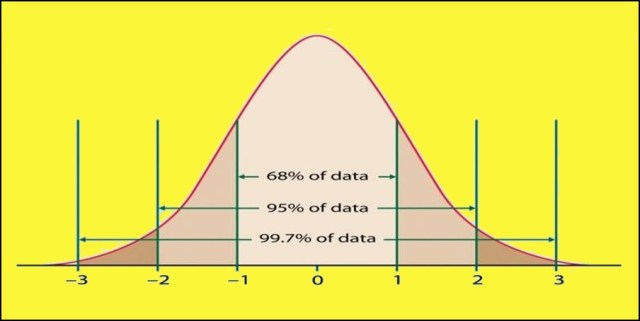
Most human traits vary through the population in what’s called a “normal distribution.” You can graph it in a bell-shaped curve, as shown in the picture at the top of this blog post.

At the highest point of the graph, in the center, is the average (also called “the mean”).

For example, suppose you’ve got five people whose heights are 60 inches, 65 inches, 70 inches, 75 inches, and 80 inches. If you add up all the numbers, you get 350 inches. Divide that by the number of people (5), and you get the average height: 70 inches.

But what if you’ve got another group of people whose heights are 35 inches, 40 inches, 70 inches, 100 inches, and 105 inches? The average is still 70 inches, but it’s much less helpful because of the large difference in heights.

The same problem arises if the heights are 70, 70, 70, 70, and 70. The average is still 70, but there’s no variation at all in the people’s heights.

If you only looked at the average heights, you’d think all the groups were pretty similar.

Standard deviation is a way to measure how much a trait varies.

For the first group (60, 65, 70, 75, 80), the standard deviation shows some variation: about seven inches. For the second group, it shows a lot of variation: 29 inches. For the third group, it shows no variation: zero inches.

Standard deviation isn’t very helpful with small groups. But if a population of a million people had an average height of 70 inches with a standard deviation of seven, then:

  • 68 percent of people would be within one standard deviation of the average.

About 680,000 people would be between 63 and 77 inches tall.

  •   95 percent of people would be within two standard deviations of the average.

About 950,000 people (which includes the 680,000) would be between 56 and 84 inches tall.

  • 99.7 percent of people would be within three standard deviations of the average.

About 997,000 people would be between 49 and 91 inches tall.

That leaves at most 3,000 people out of a million who are under 49 inches tall or over 91 inches tall. They are abnormal. It doesn’t mean they’re bad, stupid, or that their lives are worth any less than the lives of normal people. It means only that their height is far out of the normal range.

For evaluating them as people, their height is completely irrelevant. On the other hand, if you’re deciding what sizes of clothing to manufacture, the normal range of height is very relevant. You want to make sizes that will sell enough to make a profit. Those 3,000 people will have to find special stores to buy their clothing, or order it online.

For individual success and social harmony, what’s normal matters in two ways:

  • Our normal ideas and institutions have developed over thousands of years in many different kinds of human societies. They’re still around because they worked for our ancestors and their societies. Abnormal concepts and  ways of life might work or they might not work. We don’t always know, and the penalties for being wrong can include demographic extinction. Caution is appropriate.
  • Like lower animals, we tend to divide into groups based on cues such as appearance and behavior. If we see some people as abnormal, we are more inclined to see them as non-members of our own group. That can lead to social conflict. That seems to be Plomin’s motivation for denying that abnormality exists: “The most general implication of this view of the abnormal as normal is that there is no ‘us’ versus ‘them’.”

Plomin’s approach is well-intentioned, but I think it’s ultimately self-defeating to deny that human differences exist. If we pretend that they don’t exist, they’ll still be there anyway. We will still be “us” and they will still be “them.” But we won’t be able to do anything to mitigate the differences because we’re pretending they don’t exist.

Our challenge is to work with our differences in peaceful and socially beneficial ways. It’s not easy, but we can do it.


Check out my new book Why Sane People Believe Crazy Things: How Belief Can Help or Hurt Social Peace. One reviewer said “Using a dash of humor and an accessible style of writing, this will delight fans of books like Yuval Harari’s Sapiens. Highly recommended.”

Posted in Human Relations, Philosophy, Political Science, Psychology, Society | Tagged , , , , , , , , , , , , | 2 Comments