Peace Depends on Truth

The-Gods-Must-Be-Crazy-02a1

My latest blog post for The Jerusalem Post:

Truth can be a matter of life and death.

That’s no surprise, since it’s happened many times in history. But I want to make a much more difficult argument:

A theory of truth can get people killed.

Huh? What’s a theory of truth? And how could it possibly get anyone killed?

Theories of truth are part of philosophy. Everyone has a philosophy. And if you don’t consciously choose your philosophical ideas, you’ll unconsciously absorb the ideas from your environment. Often, the ideas will be wrong. Sometimes, they’ll be harmful.

What is truth?

A theory of truth tries to answer two questions:

  • What does it mean for beliefs to be true?
  • How do we know that beliefs are true?

The common-sense answer is called the correspondence theory of truth. It says that if a belief is true, then it “corresponds” somehow with a non-mental fact. The exact nature of the correspondence is unclear. According to Maimonides, who held the correspondence theory, truth means:

“That what has been represented is outside the mind just as it has been represented in the mind.”1

Here’s the cartoon version of the theory. It’s accurate enough for our purposes. Suppose you believe there is a Coca-Cola bottle on the table in the next room. You walk into the room and you see the fact: a Coca-Cola bottle is on the table. Your belief was true because a fact corresponded to your belief. The fact exists independently of you or anyone else perceiving it. Therefore, if your belief is true, it implies that there must be a Coca-Cola bottle on the table. That’s the fact.

That’s the fact, Jack

But let’s take another look at that fact. The first thing to notice is that it can be true or false. When you perceive a Coca-Cola bottle on the table, you might be mistaken. It might be a bottle of Pepsi or even a small lamp.

What verifies your explicit belief (“A Coca-Cola bottle is on the table”) is an implicit belief (your perception of what you see as a Coca-Cola bottle). No matter how much you examine the object, you’re still basing beliefs on perceptual judgments — in other words, on beliefs in your mind rather than what is or isn’t on the table.

Moreover, to recognize a Coca-Cola bottle on a table as a Coca-Cola bottle on a table requires you to know what bottles, Coca-Cola, and tables are. That requires the ability to classify bottles as a type of container, Coca-Cola as a type of carbonated beverage offered for sale, and tables as a type of furniture used by humans for specific purposes. It requires cultural knowledge of soft drinks and commercial products. Depending on who sees it, it might include knowledge of how glass is made, or a list of the chemical ingredients of Coca-Cola.2

How much of that is sitting on the table, “outside of the mind,” as Maimonides said? Hardly any of it:

“These and many other notions are so bound up with the identification that our thought would lose its character with the removal of any one of them … And these essential elements are not given in sense at all. They are elements in a system, and a system of no little complexity.”3

Most of the so-called “fact” is in the mind of the perceiver. And that’s where we get into trouble.

People unconsciously think of truth as correspondence because it seems like common sense. And the same people have beliefs, some good and some bad, about all kinds of situations. The idea that their beliefs correspond to facts independent of their own interpretation means that anyone who disagrees with them must be wrong. It can’t be just a difference in viewpoint. If the belief is about something important, it’s a short jump from “wrong” to “evil,” and thence to violence.

Facts are mostly mental

Let me introduce you to the San people, an African tribe depicted in the 1980 film, “The Gods Must Be Crazy.”

The San live in the Kalahari desert and have had no contact with modern civilization. One day, a plane passing overhead drops a Coca-Cola bottle that lands intact on a soft area of ground. The San have never seen a glass bottle and they consider it a gift from the gods. They think it might be a musical instrument or a tool for craft work. Later, a Western biologist sees it and recognizes it as a Coca-Cola bottle: a manufactured glass container that normally contains a sugary beverage.

The San neither believe what the biologist thinks nor would they understand it. They have never seen factories or manufactured items. They’ve never before seen glass. They have never tasted Coca-Cola or seen any bottled beverage. They know the object fell from the sky and has unusual properties. They consider it a religious artifact. Are they wrong, or do their different beliefs simply result from their different concepts and experiences?

Disagreements about bottles on tables are trivial. But now apply the principle to something of greater consequence, such as the nature of God, the meaning of the Bible, or who has a rightful claim to the Temple Mount. It’s no longer a trivial disagreement. At best, there will be bitterness and hatred. At worst, people will get killed.

The correspondence theory of truth is not only incorrect, but harmful. What’s the alternative?

Truth is coherence

The alternative is the coherence theory of truth, which says that beliefs are true if they fit logically with a system of other beliefs. “Fit” means that:

  • The belief logically implies some other beliefs of the system and, in turn, is logically implied by them.
  • It uses some of the same concepts in the same ways as other beliefs in the system.

Now, the idea of truth as coherence is a little counter-intuitive. Among other things, it means that there are degrees of truth. A belief that fits into a large system and has many logical connections to other beliefs is more true than a belief with a smaller system or fewer connections. It’s also more certain because the surrounding system provides lots of evidence for it. Spinoza didn’t quite advocate the coherence theory, but he came close, and he recognized degrees of truth.4

Because the coherence theory implies there are degrees of truth, it recognizes the existence of both objective reality and absolute truth.

Everything we perceive and believe is interpreted by our belief systems and conceptual schemes. There is an objective reality, but we can’t get to it. For us, “objective reality” means reality that can be confirmed by other people.5

Beliefs are absolutely true if supported by an infinite system of other consistent beliefs, but we are finite so we never have access to an infinite system. All of our beliefs are relative to our own, finite systems of belief. Only God knows absolute truth because only God can comprehend the infinite:

“In all likelihood, there will never be a proposition of which we can say, ‘This that I am asserting, with precisely the meaning I now attach to it, is absolutely true’ … The road of history is so thick with discarded certainties as to suggest that any theory which distributes absolute guarantees is touched with charlatanism.”6

Logically, it means that apparently inconsistent beliefs can all be true, each relative to its own supporting system. The beliefs are about different things so they don’t really conflict. The San people believe a Coca-Cola bottle is a religious artifact because that’s how it fits into their system. We believe the religious artifact is a Coca-Cola bottle because that’s how it fits into our system.

Coherence and social peace

By itself, understanding the nature of truth won’t bring social peace. Human beings will still be human beings. Conscience and intelligence will still battle Yetzer Hara and our lower animal nature. Terrorists won’t think about their philosophy.

However, if our understanding helps us support greater tolerance of differing viewpoints and ways of life, we can improve things a little. That’s the truth.

Works Cited

Blanshard, B. (1938), The Nature of Thought, Volume 2. London: George Allen & Unwin.

Pines, S., translator (1961), Moses Maimonides: The Guide of the Perplexed, Volume 1. Chicago: University of Chicago Press.

Shirley, S., translator (2011), Baruch Spinoza: Ethics. Indianapolis: Hackett Publishing Co.

Footnotes


  1. Pines, S. (1961), p. 111. 
  2. For a high school chemistry project, I analyzed Coca-Cola. The company was kind enough to give me a case of Coca-Cola for testing. They said they weren’t worried because part of their secret was the order in which the ingredients were mixed. 
  3. Blanshard, B. (1938), p. 229. 
  4. Shirley, S. (2011), p.32ff. Spinoza thought that our understanding of things was proportional to how much we knew about their causes. A belief based on more knowledge of causes is more true than a belief based on less knowledge. 
  5. Of course, our perception of other people is also interpreted by our beliefs and conceptual schemes, but we just have to take them on faith. We have to start somewhere. Solipsism is logically irrefutable but completely useless. 
  6. Blanshard, B. (1938), p. 270. 
Posted in Jewish Philosophy, Judaism, Philosophy, The Jerusalem Post | Tagged , , , , , , , , , | Leave a comment

What You Admire, You Can Become

Admiration-01

My latest blog post for The Jerusalem Post:

Moses was a world-changing individual. We know that. But sometimes, we don’t appreciate how far his influence extends.

I’ve been reading British historian Paul Johnson’s excellent A History of the Jews. His account of Moses was striking:

“If Abraham was the ancestor of the race, Moses was the essentially creative force, the moulder of the people; under him and through him, they became a distinctive people, with a future as a nation.”1

That much is eloquent, but familiar. It was what came next that grabbed my attention:

“He was a Jewish archetype, like Joseph, but quite different and far more formidable. He was a prophet and a leader; a man of decisive actions and electric presence, capable of huge wrath and ruthless resolve, but also a man of intense spirituality … a man who sought to transform the most intense idealism into practical statesmanship, and noble concepts into details of everyday life. Above all, he was a lawmaker and a judge …”2

When I read that, my first thought was that Moses sounded like a legendary hero, larger than life, like Hercules or Paul Bunyan.

Legendary heroes have powers “far beyond those of mortal men.” We can’t do what they do. We can only watch in amazement. Their mighty deeds make good stories. We can’t emulate them in our own lives.

But as amazing as legendary heroes are, Moses was more than that:

“Jewish writers and sages often went out of their way to stress the human weaknesses and failings of Moses. But there was no need; it is all in the record. Perhaps the most convincing aspect of the Biblical presentation is the way in which it shows Moses as hesitant and uncertain almost to the point of cowardice, mistaken, wrong-headed, foolish, irritable and, what is still more remarkable, bitterly conscious of his shortcomings.”3

Moses was a human being; perhaps better than we are, but not unattainably so. What we know about him cannot be verified by extra-Biblical evidence. The real questions are:

  • Is the Moses story only about the past, or is it also about the present and future?
  • Is it only about Moses, or is it also about us?

That reminded me of another book: The Uses of a Liberal Education by Brand Blanshard, the late Yale University philosopher. Although little known outside of academia, Blanshard reshaped the history of 20th-century philosophy. In one essay, he talked about the role that heroes play in forming our own character:

“A great personality may silently magnetize the minds of his people … Americans love Abraham Lincoln for what he was, even more than for what he did. And because they do, a million youths who read about him in New York and Omaha and Seattle find it, they don’t know why, a little more possible to feel malice toward none and charity for all.”4

Like Lincoln, Moses was admirable but not superhuman. He set an example that we can try to follow: spiritual, idealistic, practical, and a leader. A person who translates noble concepts into everyday life; who respects God, respects law, and judges everyone fairly.

And there’s more in the Biblical portrait of Moses. It’s intellectually helpful to know that honesty, kindness, justice, and courage are good. However, such knowledge by itself doesn’t change us. What changes us is to see or read about an example, a person who demonstrates those qualities in the face of adversity:

“Our admirations help us translate our newfound powers into action; they supply interest and zest in trying out a new line. If anyone, hearing another speak or sing, says ‘Wouldn’t it be really something to speak like that? What wouldn’t I give to sing like that?’ he has taken the small but necessary first step toward doing just this.”5

Such examples inspire us to improve ourselves, and provide us with the emotional fuel to do so — “galvanizing us into effort that we should otherwise make less effectively, or not make at all.”6

Moses’s example is human enough to motivate us, but lofty enough that we might never reach it — and that’s a good thing, says Blanshard:

“Admiration dispels complacency, and is always raising its eyes to a summit higher up. Does it see the summit, the snowy peak where the flag can at last be planted and the ascent declared at an end? No; for the secret is that there is no summit there at all. There is only an infinite slope that goes up and up till it is lost among the stars.”7

Works Cited

Blanshard, B. (1973), The Uses of a Liberal Education. LaSalle: Open Court Publishing Co.

Johnson, P. (1987), A History of the Jews. New York: Harper Perennial.

Footnotes


  1. Johnson, P. (1987), p. 27. 
  2. Ibid, p. 27. 
  3. Ibid, p. 28. 
  4. Blanshard, B. (1973), p. 400. 
  5. Ibid, p. 398. 
  6. Ibid, p. 403. 
  7. Ibid, p. 407. 
Posted in Bible, Jewish Philosophy, Judaism, Philosophy, The Jerusalem Post | Tagged , , , , , , , , | Leave a comment

Torah Parallels Are No Problem

The-Ten-Commandments

My latest blog post for The Jerusalem Post:

Were the Jews the first people to think of monotheism? And would it matter if we weren’t?

Such questions tend to worry Biblical scholars when they start comparing our Torah with other religious literature of the Ancient Near East. Let’s be honest: There are many parallels. That’s a fact. But the meaning of the fact depends on something you might not, at first, think is related: the nature of revelation.

Troubling Parallels

There are numerous parallels between the Torah and pagan literature of the Ancient Near East. For example:

  • The Genesis flood story corresponds point-by-point to the flood story in the Babylonian Gilgamesh epic, which was known to the Biblical writers.1
  • The covenant in Exodus corresponds closely in structure to Hittite Empire vassal treaties.2
  • Some of the commandments correspond to earlier legal codes, such as the Code of Hammurabi.3
  • Even monotheism was vaguely anticipated by pagan religions.4

A superficial look might make it seem that our Torah is just another religious document like those of other religions, and that it is entirely a human product. But that would be wrong for three reasons:

  • Because of what revelation is
  • Because of what we add to revelation
  • Because of what revelation adds to us

What Revelation Is

Revelation usually means information that God gives to a person via prophetic insight. Revelation is the truth you get, prophetic insight is how you get it.

Baruch Spinoza (1632-1677) caused outrage when he argued that non-Jewish nations had also received prophetic revelation from God: “that all nations have had prophets, and that the prophetic gift was not peculiar to the Jews.”5

People were shocked by a lot of things Spinoza said, but that statement shouldn’t have surprised anyone. Spinoza was only applying how other Jewish thinkers had explained prophecy and revelation.

The Medieval Jewish philosopher Saadia Gaon (882-942 CE) argued that all knowledge could be justified by four kinds of evidence: sense perception, reason, inference, and reliable tradition. But where does revelation fit into that picture?

According to Saadia, revelation doesn’t tell us anything that we couldn’t eventually discover on our own. But the key word is “eventually.” It might take us a long time. Therefore, God gives revelation to us as a kind of shortcut:

“God knew that the final propositions from the work of speculation can only be attained in a certain measure of time. Had he made us depend on speculation for religious knowledge, we should have existed without religion until the work of speculation was completed … From all these troubles God (be He exalted and glorified) saved us quickly by sending us His messenger, announcing through him the Tradition …”6

However, if revelation provides the same information as we could acquire through reason, then it is in principle available to all peoples — not just to us.

Two centuries later, Moses Maimonides (1135-1204 CE) argued that revelation requires no supernatural process. It requires that the prophet study and think about the subject of the revelation:

“That individual would obtain knowledge and wisdom … [and] all his desires will be directed to acquiring the science of the secrets of what exists and knowledge of its causes.”7

It’s worth comparing Maimonides’s description of prophecy with a statement by Bertrand Russell, the 20th-century philosopher, Nobel laureate, and atheist. Russell gave an eerily similar account of his intellectual process for writing books:

“After first contemplating a book on some subject, and after giving serious preliminary attention to it, I needed a period of subconscious incubation … Having, by a time of very intense concentration, planted the problem in my subconsciousness, it would germinate underground until, suddenly, the solution emerged with blinding clarity, so that it only remained to write down what had appeared as if in a revelation.”8

Russell would have denied that he was engaging in prophecy or getting revelation. However, he was clearly doing the same kind of thing that Maimonides described. If revelation is intellectual insight into reality, as Saadia and Maimonides said, then other peoples could have true revelations about God and the universe. Moses Mendelssohn, the 19th-century philosopher and leader of the Jewish Enlightenment, agreed:

“I recognize no eternal truths other than those that are not merely comprehensible to human reason but can also be demonstrated and verified by human powers.”9

Whether acquired by reason or revelation, eternal truths are available in principle to everyone. It was left to the Jews to transmit some of those truths more completely and accurately.

What We Add to Revelation

But why do non-eternal truths in the Torah sometimes resemble corresponding accounts from pagan sources?

For example, the Genesis flood is not something you could deduce by reason. It’s an event that occurred in the world. If the truth about the flood was revealed to us by God, then why does our story about it resemble the story in the Babylonian Gilgamesh epic?

The answer is that when we perceive anything — even revelation — there’s a part that is given to us, and a part that we add to it.

Whether our experience is ordinary (a book on the table) or transcendent (God speaking to us), we interpret it in terms of the ideas and beliefs we already have. For example, suppose someone said this in rather clumsy French:

Pas de lieu Rhône que nous.

A French speaker who knew no English would think it was nonsense (a rough translation is “No place that we Rhône”). But an English speaker who knew no French might hear:

Paddle your own canoe.

The French speaker’s memory contains French words, phrases, and grammar. The English speaker’s memory contains English words, phrases, and grammar. They hear the same sounds, but each person interprets the sounds in terms of what he or she knows.10

The same principle applies to how we interpret other realities. From the archaeological record, it seems clear that one or more catastrophic floods occurred in the Ancient Near East, giving rise to several different flood legends. The Gilgamesh epic was widely known, including by those of our ancestors who received and wrote down the Torah. It is therefore unsurprising that they perceived the revelation in terms of the story they already knew.

The same applies to similarities between our covenant at Sinai and Hittite vassal treaties, and our commandments and earlier legal codes. The earlier archetypes were known to Biblical writers, so they unconsciously perceived the new information in terms of the old, and that’s how they wrote it. Even if it’s God talking to us, the human mind has specific limitations, and that’s one of them.

What Revelation Adds to Us

If revelation is available to all peoples, and prophets interpret revelation in terms of ideas they already have, then what is unique about God’s revelation to our ancestors?

People have different levels of ability in different areas. Some have perfect pitch. Some have sharp vision. Others recognize mathematical patterns easily. What applies to individual people applies, with adjustments, to populations. Most distinct groups are stronger in some areas than in others.

When God gave us His revelation, He tailored it to match our particular ability to perceive it. That specific element is what God added to our ancestors’ consciousness as a people, an element for which no other nation in the Ancient Near East was prepared. What was it?

What do we find in Jewish revelation that is not in pagan documents of the era? First and foremost is the moral element. Our ancestors were the first to perceive God as morally good instead of as a relatively amoral being with supernatural powers.11

Our ancestors also understood that God cared about human moral conduct. The Genesis flood story is unique in that God brings the flood because of the sins of humanity, saving Noah and his family.

By contrast, the Babylonian Gilgamesh epic has the gods wipe out humanity for no particular reason. In another Mesopotamian flood story, Atrahasis, the gods wipe out humanity for making too much noise.

Pagan stories of the flood lack the moral teaching that was the central theme of the Torah account. The same applies to covenants and commandments. Pagan documents are mainly about power and submission; Jewish documents are about morals, sin, and redemption. They emphasize that God does care, God is involved, and that it does matter how we live.

What Our Revelation Adds to Humanity

Our Torah describes some of the same events as pagan stories, but reveals their moral aspects. The influence of pagan stories often provides a background or structure, but the revealed truths in the Torah versions are clearly contributed by God through our ancestors. Other ancient nations did sometimes get intimations of transcendent realities such as the oneness of God, but their insights were fragmentary, confused, and corrupt.

What the Torah brought, and what we must always bring to the rest of the world, is the truth of God’s existence, His love, and His wish that we all be good people. As Rabbi Hillel said, “the rest is commentary.”12

Works Cited

Blanshard, B. (1939), The Nature of Thought. London: George Allen & Unwin.

Gottlieb, M., editor (2011), Moses Mendelssohn: Writings on Judaism, Christianity, and the Bible. Waltham: Brandeis University Press.

Hays, C. (2014), Hidden Riches: A Sourcebook for the Comparative Study of the Hebrew Bible and Ancient Near East. Louisville: Westminster John Knox Press. Kindle edition.

Israel, J., editor (2007), Spinoza: Theological-Political Treatise. Cambridge: Cambridge University Press.

Kugel, J. (2007), How to Read the Bible. New York: Free Press.

Lewy, H. (2006), 3 Jewish Philosophers. London: Toby Press. Kindle edition.

Matthews, W., (2006), Old Testament Parallels. Mahwah: Paulist Press. Kindle edition.

Pines, S., translator (1963), The Guide of the Perplexed, Volume 2. University of Chicago Press, Chicago.

Russell, Bertrand (1961), Basic Writings of Bertrand Russell. George Allen & Unwin, London, UK.

Walton, J. (2013), Ancient Near Eastern Thought and the Old Testament. Grand Rapids: Baker Academic. Kindle edition.

Footnotes


  1. Hays, C. (2014), loc. 2775. 
  2. Kugel, J. (2007), p. 243; Matthews, W., loc. 777. 
  3. Matthews, W. (2006), loc. 859. 
  4. Walton, J. (2013), loc. 1569. 
  5. Israel, J. (2007), p. 49. 
  6. Lewy, H. (2006), loc. 3205. 
  7. Pines, S. (1963), Volume 2, p. 371. 
  8. Russell, B. (1961), p. 64. 
  9. Gottlieb, M. (2011), p. 80. 
  10. Blanshard. B. (1939), Vol. 1, p. 118: “Can we draw any line within perception between what is given and what is thought? … Any line we actually draw proves arbitrary and inconstant.” 
  11. Walton, J. (2013), loc. 1857. 
  12. In “Making Sense of the Revelation at Sinai,” Prof. Samuel Fleischacker gives a very thoughtful and scholarly analysis of some of these issues. He would disagree with some of the things I’ve said here, but I urge anyone who’s interested to read his article. 
Posted in Bible, Jewish Philosophy, Judaism, Modern Orthodoxy, The Jerusalem Post | Tagged , , , , , , , , , , , | 1 Comment

The Jewish Roots of Modern Science

medieval-science-hp-01

Must we choose between science and religious faith?

Many people think so.

On the scientific side, we find pop atheists such as Sam Harris, who believes that “religious faith is one of the most perverse misuses of intelligence we have ever devised.”1

On the religious side, we find Orthodox writers such as Rabbi Lazer Brody, who wrote that “If parents teach their children Darwin’s theory of evolution, then of course the children won’t respect them, for each generation brings them closer to the apes.”2

But the choice presents a false dilemma. It’s true that dogmatists of science and religion reject anything that seems to conflict with their view of the world. Both sides overlook two important facts: First, that science and religion serve different goals in human life:

“Science takes things apart to see how they work. Religion puts things together to see what they mean.”3

Second, that science grew out Biblical religion in general and Judaism in particular.

What Science Needs

Science depends on a method and an assumption, both of which come from Judaism and ancient Greek philosophy:

  • The method: Observe and reason. We obtain knowledge by observing the world and making logical inferences about it. The scientific method is more than that, but that’s the basic idea.
  • The assumption: Physical laws are universal. The world and the things in it obey the same laws everywhere and at all times. We can understand the world because the world is rational: logic and mathematics give us reliable knowledge about it. Both Judaism and modern science allow a few exceptions to these rules, but they usually apply.4

Observe and Reason

The most obvious Jewish source of modern science is Medieval Jewish philosophy, as developed by Saadia Gaon (882-942 CE), Maimonides (1135-1204 CE), and other Jewish rationalists. Saadia, for example, says that:

“There exist three sources of knowledge: (1) the knowledge given by sense perception; (2) the knowledge given by reason; and (3) inferential knowledge.”5

When scientists make observations, they use source one; when they make logical connections, they use source two; and when they form hypotheses, they use source three.

To those, Saadia adds a fourth source, “reliable tradition,” which amounts to testimony from other people about what they have observed. Scientists also depend on this source. They cannot personally verify every fact they use, so they rely on the testimony of other scientists.6

Maimonides gives a similar list of knowledge sources. Of course, Saadia and Maimonides based a lot of their ideas on ancient Greek philosophy, on Aristotle in particular. Do any purely Jewish texts say similar things?

Yes. The Tanakh is replete with philosophical ideas, but they are usually implied rather than stated outright. The prophet Jeremiah, in particular, alludes to reliable sources of knowledge:

“5:1: Go up and down the streets of Jerusalem, and see, if you can, and know, and search its broad places, look about and take note: If you can find a man, if there is one who does justice and seeks truth …”7

Philosopher Yoram Hazony explains the passage as:

“… arguing that each and every person is responsible for trying to establish the truth for themselves. This is not a matter of accepting what they hear from wise men, prophets, and priests, since these are only men … Rather, each individual must inquire and examine on their own.”8

Hazony’s interpretation makes Jeremiah even stricter than Saadia and Maimonides, since he seems to rule out relying on testimony to establish the truth.

Similarly, Jeremiah argues:

“6:16: So says the Lord: Stand on the roadways and see, and inquire of the paths of old which way is the good, and walk on it.”9

According to Hazony, Jeremiah prescribes an “essentially empirical quest for truth,” just as we would ideally find in scientific research.

Physical Laws Are Universal

In our own era, the idea of universal physical laws seems so obvious that we don’t realize how big an intellectual advance it was in ancient times. Two Jewish innovations made it possible: monotheism and Divine covenant.

To pagans, the ancient world seemed chaotic, with no unifying authority. There was a different god for almost everything; in Mesopotamia, there were 50 of them. The gods often disagreed and fought each other:

“Since no god really reigns supreme in the Mesopotamian pantheon, the promulgation of a consistent system of divine law and order is a virtual impossibility. In the Mesopotamian view, everything, with the exception of human law, is unstable.”10

In addition, the pagan gods had no obligations to humanity, nor did they behave in consistent ways. Even the Egyptian flirtation with monotheism had this problem. It solved the problem of multiple gods making inconsistent decrees, but its one god was still capricious and selfish.

Our ancestors’ insight into the moral nature of God made possible His covenant with us as described in Exodus 19. It imposes obligations both on the Israelites and on God Himself, who is bound by His own promise to act consistently and predictably according to the terms of the covenant. The covenant itself followed the form of treaties between the Hittite empire and its vassal states:

“To scholars, the whole atmosphere of an Ancient Near Eastern treaty was unmistakable … God Himself, it will be recalled, had said He was proposing a berit, a covenant or solemn agreement, between Himself and the people of Israel.”11

Pagan belief in many gods who acted capriciously made stable natural law implausible. But now, the one God had bound Himself to abide by the terms of His covenant with the Israelites, so stable natural law was suddenly a plausible idea. Assumption of stable natural law is a requirement for doing science.

Science and Religion Through History

The idea that science and religion are incompatible is fairly recent, dating from the 19th century. It would have shocked most great scientists throughout history. Copernicus, Galileo12, Newton, and many others were inspired by their faith to search for the secrets of the physical universe. It was the intellectual groundwork laid by Judaism that helped make modern science possible.

Works Cited

Hazony, Y. (2014), The Philosophy of Hebrew Scripture. Cambridge: Cambridge University Press.

Kugel, J. (2007), How to Read the Bible: A Guide to Scripture, Then and Now. New York: Free Press.

Lewy, H. (2012), 3 Jewish Philosophers. London: Toby Press. Kindle edition.

Muffs, Y. (2005), The Personhood of God. Woodstock: Jewish Lights Publishing.

Sacks, J. (2011), The Great Partnership: Science, Religion, and the Search for Meaning. New York: Schocken Books.

Walton, J. (2006), Ancient Near Eastern Thought and the Old Testament. Grand Rapids: Baker Academic.

Footnotes


  1. “The Problem with Atheism.” Harris is often mentioned with other pop atheists such as Richard Dawkins, who is a great biologist but a lightweight philosopher of religion, and the late Christopher Hitchens (1949-2011), who was a marvelous writer but seemed mainly interested in selling lots of books. 
  2. “Passover: Family, Tradition, and Freedom.” The quote is from one of Rabbi Brody’s Facebook posts, 26 April 2016. Rabbi Brody might find a kindred spirit in the English classical scholar Matthew Arnold (1822-1888). He was skeptical about evolution and debated biologist T.H. Huxley (1825-1895), known as “Darwin’s bulldog.” After listening to Huxley declare that humans had evolved from apes, Arnold replied that perhaps we did have apes in our family tree, “but something must have inclined them to Greek.” 
  3. Sacks, J. (2011), p. 2. 
  4. It’s amazing how closely the world matches our most abstract reasoning. Eighteenth-century mathematicians such as Leonhard Euler and Carl Friedrich Gauss developed mathematical ideas that had no known application in their own era, but which in the 20th century were crucial for understanding quantum mechanics. In 1960, physicist Eugene Wigner pondered the issue in a famous essay titled “The Unreasonable Effectiveness of Mathematics in the Natural Sciences.” 
  5. Lewy, H. (2012), loc. 3016. 
  6. See Palmer, N.S., “Scientific Certainty? Oops.” 
  7. Hazony, Y. (2012), p. 162. 
  8. Ibid, p. 163. 
  9. Ibid, p. 165. 
  10. Muffs, Y. (2005), p. 30. 
  11. Kugel, J. (2007), p. 246. 
  12. The common and mistaken belief is that Galileo was put on trial for saying the earth revolved around the sun. In fact, Pope Urban VIII was a friend and supporter of Galileo, but he took offense when Galileo’s book A Dialogue on the Two Chief World Systems seemed to make fun of him. Their real dispute was personal, not astronomical. 
Posted in Bible, Jewish Philosophy, Judaism, The Jerusalem Post | Tagged , , , , , , , , , , , , , | 2 Comments

The Fifth Question

elena-flerova-pesach-01

Are you the same person today as you were yesterday?

If so, how do you know?

And what does it even mean for you to be “the same person” as you were yesterday?

Therein lies a tale. It leads us through the Passover Seder, asks the traditional four questions, and finally asks a fifth question — the question that answers all the others.

Being the Same Person

What makes you “you,” and persists throughout your life?

A first guess might be that it’s your body,1 but there are problems with that explanation. Your body changes throughout your life, and most of the atoms in your body are replaced every few years.2 Moreover, if you woke up one morning in someone else’s body, you would still be the same person, but in the wrong body.

How would you know it was the wrong body? That’s an important clue. You would remember that you previously had a different body. You have an incomplete but fairly coherent set of memories, and the person in those memories seems to be the same as the person you are now.3 That is true whether or not there is a soul distinct from the body.

You can remember facts about yourself and what you did: I had a light breakfast and then went for a drive in the country. That’s called declarative memory. You get it by observing and drawing conclusions, then reinforce it by stating your memories in language.

You can also remember how to do things, such as making breakfast and driving the car. That’s procedural memory. You get it by performing physical actions, then reinforce it by repeating those physical actions.

Whenever you remember something, your brain fires a pattern of neurons (nerve cells) corresponding to that memory.4 A stable pattern of neuron firings over time and space is the worldly manifestation of a memory.

One level up from that, a stable pattern of memories over time and space, with awareness of the present and faith in the future, is the worldly manifestation of a human soul:

“As Tennessee Williams wrote in The Milk Train Doesn’t Stop Here Anymore, describing what we now call explicit memory, ‘Has it ever struck you that life is all memory, except for the one present moment that goes by you so quickly you hardly catch it going? It’s really all memory, except for each passing moment.’”5

“Why is this night different?”

You might wonder what that has to do with Passover.

Well, what do you do in the Seder? You recall and reinforce declarative memories: “This is the bread of affliction that our forefathers ate in the land of Egypt.” You also carry out and reinforce procedural memories, such as eating bitter herbs and matzah.

Through the centuries, all over the world, we have celebrated the Seder, recalling the same memories, carrying out the same procedures, and making all of them our own. They are no longer lost in the past: They are part of us, here and now, as we teach them to our children. We have an incomplete but fairly coherent set of memories, and we declare that the memories belong to us. As a result, we know who we are.

Our pattern over time and space, recalling the same memories with awareness of the present and faith in the future, is the worldly manifestation of our people’s indomitable spirit.

The ancient Greek philosopher Aristotle said that friends have “one heart in two bodies.” Just as continuity of memory makes an individual person, so does our collective continuity of memory make the Jewish people. It binds us together, with one heart in many bodies.

Who Are You?

And then, at last, comes the fifth question:

“Who are you?”

Only you can give your own answer, but I have a few suggestions.

You are Abraham, answering God’s call to “do what is just and right.”6 You are Sarah, risking your life and making tough decisions to protect Abraham.

You are Moses, not sure of your own strength but very sure of God’s strength as you confront the world’s most powerful emperor.

You are Hillel, standing on one foot to explain the essence of the Torah. You are Maimonides, Spinoza, and Heschel. You are Einstein, Ben-Gurion, and Golda Meir. You are half of the world’s chess champions and a fifth of its Nobel laureates.

You are sometimes admired, sometimes hated, sometimes standing alone against impossible odds — but never giving up.

The great heroes of ancient Greece did mighty deeds of war in hope of winning kleos, so that they would be remembered and glorified. Our ancestors did mighty deeds of faith and courage, not for kleos, but for the sake of doing right and worshipping God:

“I understood that to be a Jew is to be part of that journey, begun by Abraham and Sarah and continued by their children ever since – not just to a place but to a set of ideals, a way of life, a state of collective grace – and that I had caught a glimpse of the eternal people joining their voices across space and time and singing its never-ending song.”7

Works Cited

Hume, D. (2014), A Treatise of Human Nature. Toronto: HarperTorch Classics.

Kandel, E. (2006), In Search of Memory: The Emergence of a New Science of Mind. New York: W.W. Norton & Co.

Sacks, J. (2006), Rabbi Jonathan Sacks’s Haggadah. New York: Continuum Publishing.

Spitzer, E. (2015), Does the Soul Survive? Woodstock: Jewish Lights Publishing.

Footnotes


  1. Spitzer, E. (2015), p. 28: “In the Five Books of Moses, there is no overt distinction drawn between body and soul. For some of the early rabbis, body and soul were viewed as separate but interdependent components.” 
  2. “Your Body Is Younger Than You Think,” The New York Times, August 2, 2005. 
  3. Hume, D. (2014), loc. 3669. 
  4. Kandel, E. (2006), loc. 4196. 
  5. Ibid, loc. 4039. 
  6. Genesis 18:19. 
  7. Sacks, J. (2006), loc. 1177. 
Posted in Jewish Philosophy, Judaism, The Jerusalem Post | Tagged , , , , , , , | Leave a comment

Extensional Judaism

My latest blog post for The Jerusalem Post:

What is an apple? And what does that have to do with Judaism?

It has to do with definitions. There are two ways to define things: by intension and by extension.

An intensional definition is a rule that lets you decide if something is a certain kind of thing. For example, an apple is an edible round fruit produced by a tree that biologists call “Malus domestica.” If a thing fulfills that rule, then it’s an apple; otherwise, it’s not an apple.

An extensional definition, on the other hand, lists all the things you want to group together. For apples, that wouldn’t be practical. However, an extensional definition of whole numbers greater than zero and less than four would be {1, 2, 3}. The corresponding intensional definition is just “whole numbers greater than zero and less than four.”

There’s no logical difference between intensional and extensional definition, but there’s a lot of practical difference.

Intensional definition is abstract: It deals with reality at a conceptual level, at arm’s length. It purposely omits a lot of details. It only includes what is necessary to distinguish a thing from other kinds of things.

Man, says Aristotle, is “a rational animal:” that is, human beings belong to the wider class of animals. They are distinguished from other animals by human rationality (at least that’s the theory; historical evidence is mixed). You can know the intensional definition of a human being without ever knowing or caring a whit about any living soul, just as you can know the intensional definition of an apple without ever seeing or tasting an apple.

On the other hand, extensional definition is concrete: It deals with reality itself, up close and personal. Instead of omitting details, it embraces details, the particular, and the individual. It deals not with “man,” but with Abraham, Sarah, and Moses, in all their complexity and ambiguity.

That is the difference between purely Jewish philosophy and the Greek philosophy that later influenced it. Greek philosophy is up in the air, in “The Clouds,” as in the play by Aristophanes that mocked the Athenian philosopher Socrates. Judaism and Jewish philosophy put the focus on the personal God and His people instead of an abstract and incomprehensible Prime Mover:

“A God who is presented in terms of absolute perfection, non-involvement, self-sufficiency, and omniscience is not a viable model for human behavior … [The God of Israel’s] personality finds its true expression in love for another personality, independent of and outside itself.”1

As A.J. Heschel explained,

“To the Jewish mind, the understanding of God is not achieved by referring in a Greek way to timeless qualities of a Supreme Being, to ideas of goodness or perfection, but rather by sensing the living acts of His concern … We speak not of His goodness in general but of His compassion for the individual man in a particular situation.”2

Why is that important? Because our modern world deals mostly in abstractions, at the expense of real, living people. Judaism needs to provide some balance. As Jews, we need to provide some balance.

Abstractions cannot feel joy or fear; they cannot suffer and die; they cannot experience beauty, nobility, or the grace of God. We do not act for the benefit of abstractions, but only and always to the benefit or detriment of real people.

It’s not that we should do away with abstractions: we need them to be fully human. A life that is aware only of the concrete is the life of an animal. But the converse also applies: A life based only on abstractions is not much of a life. We must not use abstractions to insulate ourselves from awareness of the good or bad effects that our actions produce:

“God’s goodness is not a cosmic force but a specific act of compassion. We do not know it as it is but as it happens.”3

Our job is to help God make it happen.

“Humankind” is an airy abstraction. We should always remember its extension: the living people behind the abstraction.

Works Cited

Heschel, A.J. (1955 ), God in Search of Man: A Philosophy of Judaism. New York: Farrar, Straus, and Giroux.

Muffs, Y. (2005), The Personhood of God: Biblical Theology, Human Faith, and the Divine Image. Woodstock: Jewish Lights Publishing.

Footnotes


  1. Muffs, Y. (2005), p. 167. 
  2. Heschel, A.J. (1955), p. 21. 
  3. Ibid, p. 21. 
Posted in Jewish Philosophy, Judaism, The Jerusalem Post | Tagged , , , , | Leave a comment

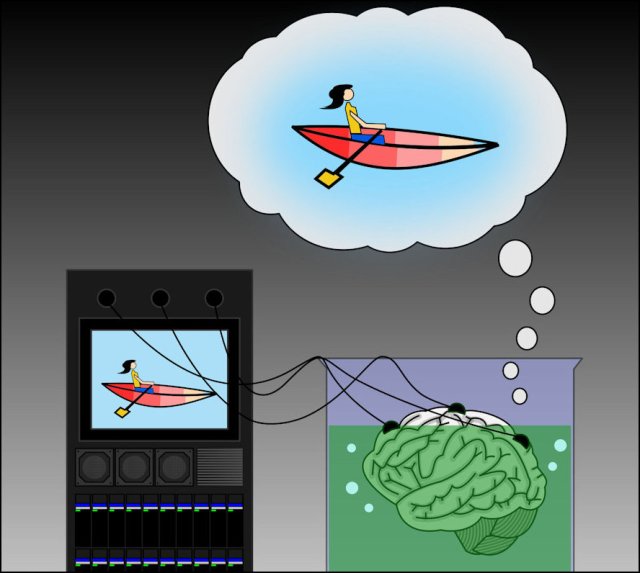
Prophetic Brains in a Vat

Brain-in-a-vat-01r1

My latest blog post for The Jerusalem Post:

“Brains in a vat”?

It sounds like the plot of a bad science fiction movie. But it might hold a key to understanding prophetic insight.

The basic idea was around even before the writing of the Torah. In fact, Moses’ encounter with God on Sinai incorporates it: The idea that there are, or might be, aspects of reality that transcend our ability to perceive or understand.

On Sinai, Moses cannot see God’s face, only His back; and the rest of the Israelites cannot even see that.1 Across the Mediterranean, in ancient Athens, Plato wrote about people who had lived their entire lives chained in a cave, and knew the outside world only by the shadows it cast upon the cave wall.2 In Medieval Egypt, the Jewish sage Saadia Gaon realized that our minds were unable to comprehend the infinite.3

The late Hilary Putnam, author of Jewish Philosophy as a Guide to Life, explained it this way in modern terms:

“Imagine that a human being has been subjected to an operation by an evil scientist. The person’s brain has been removed from the body and placed in a vat of nutrients which keeps the brain alive. The nerve endings have been connected to a super-scientific computer which causes the person whose brain it is to have the illusion that everything is perfectly normal. There seem to be people, objects, the sky, etc., but really all the person is experiencing is the result of electronic impulses travelling from the computer to the nerve endings.”4

What if we are all brains in a vat?

Putnam takes it a step further: Suppose that we are all just brains in a vat, and moreover, that we have always been in the vat. When we perceive and refer to “solid objects” around us, all we are really perceiving are the illusions created by the computer.

Could we know that we were not walking around, perceiving things, and doing things? That we didn’t even have physical bodies, and were instead just brains in a vat? Putnam says no:

“The supposition that we are actually brains in a vat, although it violates no physical law and is perfectly consistent with everything we have experienced, cannot possibly be true. It cannot possibly be true because it is, in a certain way, self-refuting.”5

There are three problems with it.

First, all the things we know about — trees, cars, our bodies, and so forth — are illusions created by the computer. The words we use refer only to those illusions. As a result, when we talk about those things, we are not actually mistaken. We think they are “real,” and in the only sense that the word “real” has meaning for us, they are real. The illusions are all we know. We just don’t know that they are illusions. If we talk about trees, for example:

“There is no connection between the word ‘tree’ as used by these brains and actual trees. They would still use the word ‘tree’ just as they do, have just the images they have, even if there were no actual trees.”6

Second, if the computer program works correctly, the illusory world of the vat contains no strong evidence that anything else exists outside it.

Third, because all of our ideas and language refer only to our illusory world, we lack even the concepts to think about anything outside it. Our meaning for “outside” is based on our perception of spatial relationships in the illusory world of the vat. It only has meaning for us in that context. The outside world might exist, but we couldn’t know or understand anything about it. We lack both the evidence and the required concepts.

Prophetic insight thinks outside the vat

So how does that help explain prophetic insight?

Let’s add one element to Putnam’s scenario. Suppose there is an electric generator outside the vat. It powers the computer, but it also creates a weak magnetic field that extends into the vat.

A few of the brains are particularly sensitive, and the magnetic field causes some of their neurons to fire. As a result, they have strange experiences that they can’t explain in terms of the vat’s language and conceptual scheme. They resort to images, poetry, and metaphor to express what they’ve experienced. It’s a version of prophetic insight.

Of course, that story doesn’t prove anything. It’s just an analogy. But it shows how prophetic insight might work, and why prophetic visions often can’t be expressed in ordinary terms. In the nature of the case, it can’t be proven or disproven by science. You either believe it or you don’t.

A scientific analogy

There is, however, a similar scientific example. In 1964, physicists Arno Penzias and Robert Wilson at Bell Labs were trying to eliminate radio interference with communications satellites. They discovered a faint cosmic background radiation that is now believed to be a remnant of the “big bang” – a huge explosion about 13.8 billion years ago that created the physical universe.7

The cosmic background radiation is a faint echo of the universe’s beginning. We can’t normally detect it, but if we point the right instruments in the right direction, we can.

What about our own built-in instrument: our minds? We can’t normally detect a reality that transcends our universe. But if we point our minds in the right direction, and through prayer, meditation, or other means tune to just the right spiritual frequency, can we hear the voice of God? Is that what Moses and other ancient prophets did?

Maybe. It’s worth thinking about. Even if you have to “think outside the vat.”

Works Cited

Cornford, F., translator (1945), The Republic of Plato. Oxford: Oxford University Press.

Greene, B. (2003), The Elegant Universe. New York: W.W. Norton & Company. Kindle edition.

Putnam, H. (1981), Reason, Truth, and History. Cambridge: Cambridge University Press. Kindle edition.

Putnam, H. (2008), Jewish Philosophy as a Guide to Life. Bloomington: Indiana University Press.

Rosenblatt, S., translator (1948), Saadia Gaon: The Book of Beliefs and Opinions. New Haven: Yale University Press.

##Footnotes


  1. Exodus 33:18-22. 
  2. Cornford, F. (1945), p. 227ff (Chapter 25 of The Republic). 
  3. Rosenblatt, S. (1948), pp. 98ff (Treatise II: “Concerning the Belief That the Creator of All Things, Blessed and Exalted Be He, Is One”). 
  4. Putnam, H. (1981), loc. 180. 
  5. Ibid, loc. 190. 
  6. Ibid, loc. 282. 
  7. Greene, B. (2003), loc. 5546. 
Posted in Epistemology, Jewish Philosophy, Judaism, Philosophy, The Jerusalem Post | Tagged , , , , , , , , , , | Leave a comment

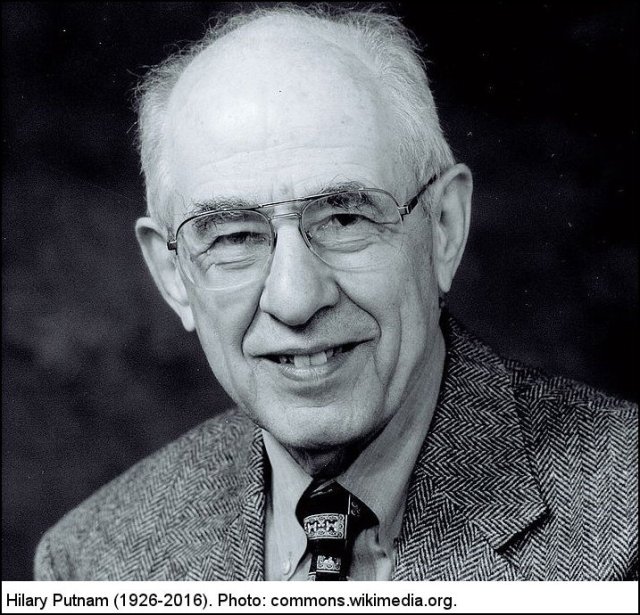
Putnam’s Predicament — And Ours

Hilary-Putnam

My latest blog post for The Jerusalem Post:

“You can’t have your cake and eat it, too.”

That was one of my father’s favorite adages, second only to “talk is cheap.” It means that if you eat your cake, you don’t have it anymore. You must choose one or the other. You can’t have both.

The cake adage came to mind when I was thinking about Hilary Putnam (1926-2016), the eminent philosopher of science who died earlier this month. In his childhood, he had some cake: Judaism. As he grew up, he traded it for a fully scientific view of the world. And then he realized that with or without science, the world wasn’t nearly as good without cake.

But here’s the good news: In some situations you can, after all, have your cake and eat it too. You can be both a scientific rationalist and a faithful Jew.

Religion and Rationality

As an adult, Putnam reconnected with the Jewish faith he had left behind in his youth. His son wanted to have a bar mitzvah. In helping his son prepare, Putnam — to his surprise — found great personal meaning in his erstwhile faith. He needed somehow to make peace between his secular understanding of the universe and the truth he found in Judaism:

“As a practicing Jew, I am someone for whom the religious dimension of life has become increasingly important … Those who know my writings from that period may wonder how I reconciled my religious streak … and my general scientific materialist worldview at that time. The answer is that I didn’t reconcile them. I was a thoroughgoing atheist, and I was a believer. I simply kept these two parts of myself separate.”1

Putnam found truth and value in both frames of reference, but he felt that he could not integrate them into a single logical system so he kept them separate.

Ironically, he had all the pieces that he needed to solve the puzzle. I think that he solved it without realizing he’d done so.

Twenty-seven years earlier, he had written about what it meant for beliefs to be rational:

“The only criterion for what is a fact is what it is rational to accept. I mean this quite literally and across the board; thus if it can be rational to accept that a picture is beautiful, then it can be a fact that the picture is beautiful … A statement can be rationally acceptable at a time but not true …”2

Putnam had a broad concept of rationality.3 Instead of always requiring logical proof or empirical evidence, he thought that beliefs were rational if they were reasonable in the relevant situations. Sometimes, that did require logical proof or empirical evidence — but not always.

Rationality Depends on Purpose

What’s reasonable depends on the context and on our purpose. If you want to bake a cake, you need beliefs based on logic and empirical evidence: “The correct procedure is: Preheat the oven to 350°F. Spray a pan with nonstick spray. Dust with cocoa powder …”

But what if you want to enjoy a cake? Enjoyment cannot be summarized in a recipe. You don’t need logic or empirical evidence. You just need to have the experience and not worry about it.

Enjoying God’s presence is somewhat similar. It’s not about logic or empirical facts. On this point, Putnam seems to have agreed with Ludwig Wittgenstein:

“Wittgenstein, like Kierkegaard, would have regarded the idea of ‘proving’ the truth of the Jewish or the Christian or the Muslim religion by ‘historical evidence’ as a profound confusion of realms, a confusion of the inner transformation in one’s life that he saw as the true function of religion, with the goals and activities of scientific explanation and prediction.”4

The purpose of religious faith is different from that of scientific investigation, and even from that of simple things like finding our way to the grocery store. The latter try to achieve specific goals in the physical world, but the goal of religious faith is moral and spiritual. It’s not a different way of doing things in the world: It’s a different way of seeing, feeling, and living in the world. The question of its scientific truth is irrelevant, just as the question of moral and spiritual value is irrelevant in science.

Because the goal of religious faith is to improve us morally and spiritually, it is reasonable to have religious beliefs that help do it. Judaism does not tell us how to get to the grocery store, but it tells us to treat other people honestly, kindly, and with respect.

Science Isn’t the Only Truth

Notice something else that Putnam said: “A statement can be rationally acceptable at a time but not true.”

There, he uses “true” to mean “true according to science,” but the implication remains the same: It’s rational to believe things in a religious context that you wouldn’t believe in a scientific context. That’s because the purpose and the basic worldview are different. And scientific truth isn’t the only kind of truth. If it were, then truth itself would not exist because it’s not a scientific concept:

“A self-refuting supposition is one whose truth implies its own falsity. For example, consider the thesis that all general statements are false. This is a general statement. So if it is true, then it must be false. Hence, it is false.”5

If scientific truth is the only kind of truth, then scientific truth is impossible.6 Hence, there are other kinds of truth. Some of those truths are the Jewish tradition and our way of life.

Cake. It’s good for you. Enjoy it.

Works Cited

Putnam, H. (1981), Reason, Truth, and History. Cambridge: Cambridge University Press. Kindle edition.

Putnam, H. (2008), Jewish Philosophy as a Guide to Life. Bloomington: Indiana University Press.

Footnotes


  1. Putnam, H. (2008), p. 3. 
  2. Putnam, H. (1981), loc. 54. 
  3. Putnam lived to be almost 90 years old and changed his mind almost as often as Bertrand Russell, who lived to be 98. However, reasonableness was a recurring theme for Putnam. 
  4. Putnam, H. (2008), pp. 13-14. 
  5. Putnam, H. (1981), loc. 218. 
  6. This is my argument, not Putnam’s. He might have disagreed. 
Posted in Bible, Epistemology, Jewish Philosophy, Judaism, The Jerusalem Post | Tagged , , , , , , , , , | 2 Comments

How to Think About Transgenderism

My new blog post for The Jerusalem Post:

In a scene from an old Monty Python movie, a mother has just given birth. She asks the doctor, “Is it a boy or a girl?” He replies, “I think it’s a bit early to start imposing roles on it.”

Back in the 1980s, that was a joke. Today, it’s a reality. Now that gay marriage is a settled issue, “transgender” is the new cause célèbre. And Jewish or Gentile, most people still aren’t quite sure how to understand it.

Reform Jews are on board because it seems compassionate. Orthodox Jews aren’t sure how it squares with Torah. Conservative Jews are having an anxiety attack from acute ambivalence.

As almost everyone knows by now, transgender people say that their feelings about what they are do not match the biological sex of their bodies. Is that a real thing? Is it moral? Is it psychologically healthy, or is it a mental illness?

I’m neither a Rabbi nor a Posek, but I can tell you a few things that are relevant.

The first and most important is: All people are children of God. Whether or not we agree with them, we must treat them with respect, kindness, and consideration.

Making Our Concepts More Complicated

Transgenderism is confusing partly because it complicates our conceptual scheme for understanding the world. On this point, the Jewish sage Saadia Gaon can give us some insight. He thought that belief was an accurate representation of a reality outside the mind of the believer:

“A true belief consists of believing a thing to be as it really is; namely, that much is much, and little is little, and black is black, and white is white, and that what exists exists, and what is non-existent is non-existent.”1

In order to believe “that things are as they really are,” we need clearly-defined concepts. A whole number is odd or even. A light switch is on or off. A dog is not a cat. If you’re confused about any of those things, then your confusion is easy to resolve.

Until recently, “male” and “female” were considered perfectly clear. Unless you were physically deformed, you had to be one or the other. You might be gay or straight, average or weird, an effeminate man or a masculine woman, but you were still male or female. There was no third option. Judaism in particular is what computer programmers would call “strongly typed,” in that its tradition and even the Hebrew language strictly adhere to a two-sex conceptual scheme.

Transgenderism rejects that conceptual scheme, throwing the doors open to all kinds of new variations: transgender, genderqueer (which seems to have several different meanings), and over 50 other sexual categories.

That challenges our traditional ways of looking at the world. Such challenges tend to provoke a hostile response. We identify our ideas with ourselves. If someone rejects our ideas, we often feel as if we have been attacked. It’s a major cause of hostility toward transgender people, and it has no particular connection to transgenderism.

Sexual Dimorphism

One of the fictions of our era is that men and women differ only in their reproductive organs. It’s not true. Male and female brains differ in a variety of ways. Those differences tend to affect how they perceive and feel about the world, as well as the areas in which they are specially talented. On average, their bodies differ greatly as well.

Relevant to transgenderism is this: Whether we have male (XY) or female (XX) chromosomes, the sex of our brains is greatly influenced by the hormones to which we are exposed in our fetal development. As a result,

”It is possible to have genetic males with female brains and genetic females with male brains.”2

Some people who think they’re transgender are probably in that situation. Their brains tell them they’re a sex different from their bodies. What to do about it is a separate question.

How Sexual Traits Vary

Masculinity and femininity, like most human traits, are normally distributed. That’s a statistical concept meaning that the degrees to which different people are masculine or feminine cluster in a specific way around an average value. Sixty-eight percent of people are close to the average: they’re “normal.” Ninety-five percent are somewhat close to the average. Ninety-nine point seven percent are at least within driving distance of the average. That leaves three-tenths of one percent of the population.

Of the 0.3 percent, half are either very masculine males or very feminine females. That leaves 0.15 percent who are the transgender people. Their psychological makeup is almost entirely like that of the opposite sex. In a population of 100 million, you would have about 150,000 transgender people and 99.85 million who are not transgender.

Should the 99.85 million change their sexual concepts to accommodate the 150,000? That’s above my pay grade to answer, but it’s a legitimate question. Conventional sexual categories work well for most people. Having 50-plus sexual categories works less well for them. It’s a “judgment call” that each society might make through the democratic process.

Defining Mental Illness

There’s one way in which transgenderism is especially interesting. Until the late 1960s, it was legitimate to call transgenderism a “mental illness,” but it can no longer be called that.3

Why? A reasonable definition of “illness” is that it’s a biological or psychological condition “adversely affecting a person or group of people.”4 Until the development of sex-change surgery, transgendered people were condemned to suffer without being able to do anything about it. They were ill. Now, they have a “cure.” They can do something about it.

If they are physically and psychologically healthy after changing their sex, they are still transgendered but no longer ill. Technology has changed the status of transgenderism. It is no longer an illness.

Works Cited

Bear, M. et al (2007), Neuroscience: Exploring the Brain. Baltimore: Lippincott, Williams, & Wilkins. Kindle edition.

Rosenblatt, S., translator (1948), Saadia Gaon: The Book of Beliefs and Opinions. New Haven: Yale University Press.

Soanes, C. et al (2009), Oxford Dictionary of English, Second Edition. Oxford: Oxford University Press. Kindle edition.

Footnotes


  1. Rosenblatt, S. (1948), p. 14. 
  2. Bear, M. et al (2007), loc. 14768. 
  3. Some transgender people are mentally ill at least in the sense of being depressed, since their attempted-suicide rate is nine times higher than average. Whether their mental illness causes their transgenderism or results from social difficulty probably depends on each individual case. See “Transgender Study Looks at ‘Exceptionally High’ Suicide-Attempt Rate,” Los Angeles Times, January 28, 2014. 
  4. Soanes, C. et al (2009), loc. 198858. 
Posted in Jewish Philosophy, Judaism, The Jerusalem Post | Tagged , , , , , , , , | Leave a comment

Could You Be Happier?

Combined

“I could be happier.”

How many of us have occasionally thought that?

While driving to work the other day, I did. And then I realized it’s not true.

I’ve done a few things of which I’m proud. There is more I want to do. And although God has blessed me with almost everything truly important to me, there are still a few more things I want.

But I couldn’t be happier.

In the Jewish tradition, happiness is most reliably found in life of justice: justice both external and internal, both in our actions and in our minds. It naturally includes reverence for God and respect for other people. It is guided by love. That agrees with the teachings of Jewish and Gentile sages throughout history. As Abraham Joshua Heschel observed:

“Judaism is concerned with the happiness of the individual as well as with the survival of the Jewish people, with the redemption of all men and with the will of one God. It claims, however, that happiness is contingent upon faithfulness to God …”1

Rebbe Menachem Mendel Schneerson agreed:

”The only way to reach true happiness is through spiritual growth and achievement. And that means giving to others, loving and sharing, finding a deeper meaning in everything you do, and recognizing G-d in all your ways.”2

What if I got everything I wanted? Would that make me happier?

No. It would make me miserable. To be alive means to be striving, to be going somewhere, to have desires that are positive, fulfilling, and constructive. If I got everything I wanted, I wouldn’t be going anywhere. I wouldn’t be peering over the horizon, trying to do more than I had done and to become more than I had been. I’d be dead in the water. The only thing that could put wind in my sails would be some new wants, new goals, new reasons to move forward.

John Stuart Mill, the 19th-century philosopher and economist, knew it. Even though he was a success, he reached a point in his early twenties when it all seemed meaningless:

“I put the question directly to myself: ‘Suppose that all your objects in life were realized; that all the changes in institutions and opinions which you are looking forward to, could be completely effected at this very instant: would this be a great joy and happiness to you?’ And an irrepressible self consciousness distinctly answered, ‘No!’ My heart sank within me: the whole foundation on which my life was constructed fell down. All my happiness was to have been found in the continual pursuit of this end. The end had ceased to charm, and how could there ever again be any interest in the means? I seemed to have nothing left to live for.”3

Like all of us, Mill needed something he cared about to draw him forward. He gradually found his way again, first through poetry, then literature, and finally — like many men — through the love of a good woman.4 He learned that happiness could not be found by brooding about our feelings, but instead by focusing on the good we can do:

”Ask yourself whether you are happy, and you cease to be so. The only chance is to treat, not happiness, but some end external to it, as the purpose of life. Let your self-consciousness, your scrutiny, your self-interrogation exhaust themselves on that; and you will inhale happiness with the air you breathe, without dwelling on it or thinking about it.”5

Or as Heschel said, taking a wider viewpoint:

”The world is torn by conflicts, by folly, by hatred. Our task is to cleanse, to illumine, to repair. Every deed is either a clash or an aid in the effort of redemption. Man is not one with God, not even with his true self. Our task is to bring eternity into time, to clear in the wilderness a way, to make plain in the desert a highway for God. ‘Happy is the man in whose heart are the highways.’ (Psalm 84:6).”6

Earthly happiness is not found at the end of the highway. It’s found in the good we do along the way.

Works Cited

Heschel, A.J. (1976), God in Search of Man: A Philosophy of Judaism. New York: Farrar, Straus and Giroux.

Mill, J.S. (1873), Autobiography. Reprinted in Eliot, C., editor (1937), The Harvard Classics, Volume 25. New York: P.F. Collier & Son.

Jacobson, S. (2002), Toward a Meaningful Life: The Wisdom of the Rebbe Menachem Schneerson. New York: HarperCollins.

Footnotes


  1. Heschel, A.J. (1976), p. 349. 
  2. Jacobson, S. (2002), p. 110. 
  3. Mill, J.S. (1873), p. 86. 
  4. Mill’s wife, Harriet Taylor Mill, was a remarkable woman. Some philosophers suspect she was the actual author of what is now Mill’s best-known work, On Liberty. They think it was published under her husband’s name because his fame guaranteed an audience. Most likely, she also inspired her husband’s energetic advocacy of equal rights for women. 
  5. Mill, J.S., op cit, p. 91. 
  6. Heschel, A.J., op cit, p. 357. 
Posted in Jewish Philosophy, Judaism, The Jerusalem Post | Tagged , , , , , , , , , | Leave a comment