Biblical Writers Were Math Nerds

Golden-Ratio-combined

My latest blog post for The Jewish Journal:

We normally look to the Bible for morals, religious inspiration, and history. But are you excited to learn that there’s some mathematics in there, too?

If you’re a nerd like me, the answer is yes. It’s very exciting. Only chocolate syrup and whipped cream could make it better.

Most people’s favorite number is pi because it’s one of the only things they remember from geometry class in school. Pi is the ratio between the circumference and diameter of a circle, about 3.14159. The decimal digits actually go on forever because pi is irrational, meaning it can’t be written as a ratio of whole numbers. One book explains that:

“An almost cultlike following has arisen about pi. Web sites report its ‘sightings’, clubs meet to discuss its properties, and even a day on the calendar is set aside to celebrate it, that being March 14, which coincidentally is also Albert Einstein’s birthday.” (Pi: A Biography of the World’s Most Mysterious Number)

The Bible refers to pi in two places. They seem to give the same number for pi. However, their wording differs slightly, by just one letter. The Vilna Gaon thought the discrepancy concealed a mystery.

The first reference to pi is in 1 Kings 7:23:

“Then he made the tank of cast metal, 10 cubits across from brim to brim, completely round; it was 5 cubits high, and it measured 30 cubits in circumference.”

The ratio of the circumference to the diameter gives pi a value of 3. Kind of close, but not very.

The second reference in 2 Chronicles 4:2 is almost identical, but the Hebrew text omits the letter “heh” at the end of the word (qof, vav, heh) for circumference.

And there’s where the mystery arises. Using gematria, the Vilna Gaon calculated the first spelling’s value as 111 and the second as 106. Dividing 111 by 106 gives 1.0472. Multiplying the Bible’s pi value of 3 by 1.0472 gives — wait for it! — 3.1416, which is the rounded value of pi. Just as you’d expect if, as some scientists argue, “God is a mathematician.”

The Bible has some other mathematical references, but that one is the most interesting. And as long as we’re talking about the Ancient Near East, the Egyptians had a neat way to calculate the area of a circle, and that also gives a value of pi.

You might remember that the formula for the area of a circle is pi times the square of the radius, and that the radius is half the diameter.

Ancient Egyptians didn’t have a science of mathematics, but they had a lot of practical tricks to calculate land areas for surveying. To calculate the area of a circle, they drew a square whose sides were eight-ninths of the circle’s diameter. Then the area of the square was close enough to the area of the circle that they couldn’t detect any difference.

And if you work it out, they had a value for pi that was, like the Bible’s, pretty darned close:

  • The diameter of a circle is two times the radius, so each side of the square was 8/9ths times twice the radius, or 16/9ths times the radius.
  • The area of the square was 16/9ths of the radius multiplied by 16/9ths of the radius, which gives 256/81 times the radius squared.
  • And 256/81 equals 3.1605, a little off the rounded pi value of 3.1416. But as they say in Washington DC, “it’s close enough for government work.”

If the Egyptians had thought of their method as a mathematical formula, theirs was 3.1605 times the radius squared — very close to ours.

Other Biblical references to mathematics are little strained. In life, the Golden Ratio (1.618..) occurs frequently, especially in art and architecture. In the Bible, Exodus 25:10 says that God commanded Noah to build the Ark of the Covenant measuring 2.5 by 1.5 cubits, and 2.5 divided by 1.5 is 1.666. Some writers say it refers to the Golden Ratio, but unless the Vilna Gaon came up with something like he did with pi, it doesn’t look like it to me.

And the Bible just doesn’t have my favorite number, Euler’s number (2.71828..). I’ve learned to live with that little disappointment.

Posted in Bible, Jewish Philosophy, Judaism, The Jewish Journal | Tagged , , , , , | 2 Comments

Tisha B’Av Turns Tragedy into Victory

Tisha-B-Av-01-combined

My latest blog post for The Jewish Journal:

“They tried to kill us. We won. Let’s eat.”

According to the late comedian Alan King, that’s the explanation of most Jewish holidays.

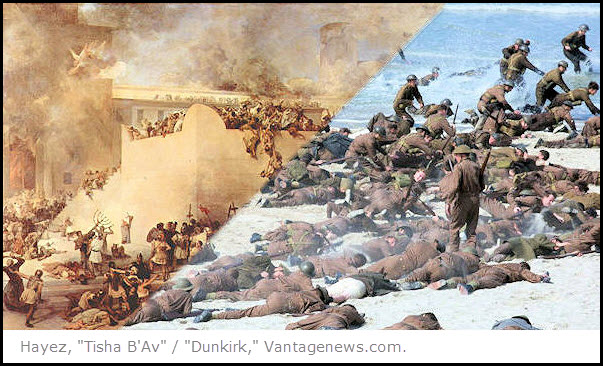
It’s particularly relevant to the fast day of Tisha B’Av, which is a few days from now. On Tisha B’Av, we mourn the destruction of the First and Second Temples, along with other tragedies that have befallen our people.

But this year, the approach of Tisha B’Av has me thinking of — Dunkirk. A big-budget movie about it is scheduled for release next summer.

If you’ve never heard of Dunkirk, or what makes it significant, don’t worry. About half of the U.S. population thinks that World War II occurred shortly after the Civil War. You’re way ahead of the game if you can find France on a map.

In May 1940, the German Army trapped 10 divisions of the British Army at Dunkirk, an area in the North of France that was directly across the English Channel. Hitler ordered the Luftwaffe to destroy the British forces, which had no way to escape from the French coast back to England. If the Luftwaffe had succeeded, Germany might have won the war.

Instead, the British people set sail in their own private boats — fishing boats, cargo ships, rowboats, anything that could make it across the channel and back — to rescue “their boys” from the beaches of Dunkirk. Almost 800 boats made the trip, over and over, under heavy fire from German planes and artillery. They rescued almost 340,000 British soldiers from certain death. Many of the rescuers died in their heroic mission.

By military standards, the Battle of Dunkirk was a crushing defeat. But “Dunkirk!” became a symbol of British people’s courage, unity, and determination to prevail against any odds.

I’m sure you see where this is going. If anything on earth has preserved the Jewish people for millennia, it’s courage, unity, and determination to prevail against any odds. Tisha B’Av, just like Dunkirk, takes something bad and turns it into something good.

According to our tradition, the first tragedy to occur on Tisha B’Av was in 1313 BCE when the Israelites failed to trust God during the Exodus. As a result, they had to wander for another 38 years before entering the promised land. On Tisha B’Av in 423 BCE, the Babylonians destroyed the First Temple, and on the same date in 70 CE, the Romans destroyed the Second Temple. It was on that date in 1290 CE that our people were expelled from England and on the same date in 1492 that they were expelled from Spain.

We must allow tradition a bit of poetic license, since archaeology finds no evidence of the 1313 event and says that the First Temple was destroyed in 586 BCE instead of 423 BCE. Only about 2,000 of us were expelled from England, peacefully, and the Spanish expulsion edict wasn’t issued on Tisha B’Av. The value of a religiously helpful story trumps (pardon the expression) a few minor factual inaccuracies.

Tisha B’Av, just like Dunkirk, shows how a people can turn tragedy into victory by telling a new story about it and giving it a new meaning. Instead of being a weakness, the tragedy becomes a source of strength:

“A story told by English Jews, perhaps apocryphal, tells of a prominent nineteenth-century British politician who was walking near a synagogue on Tisha B’Av and heard wailing coming from inside. He looked in and was informed that the Jews were mourning the loss of their ancient Temple. Deeply impressed, the politician remarked, ‘A people who mourn with such intensity the loss of their homeland, even after two thousand years, will someday regain that homeland.’” (Joseph Telushkin, Jewish Literacy, p. 669)

What applies to groups also applies to individuals. You can turn your personal tragedies into victories by telling yourself a new story about them: a story in which you are no longer a passive victim but are instead a survivor, who suffered but became a better and stronger person as a result.

They tried to kill us. We won. Let’s eat (just not on Tisha B’Av).

Posted in Bible, Jewish Philosophy, Judaism, Modern Orthodoxy, The Jewish Journal | Tagged , , , , , , | 4 Comments

Is It Moral to Have Children?

TJFS-org

My latest blog post for The Jerusalem Post:

The question is strange but not crazy: Should we have children? Are there cases when we shouldn’t?

Judaism and common sense agree that generally we should and sometimes we shouldn’t.

But there are bigger issues involved. In her book The Risk of a Lifetime: How, When, and Why Procreation May Be Permissible, philosopher Rivka Weinberg seems to over-think all of them.

The essence of her argument is that life can be pretty darned awful, and we should not impose that risk on an unsuspecting would-be child without sufficient moral justification. Two things can justify it:

  • Correct motivation: You should have “the desire to engage in the parent-child relationship as a parent.” She argues that you can’t do it to benefit the child because the child doesn’t yet exist, and you may not do it to benefit society because that treats the child as a means to something else.
  • Reasonable risk: Having children “is permissible when the risk you impose [on the child] would not be irrational for you to accept as a condition of your own birth.” This is a fancy re-statement of Rabbi Hillel’s advice: “If you wouldn’t want it done to you, then don’t do it to anybody else.” Philosopher John Rawls made a similar argument more generally in his classic book A Theory of Justice.

I don’t mean to make light of Weinberg’s arguments. They’re totally legitimate from a philosophical point of view. Anything we do should be justifiable in principle, even if we rarely get challenged to justify it. However, it would not occur to most people that activities in which we have engaged since the dawn of the species require justification, unless some obvious harm is involved.

The big-picture answer to Weinberg’s concern involves trees, forests, and what it means to believe in God, if you do.

Which is real, the trees or the forest? Most people today unconsciously think that only the trees are real. The forest is just something we made up.

Likewise, contemporary attitudes enshrine the individual person’s desires and welfare above all else, even above biological reality. As a result, the idea of having children to benefit nation, society, or family seems vaguely suspect, perhaps even fascist.

But in fact forests do exist, albeit not in the same way as individual trees. So do nations, societies, peoples, and families have an existence beyond that of their individual members. It’s just as reasonable to consider the welfare of society or the Jewish people as to consider the welfare of an individual not-yet-conceived child who might have a pleasant life or a difficult one. And valuing the welfare of the child as an individual is entirely consistent with also valuing the contributions he or she might make to society.

But what about God? Where does He come into the equation?

Well, if you’re an Orthodox believer, it’s pretty straightforward: “To sire children is to fulfill a mitzvah, the Biblical commandment ‘Be fertile and increase.’ … to avoid having children is to negate a Divine commandment.” (To Be a Jew: A Guide to Jewish Observance in Contemporary Life)

If you’re not an Orthodox believer, it’s a little more complicated but not impossibly so. What does it mean to say that you believe in God, if God is a Being utterly transcendent and incomprehensible?

Believing in the existence of dogs or houses is easy: You can see them and understand them. If you say “I believe in the existence of houses,” it’s perfectly clear what you mean. But believing in God isn’t like that. You can’t see God and you can’t understand Him. If believing in God means anything, it means that you believe the universe is moral and that good is more powerful than evil.

A moral universe means that the chance of a child’s life being good or bad is not 50-50: It’s more likely to be good (in some way) than to be bad. Under normal circumstances, not having children more probably deprives them of goodness than subjects them to evil.

Of course, circumstances aren’t always normal: Even the Bible has God warning Jeremiah not to have children because of the dire fate they would suffer (Jeremiah 16:1-4). If you’re in a war zone or would pass on a hereditary disorder, you have to think seriously about the risks for your child.

But in circumstances that are more benign, having children is not only moral but is a blessing: to them, to you, to the Jewish people, and to the God who loves them.

Posted in Jewish Philosophy, Judaism, Philosophy, The Jerusalem Post | Tagged , , , , , , , | 4 Comments

“Why is everybody wrong except me?”

My latest blog post for The Jewish Journal:

“These are the times that try men’s souls,” wrote American founder Thomas Paine.

Our own times are more likely to try people’s patience than their souls. We can’t stop shouting at each other. If it’s not about the presidential election, it’s about Israel. If it’s not about Israel, it’s about Ukraine. If it’s not about any of those things, it’s about who gets to use which bathroom.

Many people today are full of passionate intensity, and not only, as William Butler Yeats said, “the worst.” Good people, educated and reasonable, disagree about issues of consequence. In the most tragic cases, argument descends into bitterness. Friendships and family relationships are sundered.

We cannot eliminate disagreement, nor should we try. But if we understand why we disagree, we can minimize the bitterness and become more tolerant of others.

Consider an example that’s on many people’s minds: Who should be elected president? There are two main choices. Choosing one requires assessing the candidates’ personal character, the merits of their proposed policies, and how accurately they understand the world.

Most of us rely on the campaigns’ carefully crafted images and sound bites to assess the candidates’ character. We assess their policies based on what we think is desirable, moral, and achievable. We decide the latter mostly through memes and mental images, but also with one eye on what our peer group regards as acceptable opinion.

In the best case, you and a friend disagree. You both respect evidence, respect each other, and sincerely want to discover the truth. You both start with unreliable information, simplified mental pictures, and biases about issues of which you have little or no first-hand knowledge. Your most fundamental beliefs are so much a part of you that you don’t even realize you hold them.

Think about it. Is Hillary Clinton or Donald Trump a good person? A bad person? Given that a small army of propagandists stands between you and them, how sure can you be? Should you support policy X? Making that decision requires you to understand policy X, know the relevant facts, predict reliably about X’s results, and assess its morality when all factors are considered.

If you have a day job — or even if you don’t — you probably can’t do it. At best, you can learn a few things to support what you believe on instinct. And what you believe on instinct is influenced dramatically by your brain.

The troubling fact is that human intelligence didn’t evolve to analyze and evaluate complex political or economic issues. It evolved to help us survive and pass on our genes to the next generation. Period.

Biologists call it “the evolutionary legacy principle:” Our brains evolved to cope with prehistoric and pre-technological situations. We use essentially the same cognitive methods to cope with modern situations, and it often works poorly for them.

The biggest single flaw in our cognitive machinery is “us versus them” thinking.

In small primitive tribes, it was helpful to cooperate with “us” and to be hostile or suspicious toward “them” — that is, toward outsiders who weren’t members of our group. Compassion was reserved for other members of our own group, since compassion toward outsiders could get us or other group members killed.

In modern societies, it’s much more difficult and much less useful to decide who is “us” and who is “them.” But our caveman cognitive machinery still putters along as if nothing had changed. If we feel that people who believe X or support candidate Y are “them,” then we tend to disbelieve anything they say. We consider them so despicable or morally unworthy that their feelings and welfare are unimportant. Then we are in danger of becoming cruel and vindictive, as are they.

Our best option is to remember that all of us have flaws and biases, but none of us deserves to be presumed evil and unworthy of consideration.

Let’s listen to each other, pay attention to each other’s concerns, and respect even those with whom we strongly disagree.

Posted in Judaism, Philosophy, The Jewish Journal | Tagged , , , , | Leave a comment

Pianko and Peoplehood

My new blog post for The Jewish Journal:

Are we not one people, but many?

Today’s Jewish population is incredibly diverse. World Jewry includes people of all races and nationalities. It includes “honorary members” such as interfaith spouses and children who are not Jewish and don’t intend to convert. We disagree, often bitterly, about belief and observance. The headline “Orthodox rabbi says Reform isn’t Jewish” has become a regular occurrence.

It’s hard to find the unity in all that diversity. Some influential writers say we shouldn’t try.

We commonly think that Jewish peoplehood is an old idea, but Jewish Studies scholar Noam Pianko argues that it’s a new one. In his book Jewish Peoplehood: An American Innovation, he traces the term’s origin to American Zionist Mordecai Kaplan in the 1940s.

Kaplan wanted to build support for Zionism, and until 1942 he did it by talking about Jews as a nation. However, he worried that calling Jews a nation would invite accusations of dual loyalty. He needed an alternative term without the anti-Semitic implications. By 1948, “peoplehood” had become his term of choice. Pianko observes that it was hardly used at all before then, and it did not appear in English dictionaries until the late 1960s.

In Pianko’s view, the idea of peoplehood was too closely related to that of nationhood. It misled us into looking for a Jewish unity that wasn’t there. To replace it, he proposes “peoplehood in a new key” that doesn’t require unity.

Instead of asking who is Jewish, what values unite us, and how we differ from non-Jews, he would ask what we do in the Jewish community and what parts of Judaism are meaningful to us. Pianko sees it as a decentralized “neighborhood model” of Judaism:

“A neighborhood model [seeks] to build collective consciousness by recognizing the organizing power of specific groups to develop different, and sometimes even mutually incompatible, visions of what it means to be part of the Jewish people. A sense of connection to a larger entity is generated most authentically— and enduringly— from the bottom up.” (Jewish Peoplehood)

“Different neighborhoods, with incompatible values, doing different things.” That suggestion made me uneasy. It sounded too much like something from another book, this one by renowned biologist Ernst Mayr:

“What happens in the isolated population? There may be new mutations, certain genes may be lost owing to accidents of sampling, recombination results in the production of a diversity of new phenotypes … The isolated population will diverge increasingly from the parental species. If this process continues long enough, the isolated population changes enough to qualify as a different species.” (What Evolution Is)

In biology, the neighborhood model results in the evolution of new species and the possible disappearance of the parent species. In the case of the Jewish people, it might not work out that way, but the analogy is uncomfortably close.

To understand each other, people must have something in common. To be loyal to each other, they must have a relationship. Explicitly separate Jewish neighborhoods, doing different things and holding incompatible values, do not have that kind of relationship. They will not long remain united by nothing but a name. Soon, the name itself will disappear. And then what is left?

Why should we care if our people continue to exist as a distinct group? Does it really make a difference?

Yes, it makes a big difference. Goodness in human life never appears in the abstract. It always appears in specific social, religious, and historical contexts.

Our people and tradition have brought goodness into the world in unique ways that no other group can replace. For us to give up existence as a separate people and forsake our unique tradition would deprive not only us but everyone else in the world of something precious that only we can provide. “Peoplehood” might be a new word, but our people have been around for millennia. That’s not new at all.

All humans band together in groups that provide a safer, richer, and happier life than being alone. It gives both our families and us as individuals a better chance to survive and prosper. Our ancestors struggled to give us that chance. We should pay it forward to our children and to the generations that follow.

Political philosopher Edmund Burke said it well: “History is a pact between the living, the dead, and the yet unborn.”

Posted in Jewish Philosophy, Judaism, The Jewish Journal | Tagged , , , , , , , , , , | Leave a comment

Gloomy Gus Mendelssohn

gloomy-gusses

My latest blog post for The Jerusalem Post:

Do we survive bodily death?

There are reasons to think so, but nothing that qualifies as proof. Perhaps the most sensible attitude (because it’s mine) is that if we do survive death, then we’ll find out someday. If we don’t survive death, then we’ll never know, so it won’t bother us.

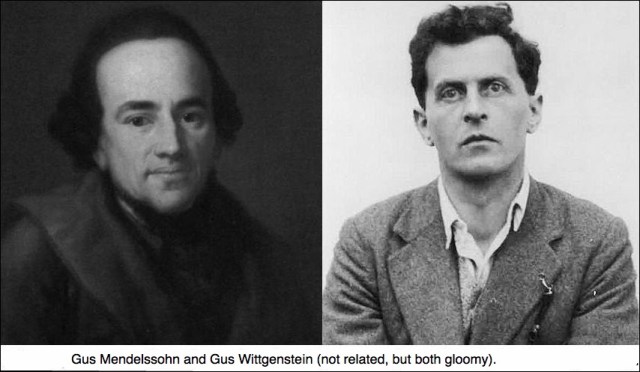
A kind of proof was offered by Moses Mendelssohn (1729-1786), the German Jewish philosopher whose fame was such that he was nicknamed “the Socrates of Berlin.”

However, Mendelssohn seemed so distressed by the subject of death that it reminded me of another nickname: “Gloomy Gus,” applied to people who obsess about the negative side of life.

He wrote about death in his 1767 book Phaedo, or Concerning the Immortality of the Soul (Phädon oder über die Unsterblichkeit der Seele). “Phaedo” refers to a dialogue by Plato in which Socrates, while he is dying, discusses the issue with his students.

Mendelssohn has two main arguments for the immortality of the soul. The first is metaphysical, but since it’s both complicated and unconvincing, I won’t inflict it on you. Immanuel Kant gives a fairly good summary of the argument in his Critique of Pure Reason (B-413).

The second argument is where Mendelssohn turns into a Gloomy Gus of major proportions. His argument isn’t very convincing either, but at least it’s interesting and you can understand what he’s talking about.

He seems to worry about death a lot more than a psychologically healthy person should:

“During happy times, the dreadful thought of nonexistence winds its way through the most delightful representations like a snake through flowers, and poisons the enjoyment of life. During unhappy times, such a thought dashes a man to the ground in complete hopelessness …”1

His basic argument, as far as I can tell, is this:

  1. If death is the end of us, then life is our ultimate good.
  2. If life is our ultimate good, then we have a right to do whatever is necessary to protect and prolong our lives.
  3. Each country has a right to demand that its citizens sacrifice their lives for their country.
  4. Our right to life conflicts with our countries’ right to demand that we sacrifice our lives.
  5. There are no irresolvable conflicts of rights.
  6. Therefore, death is not the end of us.

In this argument, Mendelssohn deduces a metaphysical conclusion (the soul is immortal) from a moral conundrum: if the soul isn’t immortal, then there are conflicts of rights.

The problem is that all of his premises are highly debatable. He might believe in them, but they require a lot more argument to convince anyone else.

I’m not sure that Mendelssohn himself thought his argument was valid. He might have thought that belief in immortality promoted happiness and moral behavior, so it was justified for him to use heavy-breathing rhetoric to convince people it was true.

In his “Open Letter to Lavater” (1769), he said that when truth conflicts with the social good, we should sometimes support the social good instead of the truth:

“Whoever cares more for the welfare of mankind than for his own renown will keep a rein on his opinions concerning … erroneous religious opinions that are accidentally connected to the promotion of the good.”2

Mendelssohn seems to have been a wise man: indeed, wiser than we might think from reading his shaky argument in favor of human immortality.

Works Cited

Gottlieb, M., editor (2011), Moses Mendelssohn: Writings on Judaism, Christianity, and the Bible. Lebanon: Brandeis University Press.

Footnotes


  1. Gottlieb, M. (2011), p. 246. 
  2. Gottlieb, M. (2011), p. 12. 
Posted in Jewish Philosophy, Judaism, Philosophy, The Jerusalem Post | Tagged , , , , , | 2 Comments

Is Jewish Peoplehood Passé?

Google-graph-01a

Is it time for us to stop thinking of ourselves as “the Jewish people”?

Are we not one, but many?

Some influential writers think so.

They start with what is obvious: today’s Jewish population is incredibly diverse. World Jewry includes people of all races and nationalities. It includes Jews who call Israel their home and Jews who rarely think of it except in synagogue. It also includes as “honorary members” people who are not Jewish and don’t intend to convert, such as some interfaith spouses and children.

That’s just the demographic side. We also disagree, often bitterly, about belief and observance. The headline “Orthodox rabbi says Reform isn’t Jewish” has become a regular occurrence.1

Most Jews think we’ve got a problem. But what kind of problem is it? There are two viewpoints:

  • The problem is not the situation itself, but how we think about it.
  • The problem is the situation itself.

How We Think About Peoplehood

William Shakespeare wrote that “There is nothing good or bad, but thinking makes it so.”2

Jewish Studies scholar Noam Pianko doesn’t go that far, but he says that the way we think about peoplehood causes most of the trouble.

We commonly believe that Jewish peoplehood is an old idea, but Pianko argues that it’s quite new. He traces the term’s origin to American Zionist Mordecai Kaplan in the early 1940s. The graph at the beginning of this article shows that published mentions of Jewish peoplehood were almost non-existent before that decade.

Kaplan wanted to build support for Zionism, and until 1942 he did it by talking about Jews as a nation. However, he worried that calling Jews a nation would invite accusations that American Jews had dual loyalty. Similar accusations had been leveled many times in history, most recently and tragically in Europe. Kaplan needed an alternative term, one that implied similar duties of loyalty as a nation but without the potential anti-Semitic implications. By 1948, “peoplehood” had become his term of choice. Pianko observes that:

“The success of the term peoplehood can be attributed in part to the ambiguity of the term itself, which does not appear in English dictionaries until the late 1960s. Peoplehood came to offer a largely blank slate that alluded to many elements associated with nationhood, while avoiding the highly charged language of nation …”3

Apart from its application to the Jewish people, it was a good fit on general grounds as well. Political scientist Rogers Smith described “political peoples” as:

“All human associations, groups, and communities commonly understood to assert that their members owe them a measure of allegiance against the demands of other associations, communities, and groups.”4

“A measure” of allegiance was just what Kaplan needed. It encouraged support for Zionism but couldn’t be used to justify accusations of national disloyalty. Shaul Magid, a professor of Jewish Studies at Indiana University, summarized:

“The myth of Jewish peoplehood enabled Jews who abandoned religion and chose not to immigrate to Israel to make sense of their identity as part of a larger collective without bumping up against national affiliation or dual allegiance.”5

Drawbacks of Peoplehood

However, in Pianko’s view, the idea of peoplehood had serious drawbacks. In particular, it was too closely related to the idea of nationhood, which implies a national essence, political solidarity, and clear boundaries of membership. It misled us into looking for a Jewish unity that wasn’t there. To replace it, he proposes “peoplehood in a new key” (a.k.a “Jewishhood”) that doesn’t require unity:

“Peoplehood in a new key must recognize a diversity of Judaisms not as a problem that must be overcome, but as the basis for building a sustainable alternate model of collectivity.”6

If we think of the Jews as one people, his idea sounds like nonsense. But it makes perfect sense when you recognize the kind of argument he’s making:

“Is Jewish collectivity fundamentally about unity? Modern notions of Jewish peoplehood certainly have insisted that the answer is yes. … This makes sense as long as Jewish peoplehood defines itself according to the logic of nationhood, which concentrated on unity and shared characteristics to create (rather than merely describe) a political, cultural, and economic entity.”7

Notice how he contrasts his viewpoint with peoplehood that tries to “create (rather than merely describe) a political, cultural, and economic entity.”

The contrast shows that he is not prescribing an ideal situation and urging us to make it a reality. Instead, he is describing our actual situation and suggesting that we learn to live with it. If world Jewry is fragmented and diverse, then he thinks we should simply “get with the program” and embrace it. The question then becomes: Should we?

Jewish Peoplehood in a Diverse Key

Embracing fragmentation requires changing the very concept of Jewish peoplehood, says Pianko, who also refers to his proposal as “post-Jewish.”

Instead of asking who is Jewish, what values unite us, and how we differ from the non-Jewish world, it would ask each of us what we do in the Jewish community, what parts of Judaism are meaningful to us, and how we manage our allegiances to the non-Jewish world.8 He sees it as a decentralized “neighborhood model” of Judaism:

“A neighborhood model [seeks] to build collective consciousness by recognizing the organizing power of specific groups to develop different, and sometimes even mutually incompatible, visions of what it means to be part of the Jewish people. A sense of connection to a larger entity is generated most authentically— and thus enduringly— from the bottom up.”9

“Disparate neighborhoods, all doing different things, descended from a unified population:” That reminded me of a passage in another book, this one by renowned biologist Ernst Mayr:

“What happens in the isolated population? There may be new mutations, certain genes may be lost owing to accidents of sampling, recombination results in the production of a diversity of new phenotypes that are different from those of the parent species, and there may be the occasional immigration of different genes from other populations. The isolated population will diverge increasingly from the parental species. If this process continues long enough, the isolated population changes enough to qualify as a different species.”10

Speciation-Mayr-loc-2839

In biology, the neighborhood model results in the evolution of new species and the possible disappearance of the parent species. In the case of the Jewish people, it might not, but the analogy is uncomfortably close.

For people to understand each other, they must have something in common. For people to be loyal to each other, they must have some kind of relationship, however remote: familial, pragmatic, or religious. Separate “Jewish neighborhoods” operating independently of each other do not have that kind of relationship. There is no “larger entity” to which they can connect. Dozens of different Jewish neighborhoods, doing different things and holding incompatible values, will not long remain united by nothing but a name. Soon, the name itself will disappear. And then what is left?

Group members who have nothing in common except a name have no reason for being in a group and no reason to be loyal to each other. If all that’s left is the name, then what’s the point? We might as well join the Masons or convert to Islam, whose adherents at least think they have a reason for being Muslims.

An Element of Circularity

Pianko is not blind to the problem of defining a group by a variety of different, unrelated, and incompatible beliefs and activities. That definition could classify as Jewish almost any group doing almost anything: bicycle mechanics, Buddhists, football clubs, and so forth. His solution is to specify that the activities must be Jewish:

“Putting Jewish at the center would mean defining what links Jews to one another as the active engagement with Jewish ideas, communities of practice, and other forms of intentional engagement … connections to what we now call peoplehood would be just as strong for someone studying the weekly Torah portion as it would be for someone who regularly participates in organizations such as AIPAC, J Street, the American Jewish Committee, and others explicitly dedicated to advocating on behalf of collective Jewish interests.”11

That sounds reasonable. And it is. But it doesn’t solve the problem. In essence, the argument is:

  • Activities are Jewish if they are on behalf of Jewish interests.
  • Interests are Jewish if they are the object of activities that are Jewish.

It’s circular reasoning. Unless “Jewish” is defined independently of the activities, as for example by religion, nation, or peoplehood, then the argument is self-fulfilling. It doesn’t help us.

His examples imply that he wants to “grandfather in” as Jewish any activities currently considered Jewish. However, with an open-ended definition of the concept, such activities might or might not be retained over time. Jewish activities in a hundred years might be nothing on our current list.

Why Have Any Group At All?

As Franz Rosenzweig said, “From Mendelssohn on … the Jewishness of every individual has squirmed on the needle point of a ‘why?'”12

Why should we care if the Jewish people continue to exist as a distinct group? What difference does it make? What worthy goal does it achieve?

Throughout history and prehistory, people have banded together into groups. Why? And why are groups so omnipresent: where we find people, we find them organized in groups.

Do the Jewish people have, as they say in business, a “unique selling proposition”?

As it happens, we have several of them. They define the ways in which the Jewish people can be a group that matters — to us, to the world, and to God.

Loyalty to God

Many contemporary Jews don’t believe our people were chosen by God, so I hesitated about putting it first. But if it is true, then it’s certainly the most important reason.

Our mission, should we decide to accept it, is to share God’s, truth, love, and justice with the world, and by our own conduct to set an example for others. It is a difficult mission, and we will often — painfully often — fall short. But we betray both ourselves and all of humanity if we don’t even try. Whether or not God exists, we can do a lot of good in the world if we assume that He does.

Loyalty to Humanity

Goodness in human life never appears in the abstract. It always appears in specific social, religious, and historical contexts.

The Jews (our people) and the Jewish tradition (our tradition) have brought goodness into the world in unique ways that no other group can replace. For us to give up existence as a separate people and forsake our unique tradition would deprive not only us but everyone else in the world of something precious that only we can provide.

Loyalty to Each Other

The reason humans and lower animals band together in groups is that it provides a safer, richer, and happier life than living alone. It gives both our families and us as individuals a better chance to survive and prosper. Our ancestors struggled to give us that chance, and we should pay it forward to our children and the generations that follow. Political philosopher Edmund Burke said it well:

“History is a pact between the living, the dead, and the yet unborn.”

Those who came before us passed along the heritage of a great people and a challenging tradition. We are their heirs. Our sacred duty is to exemplify and share that tradition — both as individuals and as a distinct people.

Links

“Does Jewish Peoplehood Have a Future?” Video lecture (16 minutes) by Dr. Noam Pianko.

“I am just a Jew.” Excellent video (2 minutes) created by Nachman Weiss, a 7th grader at Harkham Hillel Hebrew Academy in Los Angeles. Orthodox perspective but inclusive.

“Is There Such a Thing as the Jewish People?” A Moment Magazine symposium with comments from Adin Steinsalz, Jill Jacobs, and other leading Jewish thinkers.

“The Video That Every Jew Needs to Watch.” A commentary by Dr. Mayim Bialik about the issues raised in the Harkham Hillel Hebrew Academy video.

Works Cited

Cohen, S. (1999), The Beginnings of Jewishness. Berkeley: University of California Press. Kindle edition.

Glatzer, N., ed. (1998), Franz Rosenzeig: His Life and Thought. Indianapolis: Hackett Publishing.

Mayr, E. (2001), What Evolution Is. New York: Basic Books. Kindle edition.

Pianko, N. (2015), Jewish Peoplehood: An American Innovation. New Brunswick: Rutgers University Press. Kindle edition.

Smith, R. (2015), Political Peoplehood: The Roles of Values, Interests, and Identities. Chicago: University of Chicago Press. Kindle edition.

Footnotes


  1. Kershner, I., “Israeli Minister Says Reform Jews Are Not Really Jewish.” The New York Times, July 7, 2015. 
  2. Hamlet, Act 2, Scene 2. 
  3. Pianko, N. (2015), loc. 737. 
  4. Smith, R. (2015), loc. 74. 
  5. Magid, S., “Letting Go of Jewish Peoplehood.” The Forward, July 9, 2016. 
  6. Pianko, N. (2015), loc. 2812. 
  7. Ibid, loc. 2842. 
  8. Pianko, N. (2015), Video lecture “Does Jewish Peoplehood Have a Future?” 
  9. Pianko, N. (2015), loc. 2860. 
  10. Mayr, E. (2001), loc. 2843. 
  11. Pianko, N. (2015), loc. 2791. 
  12. Glatzer, N. (1998), p. 238. 
Posted in Jewish Philosophy, Judaism, Modern Orthodoxy, The Jerusalem Post | Tagged , , , , , , , , , , , , , | Leave a comment

Spinoza on the Couch

Baruch_Spinoza_-_Franz_Wulfhagen_-_1664-01cr1

My latest blog post for The Jerusalem Post:

I’ve spent a lot of my life dealing with crazy people, including myself. “Crazy,” of course, has various definitions, though it’s not the topic of this blog post. My favorite definition was given by the American writer Ambrose Bierce (1842-1914):

Mad, adj.: Affected with a high degree of intellectual independence; not conforming to standards of thought, speech and action derived by the conformants from study of themselves; at odds with the majority; in short, unusual.”1

A definition that’s less funny but more in accord with common sense is that people are crazy if they have beliefs, emotions, or compulsions inconsistent with leading happy, productive, fulfilling lives; or more seriously, that cause them to harm themselves or others. It describes most of us at one time or another.

Regardless of definition, my experience with crazy people leads me to conclude that logic and evidence are secondary when it comes to holding beliefs. The main reason people hold beliefs is that the beliefs do something for them.

In many cases, the “something” matches our ordinary model of beliefs. You want to get to the grocery store, so you consult your memory, check the city map, and perhaps activate the GPS app on your cell phone. That evidence supports a belief that the store is in a particular location and you can reach it by a particular route. Based on the evidence, you believe it. It seems that the ordinary account of belief is correct. Case closed. Right?

Wrong. Why does the belief matter to you? Do you cherish it because of its abstract truth? No. You never give a thought to its abstract truth. Do you care a whit how you arrived at the belief? No. How you got it doesn’t matter except to increase your confidence in it. The belief itself has value because it helps you get to the store. It does something for you.

The situation becomes clearer when you’re dealing with “crazy” beliefs that have no ordinary and obvious justification: A man believes he’s Napoleon. A woman believes she’s married to Brad Pitt. Brad Pitt believes he’s Napoleon, and he challenges the first man to a duel. That kind of thing.

Unless there’s a brain disorder, what you find in such cases is that the beliefs serve some purpose for the believers. It’s not getting to the store, of course; nor is it commanding the French army. It’s often connected with the need to feel loved, important, or accepted by a peer group. But it’s not based on evidence. The beliefs do something for the believers.

What does all that have to do with Spinoza?

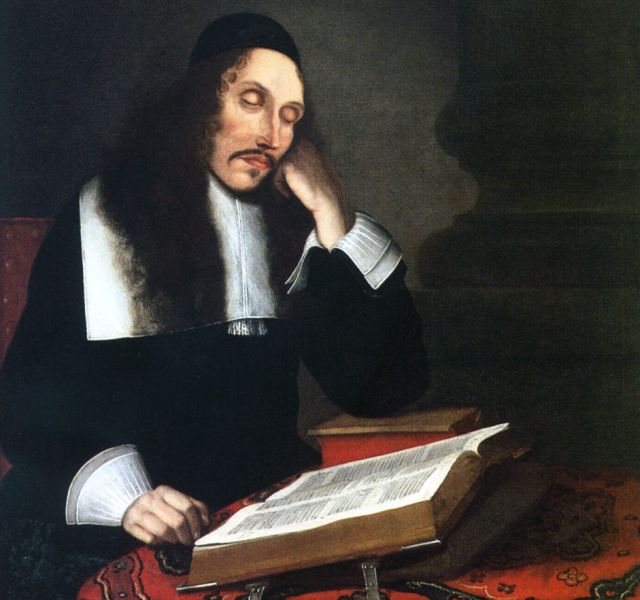
Spinoza was a genius, to be sure, but he was also a human being with emotional needs. He devised a radically new interpretation of God that satisfied those needs.

Oh, yes, he also had lots of arguments to support his beliefs; but we all have lots of arguments. Highly intelligent people have the most extensive and sophisticated arguments, as Spinoza did. But the psychological needs, and the need to satisfy them, come first.

As an Enlightenment-era rationalist and an admirer of the French philosopher Rene Descartes, Spinoza needed to feel that the world was intelligible. To merit his attention, any kind of reality had to make sense to him. If he couldn’t understand it, then it was hard for him to believe in it.

And though Spinoza was willing to challenge Jewish belief, he was still a Jew down to his bones. He had grown to maturity in that intellectual and spiritual environment. Whether he liked it or not, the Jewish tradition was part of him and he was part of it. It was important to him. For him, it just had to make sense somehow. It had to. He couldn’t rest until he figured out how.

And that’s where he ran into problems. Jewish rationalists such as Saadia and Maimonides had redefined Jewish belief in terms that made philosophical sense but were religiously useless. As an article in The Boston Globe observed last week:

”Following philosophers like Maimonides, God had become an abstract, practically inconceivable entity, which made the idea of prayer and religious observance seem almost absurd.”2

Spinoza couldn’t live with that. He needed a God he could understand. But the unexplained God of Judah Halevi was no more help to him than the unexplainable God of Saadia and Maimonides.

In his Treatise on the Emendation of the Intellect, Spinoza revealed his deepest motivation:

“After experience had taught me that all the things which regularly occur in ordinary life are empty and futile … I resolved at last to try to find out if there was anything which would be the true good … if there was something which, once found and acquired, would continuously give me the greatest joy for eternity … I would be giving up certain evils for a certain good.”3

In essence, Spinoza “got saved.” He despaired of things that were “empty and futile,” but he found in reason something that could give him “the greatest joy for eternity.” That is the language not of a secular philosopher but of a fervent religious believer.

For his psychological salvation, Spinoza needed a God that he could understand rationally. Because he needed it, he found a way to believe in it:

“God, or substance consisting of infinite attributes, each of which expresses eternal and infinite essence, necessarily exists.”4

That’s philosopher-talk for saying that God is the universe. God is more than just the universe, to be sure, but the universe is the aspect of God we can see and comprehend. Everything that exists is included in God, so the more we learn about the natural universe, the more adequately we form an idea of God:

“Whatever is, is in God, and nothing can be or be conceived without God.”5

That’s a God in which Spinoza could believe without reservation: deus sive natura, the vast extended system of the physical universe with its parallel mental system of ideas. We understand it only imperfectly, but we can understand it.

Thus, Spinoza’s idea of “God as the universe” was ultimately rooted in his emotional need to believe that the world was rational and comprehensible. He couldn’t live with religious mysteries, so he didn’t.

Works Cited

Bierce, A. (2014), The Devil’s Dictionary. Seattle: Amazon Digital Services.

Shirley, S. translator (2011), The Ethics by Baruch de Spinoza. Indianapolis: Hackett Publishing.

Footnotes


  1. Bierce, A. (2014), p. 121. 
  2. Glinter, E., “A Mysterious Medieval Text, Decrypted.” The Boston Globe, June 26, 2016. 
  3. Shirley, S. (2011), p. 233. 
  4. Ibid, p. 36; Proposition I.11. 
  5. Ibid, p. 40; Proposition I.15. 
Posted in Epistemology, Jewish Philosophy, Judaism, Philosophy, The Jerusalem Post | Tagged , , , , , , , , , | 2 Comments

Seeing the Reality Beyond “You”

Michelangelo_-_Creation_of_Adam

My new blog post for The Jerusalem Post:

What’s real and what isn’t?

How do you know?

Could there be different kinds of realities that you know in different ways?

The greatest thinkers, both Jewish and gentile, have given the same answers:

  • First, we know different kinds of reality in different ways.
  • Second, it’s a mistake to think there’s only one way of knowing things.

For example, suppose I want to show you that dogs exist and what they’re like. Should I give you a mathematical proof? No. I should simply point to a dog.

Or suppose I want to show you that stealing is wrong. Should I set up a microscope? No. I should simply sneak into your house and steal your piano. On second thought, perhaps I shouldn’t do that, since it’s illegal and I might hurt my back.

The best way to know — and the best way to teach — depend on what kind of lesson is involved. The Bible and our Jewish tradition teach us important lessons in appropriate ways. The ways are generally not scientific, but they’re effective for their purpose.

Breath is more than life

Thus, Genesis teaches both that humanity is part of the natural world and that it transcends the natural world:

”The Lord God formed man from the dust of the earth.” (Genesis 2:7)

God makes man (ha adam) from the earth (ha adama): the word pairing makes the connection clear. We are part of nature, as science agrees. But there’s more:

”He blew into his nostrils the breath of life, and man became a living being.” (Genesis 2:7)

There’s more to human nature than just the dust of the earth. There’s more than just biological life. Notice what happens — and what does not happen — a few verses later:

”And the Lord God formed out of the earth all the wild beasts and all the birds of the sky, and brought them to the man to see what he would call them …” (Genesis 2:19)

Both humanity and lower animals are formed from the earth. Both are alive. However, Genesis does not tell us that God blew the breath of life into lower animals as He did into man. Therefore, the breath of life cannot mean just biological life. It’s self-awareness, intelligence, and spirituality.

How much more vivid and comprehensible are those simple verses than a ponderous lecture about biology and psychology? Whether we’re reading it today or 3,000 years ago, the message is clear. The lesson is taught effectively.

The breath in “you”

One of the great things about Hebrew College is that I get to talk with a lot of famous Jewish thinkers. One of them is Rabbi Arthur Green. In his book These Are The Words: A Vocabulary of Jewish Spiritual Life, he explains the significance of the Hebrew word atah (you). First, it always suggests a connection with God:

“Because Hebrew was preserved for so long as the language of the synagogue, most Jews for more than 1,000 years learned atah as the word that followed barukh (in the phrase ‘blessed are You’) … Every atah, then, contains within it some hidden fragment of prayer.”1

But it’s in the spelling of atah (aleph-tav-heh) that things get really interesting. Aleph is the first word of the Hebrew alphabet, and tav is the last:

“Since the mystical masters believe that God created all the worlds by combinations of letters, aleph and tav can be seen to stand for all Creation …”2

But that kind of creation is not alive in the same sense as human beings: it is merely an object, not a subject:

”Combining those two letters gives us only the word et, a particle used to indicate the direct object. Aleph to tav by themselves refer to the world only as object.”3

What’s missing? It’s “the breath of life,” represented here by the aspirated sound of the letter heh:

“With the heh added (even though heh is really nothing but a breath!), the word is no longer “it,” but “You”! The “aaahh” sound at the end draws us out, connects us to the other. With atah we address the living Subject, not the inanimate or abstract object.”4

The word atah reminds us that what you see isn’t what you get. Beyond the visible, physical “you” of another person is the invisible, spiritual atah, created by and connected to God.

Back to the Beginning

And so we are back where we started: In Genesis 2, receiving the breath of life (heh) that transforms us from mere aleph-tav objects into atah subjects who have self-awareness, intelligence, and spirituality.

Those are not scientific concepts. They’re not given to us in scientific lessons. They take the form of stories and speculation. But they tell us who we are, what we are, and how to treat each other. We would be morally impoverished without them.

Works Cited

Green, A. (2000), These Are The Words: A Vocabulary of Jewish Spiritual Life. Woodstock: Jewish Lights Publishing. Kindle edition.

Footnotes


  1. Green, A. (2000), loc. 260. 
  2. Ibid, loc. 266. 
  3. Ibid, loc. 269. 
  4. Ibid, loc. 274. 
Posted in Bible, Jewish Philosophy, Judaism, Philosophy, The Jerusalem Post | Tagged , , , , , | Leave a comment

What Tolerance Requires

prager_university_religious-tolerance-made-in-america_banner_205

My latest blog post for The Jerusalem Post:

My father had a lot of favorite adages. One was:

”Smart people learn from their mistakes. Smarter people learn from other people’s mistakes.”

Learning from other people’s mistakes is easier said than done. For one thing, it requires us actually to listen to other people and to think about what they say. Instead, we tend to rehearse our own thoughts and the reasons why we, and we alone, are totally in the right.

Tolerance of other people’s ideas should be easiest of all. Unfortunately, ideas often come wrapped in situations that provoke our emotions and make the ideas seem like a threat to our physical safety. It’s hard to be tolerant in the middle of a screaming contest.

And let’s be sensible. If it’s more than a screaming contest, if we really are in a life-or-death situation, tolerance has to wait. Nobody is required to tolerate violent aggression and physical harm. Fortunately, those situations are unusual even in areas plagued by crime and terrorism.

Most of the time, tolerance means just two things:

  • Letting other people live and believe as they wish, as long as they don’t harm us or innocent third parties.
  • Listening to other people’s viewpoints even if we think they’re wrong, and seriously considering the merits of their arguments.

What Tolerance Isn’t

Tolerance isn’t the same thing as approval. In fact, if we approve of something, tolerance doesn’t make any sense. We don’t “tolerate” it if our children get good grades in school, or if a stranger performs an act of kindness. We can only tolerate things we don’t like.

Moreover, tolerance is not the same thing as active support. Requiring people to say or do things that support what they disapprove is intolerant of their right to live and believe as they wish without harming others. Zealots are often confused about that point.

Tolerance Requires Common Ground

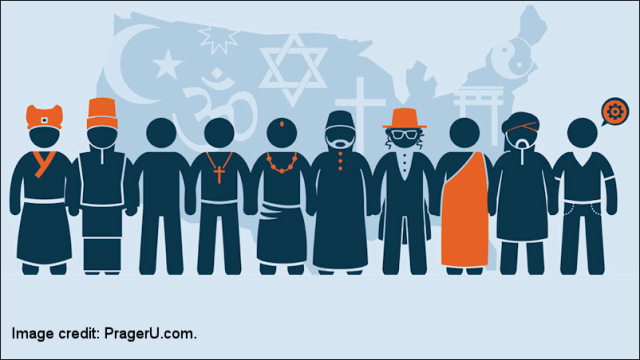
But we aren’t machines. Our ability has its limits. The more strongly we disapprove of something, the harder it is for us to tolerate it. That’s why tolerance requires at least some common ground in society.

To be tolerant, people must have at least some shared beliefs, shared loyalty, or shared commitment to the common good. Writing in 1993, the influential American philosopher John Rawls wondered:

“How is it possible for there to exist over time a just and stable society of free and equal citizens, who remain profoundly divided by reasonable religious, philosophical, and moral doctrines?”1

And he added:

“In fact, historical experience suggests that it rarely is.”2

Judaism and Tolerance

For Jews, that common ground has been found in our faith and our tradition. It hasn’t made us perfectly tolerant of each other, but it has helped.

The Talmud tells of a disagreement between the schools of Hillel and Shammai that was finally resolved by a voice from Heaven: “The teachings of both are the words of the living God, but the law is in agreement with the School of Hillel.”3

Why did God side with the School of Hillel?

“Because they were kindly and humble, and because they studied their own rulings and those of the School of Shammai, and even mentioned the teachings of the School of Shammai before their own.”4

Modern Orthodox Rabbi Shlomo Riskin, chief rabbi of Efrat, expressed a similar view last week. He called for greater tolerance of Reform and Conservative Judaism in Israel:

“You win over Jews, and people in general, through love … Anyone who’s trying to bring Jews closer to Judaism is my partner, not my enemy.”5

What about people who aren’t our partners, with whom we have little or no common ground? That’s a tougher problem. In that case, disagreement too easily turns to hatred and violence.

Jacob Neusner observes that “Scripture’s Halakhah does not contemplate Israel’s coexisting, in the land, with gentiles and their idolatry.”6

For pragmatic reasons, we’ve often had to modify that view as we lived as minorities in other lands. In those cases, we were less concerned about how we could tolerate others than about persuading them to tolerate us. However, toleration between incompatible or hostile groups is perennial challenge for heterogeneous societies.

Principle or Pragmatism?

There are two ways of looking at tolerance: as a matter of principle or of pragmatism.

On principle, out of respect for individual autonomy, we might tolerate beliefs and practices we don’t like because they’re not physically harmful. We might refuse to tolerate beliefs and practices that do cause harm. In those cases, we must be very sure that we’re right and we must have the power to prevent people from doing what we won’t tolerate.

Sir Charles Napier (1782-1853) told a relevant story about his experience as a young British officer in India. When he and his soldiers arrived at a village, the locals were preparing to burn a widow alive on her late husband’s funeral pyre. The village elders explained that it was part of their tradition. Napier listened respectfully, then explained that it was British tradition to hang anyone who did such a thing. The widow was set free. Today, we might make a similar argument about female genital mutilation and other barbaric practices of some migrants to Western countries.

Pragmatically, however, we often lack the power to prohibit some things without causing social unrest or worse problems. Whatever principles are at stake, tolerance becomes a practical necessity. In order to get anything done, we have to find a lowest common denominator on which all social groups can agree.

There are no perfect solutions to social problems. However, if we can manage to tolerate each other and live together in peace, it’s a good first step.

Works Cited

Neusner, J., editor (2008), Religious Tolerance in World Religions. West Conshohocken: Templeton Foundation Press.

Rawls, J. (1993), Political Liberalism. New York: Columbia University Press. Kindle edition.

Telushkin, J. (2000), The Book of Jewish Values. New York: Random House.

Footnotes


  1. Rawls, J. (1993), loc. 716. 
  2. Ibid, loc. 723. 
  3. Telushkin, J. (2000), p. 186. 
  4. Ibid, p. 186. 
  5. Rabbi Riskin Urges Israelis: End the ‘War’ on Reform Jews,” Arutz Sheva, June 14, 2016. 
  6. Neusner, J. (2008), p. 195. 
Posted in Jewish Philosophy, Judaism, The Jerusalem Post | Tagged , , , , , , , , , , | Leave a comment