A Retro Idea to Improve the Net

In 1949, the legendary American comedian Groucho Marx resigned from the Friars Club of Beverly Hills. His reason?

“I don’t want to belong to any club that would accept me as one of its members.”

A lot of people are starting to feel that way about the internet. The hate, hysteria, Twitter mobs, privacy invasions, and intrusive advertising are too much.

But the internet wasn’t always like that. When I first used it as a student in the late 1980s, the internet seemed new, exciting, and fairly reasonable.

Email was an awesome idea, though it was text-only and didn’t work reliably. You couldn’t email files. Connection speeds were slow, even over campus networks.

To connect with remote computers, you had to use the telephone lines, and that was even slower. Don’t ask me how I know, but it took about two minutes to download a single photo of Star Trek’s Counselor Troi — fully clothed, of course, which was about as edgy as “internet porn” got.

Finally, you had to know how to use internet commands and computer operating systems such as Unix and MVS.

But as primitive as it now seems, that retro version of the internet might hold solutions to some of our current problems:

  • People seldom insulted each other. Even if they did, nothing much happened as a result.

The only memorable exception for insults was a group titled “alt-ensign-wesley-die-die-die,” devoted to a Star Trek character who many fans disliked (although the actor who portrayed him seems like a pretty decent guy).

  • There was very little fake news. You couldn’t even find fake news unless you had technical skills.

In the late 1980s and early 1990s, there were basically two versions of the internet. One version was for people in general. Everyone could use it. The other version was for researchers and technical nerds. Only they could use it, because only they had the knowledge required to do it.

Yes, Millennials, I know that I sound like your grandpa talking about “the good old days.” It is what it is. 

The Consumer Internet

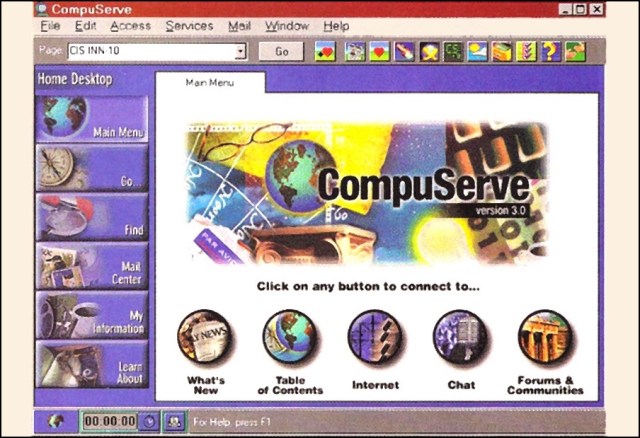
The consumer internet consisted of competing online services such as CompuServe and America Online.

Online services were like Facebook: lots of people, lots of content, easy to use, and requiring no technical knowledge. But they differed from Facebook in four ways:

  • First, you paid a monthly subscription fee to use them, so they didn’t bombard you with ads or sell your information. But they knew who you were. It was technically possible to create bots or fake identities, but it was more trouble than it was worth.
  • Second, they had meaningful competition to keep them honest. If you didn’t like one of the services, you could switch to a competitor that was just as good. None of them dominated the market like Facebook. Present-day competitors like MeWe, Minds, and Gab might eventually dethrone Facebook, but not in the short term.
  • Third, they didn’t automatically show you a “newsfeed” whose content they could alter to manipulate you. Instead, you looked for content and forums that interested you.
  • Fourth, online services did not even pretend — like Facebook and Twitter — to be free speech zones. Their users were paying customers who were usually well-behaved. And users did sometimes discuss politics, including controversial opinions. But if anyone started harassing others or using offensive language, each forum had moderators who could impose penalties from censorship to expulsion. That was understood.

As far as I could tell, moderators were not employees of the online services. They were users who got free accounts in exchange for moderating the forums in which they participated.

The moderators were not nameless. They posted in the forums. They were readily available to discuss users’ concerns or complaints. There were no hidden censors deploying mysterious algorithms to block any content they didn’t like. If you got censored, you knew who did it and why. It was all open and above-board. People sometimes griped about it but it worked well.

And since users were paying customers, moderators did not censor people arbitrarily. There had to be a good, defensible reason. The services didn’t want to lose that monthly subscription money. As has been said about Facebook and Twitter, “If you’re not paying for the product, then you are the product.” Users of online services were paying for the product.

On a smaller, non-commercial scale, individual computer nerds often ran “bulletin board systems” (BBSs) on their own PCs. If you had the phone number, you could get access. BBSs were usually owned by fanboys, so their content and discussion forums reflected that. Their influence was limited to their own small user base. Two interesting side-notes:

  • If I remember correctly, the photo of Counselor Troi came from the Westside BBS in West Hollywood. That BBS was pretty well known to Star Trek fans.
  • When PCs were first introduced in government agencies, many agencies had enthusiasts who set up BBSs with all their agency’s information. If you were a spy and you had the BBS phone number, you could have learned a lot. Of course, military and intelligence agencies were a lot more security-conscious. You couldn’t get into their systems unless you were a very good hacker who didn’t worry about going to prison. The method used in the 1980s movie “WarGames” was called a hack-hack attack, and it wouldn’t work on any secure computer except in a movie.

The “Real Internet”

The other version — the “real internet” — was more of a wild-west show. It offered uncensored freedom to say anything or share any content that was legal. But as I described earlier, it was not easy to use. There was no such thing as “point and click.” You had to learn commands to establish connections, get access to remote computers, and navigate different operating systems. You also needed a real internet account through a school or government agency. You couldn’t get to it from the consumer internet, at least not until the mid-1990s. And you still couldn’t do very much with it.

So the real internet wasn’t available to everyone. Even if you had an account, the skills barrier made it almost like an IQ test. You couldn’t use the real internet unless you were smart, technically sophisticated, and highly motivated. That limited the size of the user population. Even with total freedom of speech, there weren’t enough susceptible people for anyone to whip up a Twitter-style mob or harassment campaign.

You could shop, but not much. Most of the shopping and other commercial activity was on the online services because they had large customer bases. E-commerce wouldn’t really take off until after the invention of web browsers in the 1990s. The web put a “front door” on the internet that made it easier for non-technical people. Some consequences have been good, while others have been bad.

What’s the Internet For?

Is there a way to apply the 1980s kind of model in 2019? We want to keep the good things about the internet and minimize the bad things.

What are the good things that people do on the internet? Here’s my list. If you can think of other things, please comment: I don’t pretend to have all the answers. We want to keep:

  • E-commerce: Buying and selling. Brick-and-mortar stores hate it — justifiably — but it’s here to stay.
  • Email: Written correspondence delivered faster than postal mail. It’s become an essential part of our lives.
  • Personal interactions: Chats, videoconferencing, and discussion threads provide limited contacts with other people. They’re not as good as face to face conversations, but (a) they’re not nothing, and (b) they permit interactions that would otherwise be impossible.
  • Posting content: Blogs, photos, and videos seem to be the most common types of content.
  • Getting news: Real news is a good thing. Fake news is a bad thing. But what’s real or fake is sometimes in the eye of the beholder. That’s going to be a problem.

What Should It Not Be For?

What are the bad things that people do on the internet? We want to eliminate or minimize:

  • Mobs: Inciting hysterical mobs to harass and threaten people online or in real life. Organizing riots.
  • Fake news: News stories that are demonstrably (often obviously) misleading and that incite people to hate each other.
  • Privacy invasion: Social media, websites, and search engines collect personal data and sell it: “If you’re not paying for the product, then you are the product.”
  • Pornography: Even if it’s mild, legal, and not horrifying, pornography is too easy to get on the internet. That leads to addiction, desensitization, and it damages human relationships.

Applying a 1980s-Style Remedy

No solution to any social problem can be perfect. There are always costs and benefits. Improving the internet is no exception. Here are my suggestions:

  • Use antitrust law to break up Facebook. A social media company that controls 68 percent of the U.S. market is too powerful.
  • Use antitrust law to break up Google. A technology company that controls about 70 percent of internet searches while selling software, computers, tablets, and phones is too powerful.
  • Regulate social media. For example, eliminate “newsfeeds,” so that content is available if users want it but it doesn’t display automatically. Prohibit user conduct such as objectively-defined harassment or bullying. Require social media companies to publish clear and specific guidelines for moderation, so that users can know in advance what is and is not allowed. Require social media companies to have enough moderators for individual moderation, just like in the glory years of CompuServe.
  • Make the internet harder to use, so that most people will flock to easier social media sites or reborn online services. Most e-commerce should be there.
  • Require a license to engage in e-commerce. Just as with a brick-and-mortar store, the license should document who owns the business, where it’s located, and what it’s selling.
  • Prohibit some e-commerce on social media. If some kinds of e-commerce are legal but socially harmful, prohibit them on social media and online services. They’ll still be available on the hard-to-use real internet. Freedom sometimes includes the right to do unwise things, but there’s no reason to make unwise things easy to do.

Those are partial and imperfect ideas for solving serious problems. But we’ve got to start someplace. Our current situation is unsustainable.

Your thoughts?


Check out my new book Why Sane People Believe Crazy Things: How Belief Can Help or Hurt Social Peace. Foreword Reviews called it “intriguing and vital to living.”

Posted in Human Relations, Life, Political Science, Psychology, Society | Tagged , , , , , , , , , , , , , , | 7 Comments

Don’t Be Seduced By Hate

We’re all a mixture of good and bad impulses.

That’s not new. Alexander Pope observed in 1734:

“Virtuous and vicious every man must be,
Few in the extreme, but all in the degree,
The rogue and fool by fits is fair and wise;
And even the best, by fits, what they despise.”

But something else is new, and it’s uniquely harmful: Online sites use powerful technology to encourage our worst impulses.

According to Silicon Valley investor Roger McNamee in his book Zucked: Waking Up to the Facebook Catastrophe:

“Fear and anger [make users] consume and share more content. Dispassionate users have relatively little value on Facebook … The algorithms choose posts calculated to press emotional buttons because scaring users or pissing them off increases time on the site.”

Something has to change. No society can survive 24/7 incitement of its people to hate and fear each other.

Most likely, we’ll end up with China-style government regulation of the internet. No anonymity. Strict monitoring of what we can see and say. That would be bad, but it might be the least-bad alternative we’ve got.

Even so, we can’t just blame online sites and then wash our hands of the problem.

The sites can manipulate us because we let them. We can get emotional satisfaction from hating, fearing, and despising other people.

Are we unsure of our own worth? Feeling ignored? Angry at life’s frustrations? Ashamed of something we did?

Then whoever they are, those people are worse. We can affirm ourselves by hating others:

“We grow tired of every thing but turning others into ridicule, and congratulating ourselves on their defects … The wild beast resumes its sway within us, and utters a cry of joy, at being restored once more to freedom and lawless unrestrained impulses.”

It’s the crack cocaine of self-justification. And it wildly distorts our perception of reality. The people who we hate become symbols of everything we dislike about ourselves and our own lives.

But human nature also enables us to recognize the problem and try to minimize it. Here are three tips:

First, take time away from the computer

Most of your life should be offline. Unless you have actual work to do, turn off the computer every evening and leave it off. Set aside one day a week as a “no computers” day.

Second, limit your time online

Internet addiction has become a serious social and psychological problem. Apps such as Cold Turkey help you limit online time so that you don’t waste your life staring at a screen. Cold Turkey is for Windows and Mac; many other apps do the same thing for phones and tablets. (Note: This blog gets no compensation from Cold Turkey.)

Finally, keep things in perspective

Did some politician or celebrity say something you don’t like? Then think about what it really means for your life: nothing. They said something outrageous to get attention. They got it. Meanwhile, you’ve got work in the morning and a family to feed. Let the publicity seekers play their silly games. Keep things in perspective, keep your sanity, and live your life.


Check out my new book Why Sane People Believe Crazy Things: How Belief Can Help or Hurt Social Peace. Foreword Reviews called it “intriguing and vital to living.”

Posted in Human Relations, Life, Political Science, Psychology | Tagged , , , , , | Leave a comment

Don’t Be A Quitter

“Quitters never win, and winners never quit. But those who never win and never quit are idiots.”
Despair.com

Don’t be a quitter. But don’t be an idiot, either.

The problem in many situations is to know which is which.

Contrary to Despair.com’s funny saying, quitters do sometimes win and winners do sometimes quit.

So what’s the difference between them?

Part of the answer is what Buddhism calls “the middle way” and Aristotle called “the golden mean.”

To Aristotle, observes philosopher Daniel Robinson, “every vice is a virtue in the extreme, either an extreme of defect [not enough of it] or of excess [too much of it].”

For the virtue of persistence, the defect is never even trying to achieve our goals: we’re too afraid. The excess is refusing to change our goals regardless of new events or information: we’re too stubborn.

The best advice about persistence was given by British Prime Minister Winston Churchill to students at Harrow School in 1941. Nazi Germany had bombed British cities repeatedly for over a year, and many people feared that a German invasion was imminent. Churchill said:

“Never give in. Never give in. Never, never, never, never — in nothing, great or small, large or petty — never give in, except to convictions of honour and good sense.”

He doesn’t say we should never give up under any circumstances. He says only that if we’ve thought about our goal and we know it’s right, then we should stick with it. We should only abandon our goal if the relevant facts change (good sense) or if we learn that our choice was wrong in the first place (honor).

The same principle applies in ordinary life, not just in times of war or danger. If my spouse asked “Does this dress make me look fat?” then my first answer would be, “it makes you look beautiful.” That’s because I’d assume what she really wanted was my affection and support, not a critique of the dress.

However, if she replied “no, seriously, what do you think,” her reply would provide new information. I would then offer a carefully-worded but more candid answer — bearing in mind that she wants the truth but still wants my affirmation and support.

Yes, it can be challenging at times. But if life were too easy, we’d be bored.

Embrace the challenge: don’t be a quitter, but don’t be an idiot, either.

Find the middle way.


Check out my new book Why Sane People Believe Crazy Things: How Belief Can Help or Hurt Social Peace. Foreword Reviews called it “intriguing and vital to living.”
Posted in Life, Psychology | Tagged , , , , , , , , , , , | Leave a comment

Confucius Said: “Consider the Source”

I admit it: the ancient Chinese sage Confucius didn’t really say “consider the source.”

At least it’s not in The Analects of Confucius, a collection of his teachings that were compiled and edited after his death. (The linked edition provides a lot of commentary and context that you don’t get in most other editions.)

If you like old movies and aren’t prone to fits of righteous rage, you might have heard of Confucius from the fictional Chinese detective Charlie Chan. When he was about to drop a pearl of fortune-cookie wisdom, he often began his statements with “Confucius say …”

Though usually portrayed by Western actors — the most famous being Peter Ustinov — Chan was far from a racist stereotype. Wikipedia, which leans left on anything remotely political, says:

“Readers and movie-goers of white America greeted Chan warmly, seeing him as an attractive character who is portrayed as intelligent, heroic, benevolent and honorable in contrast to the racist depictions of evil or conniving Asians which dominated Hollywood and national media.”

But as for “evil or conniving Asians,” that’s exactly what some people see in Chinese government-sponsored Confucius Institutes at American universities.

The institutes provide money, instructors, programs, and course materials for teaching Chinese history, language, and culture. They amount to a huge subsidy for universities’ Asian studies departments.

And many politicians see that as a national security threat. A recent article in The Los Angeles Times asked, “Do they improve U.S.-China ties or harbor spies?”

The answers are “yes” and “possibly.” As with many choices in real life, we need to balance the good against the bad.

Full disclosure:

  • I respect the Chinese. They’re imperfect, and China is America’s geopolitical adversary. But those things don’t preclude recognizing what they get right.
  • I wish that more Americans respected themselves and our own country as much as the Chinese respect theirs.
  • I speak Chinese (Mandarin dialect, badly) and watch a lot of Chinese television shows.
  • I’ve taken a couple of language classes at Confucius Institutes.

That being said, it’s ridiculous to be surprised if institutes sponsored by the Chinese government usually present the Chinese government’s viewpoint.

A personal experience is relevant.

I’ve done a lot of different jobs. For a while, I worked as a paralegal in a law firm. It’s easy enough if you can read, think logically, and write clearly. A real lawyer needs much more knowledge, of course — just as a paramedic can splint a broken leg but can’t do brain surgery. However, most of the work is routine. I prepared a lot of cases for the lawyers to present in court.

One case bothered me. Our client was obviously at fault, and the person we were suing was blameless. I shared my qualms with the lawyer on the case. His answer made sense:

“It’s not our job to decide the merits of the case. That’s up to the court. Our job is to represent our client’s interests within the law.”

The same thing applies to Confucius Institutes — or indeed, to any similar situation: “He who pays the piper calls the tune.”

As long as we remember that fact, it’s a problem but not an insurmountable one.

When it’s relevant, consider the source.

P.S. An interesting development: I attended a lunch presentation (about acupuncture) yesterday at the local Confucius Institute, and today it seems to be gone. The Institute’s page on the university website has disappeared. No explanation.


Check out my new book Why Sane People Believe Crazy Things: How Belief Can Help or Hurt Social Peace. Foreword Reviews called it “intriguing and vital to living.”

Posted in Epistemology, Human Relations, Political Science | Tagged , , , , , , , , | Leave a comment

How Not To Be Crazy

People are crazy, and it seems to be getting worse.

In addition, many heavily-promoted news stories turn out to be false. The reasons are various.

There’s a lot we can’t do about the situation. But there are also things we can do. Here are some tips:

Emotional reaction is a red flag

If you react emotionally to something, it clouds your judgment. You become more vulnerable to manipulation by propaganda.

Any time you have a strong emotional reaction to a news story, pause and take a breath. Calm down. Be extra careful to look at the evidence and ask questions about it. Watch out for weasel words like “could,” “might,” and “possibly.” Don’t simply accept what you’ve been told. It might be true, or it might be someone trying to mislead you. They’re good at it. Very good at it. They eat three-card monte dealers for breakfast.

Don’t make snap judgments

Before making up your mind, wait at least a couple of days. See how the story develops.

As soon as you make up your mind about something, it biases all your judgments about it afterward. Propagandists know that. They want you to make a snap judgment so you “frame” new information in terms of the narrative they created in your mind. That puts them in control of what you think. Don’t let that happen. Keep control of your own mind.

Don’t mind-read

Unless there’s actual evidence, don’t assume that you know what other people think or feel.

If someone says, “I hated ‘The Last Jedi’,” then you have reasonable evidence that the person hated the movie. But you can’t reasonably go much further than that. If someone picks the mushrooms off his pizza before eating it (as I in fact do), then you have reasonable evidence that he doesn’t like mushrooms. But that’s all.

Beware of groupthink

If you want to believe something because all your friends believe it and you want to avoid conflict with your friends, then go ahead. But be aware of what you’re doing.

When I was eight years old, I was very concerned about knowing “our side” of every issue. Having a side is fine, as long as we remember that it’s only a side — not the whole story. Eight-year-olds are exempt. Adults aren’t.

Keep an open mind

It’s impossible for anyone’s mind to be completely open. We can’t start with a blank slate every time we get new information. We must make assumptions and rely on what we think we know. But we should be as objective as we can.

Suppose that we believe X, but we get new information that seems to contradict X. Then:

  • One of our options is simply to reject the new information.
  • A second option is to see if we can reconcile it with X so both things can be true.
  • A third option — and you know this is the one I like, since I saved it for last — is to ask what we would think about the new information if we weren’t already committed to believing X. Does it seem to stand on its own merits?

Sometimes, we will still make mistakes. We will believe things that are incorrect, implausible, or downright crazy. But if we’re careful, we can make fewer mistakes and avoid having to delete our embarrassing tweets about the latest hyped news story.


Check out my new book Why Sane People Believe Crazy Things: How Belief Can Help or Hurt Social Peace. Foreword Reviews called it “intriguing and vital to living.”
Posted in Life, Psychology, Society | Tagged , , , , , , , , , | Leave a comment

What You Don’t Know

“Every person you meet knows something that you don’t know.”

That was one of my grandfather’s favorite adages.

He died when I was quite young, so I don’t remember him well. I remember his appearance, his book-lined study, his beloved pipe, and the top left drawer of his desk that always had a fresh bag of M&Ms candy in it. I also remember the tree that I liked to climb in his front yard. That’s about all.

But my grandfather’s adage reflected millennia of human wisdom.

The ancient Greek playwright Sophocles (496-406 BCE) wrote about Antigone, whose brother had been killed in battle. In the play, the king declares her brother a traitor and orders that his body be left unburied.

Antigone defies the decree and buries her brother as required by moral law. She knows that she’ll probably be executed, but she faces her fate calmly, confident in the justice of what she has done.

As expected, the king orders her put to death. His son Haemon then tells him what no one else dares to say:

“‘No other woman’,
So they are saying, ‘so undeservedly
Has been condemned for such a glorious deed.
When her own brother had been slain in battle
She would not let his body lie unburied
To be devoured by dogs or birds of prey.
Is not this worthy of a crown of gold?’
Such is the muttering that spreads everywhere.”

The king doesn’t want to back down. He thinks that changing his mind would show weakness.

But — getting back to my grandfather’s adage — Haemon argues that open-mindedness isn’t weakness:

“The man who thinks that he alone is wise, that he
Is best in speech or counsel, such a man
Brought to the proof is found but emptiness.”

He concludes:

“There is no disgrace, even if one is wise,
In learning more, and knowing when to yield.”

The American President Franklin Roosevelt (1882-1945) had a group of advisors called his “brain trust.”

If we’re wise enough to listen to each other, consider opposing viewpoints, and work together, then we don’t need to be elected president to have a brain trust.

Then, the whole world becomes our brain trust.


Check out my new book Why Sane People Believe Crazy Things: How Belief Can Help or Hurt Social Peace. Kirkus Reviews called it an “impressively nuanced analysis.”

Posted in Human Relations, Life, Philosophy, Political Science, Psychology, Society | Tagged , , , , , , , , , , , , | Leave a comment

Trust Not in Ideologies

“Put not your trust in princes,” advises the Bible.

I would add “put not your trust in ideologies.”

Ideologies don’t make decisions. People make decisions, for good or for ill.

Every way to organize society has advantages and disadvantages. If you want the advantages of a particular method, you must accept its disadvantages.

And one way or another, the disadvantages usually come back to the human factor. Every social system is inevitably run by people.

Rarely, people are wise; occasionally, they are noble. Once in a while, they are lucky. Often, they are self-interested. Usually, they are blind to anything except what they want. And they’ll make up all kinds of reasons why what they want is the only sensible choice.

Let’s take capitalism versus socialism as an example. A couple of people were arguing about them on the internet Friday morning.

First, we should define the terms. Too often, people skip that step. Their arguments degenerate into shouting matches because neither side knows what it’s arguing about. Let’s go to The Oxford English Dictionary:

  • Capitalism: “an economic and political system in which a country’s trade and industry are controlled by private owners for profit, rather than by the state.”
  • Socialism: “[an economic and political system in which] the means of production, distribution, and exchange are owned or regulated by the community as a whole.”

In both of those systems, the devil is in the details.

Capitalism has two main advantages. First, it’s very efficient at making stuff. If it works right, people can have a higher standard of living than under socialism. Second, in theory, lots of private businesses compete with each other. That keeps any individual business or person from getting too powerful. Moreover, all those businesses compete for workers, thereby raising wages and decreasing inequality.

But capitalism needs rules. Whoever writes the rules can rig the economy to favor themselves.

If the political system is decentralized, then they can only write rules for their own small area. So they try to centralize all decision-making in the national government, where they can rig the system for the entire country. That’s how we got five big banks that control most finance; five big media companies that control publishing, entertainment, and communication; Amazon; and many of our current billionaires. It’s why open-borders activists have no clue that they’re being used by the U.S. Chamber of Commerce, which wants millions more workers to push down wage rates.

Likewise, in theory, socialism has resources owned “by the community as a whole.” But the community as a whole doesn’t get to decide how resources are used. Those decisions are made by a small group of people at the top.

If the people on top mean well, which happens once in a while, they try to make decisions for the common good. Unfortunately, their decisions are guesses, because socialism gives them no way to know how much things are worth. That’s one reason it’s inefficient.

If the people on top don’t mean well, then there’s not much that average citizens can do about it. That’s how the Russians got Stalin, the secret police, gulags, and mass starvation that The New York Times very helpfully covered up.

But in a homogeneous, high-trust society with good people running things, socialism can work well enough. It can satisfy people who value cooperation and material equality more than efficiency and a high standard of living. Sweden used to be like that.

The bottom line goes back to people, as well as to a lot of circumstances that nobody can control or predict. Whether you call it capitalism, socialism, Georgism, propertarianism, libertarianism, or anarcho-capitalism, what happens will depend mainly on a combination of people and sheer luck. The ideology is just the label we’ll give to it.

So hang on tight, and good luck. Don’t worry too much. Have some soup.


Check out my new book Why Sane People Believe Crazy Things: How Belief Can Help or Hurt Social Peace. Kirkus Reviews called it an “impressively nuanced analysis.”

Posted in Bible, Life, Political Science, Society | Tagged , , , , , , , , , , , , | 1 Comment

A High School Psychology Experiment

I’ve criticized people for not getting their minds out of high school, and I stand by that criticism. Even when it applies to me.

On the other hand, high school is the first time we learn certain lessons about life. When we think about the lessons, we naturally think about where we got them.

One lesson I got was that how we act toward other people affects how they act toward us.

Another student seemed to dislike me intensely. The reason was mysterious, because we barely knew each other.

But I decided to try an experiment.

From that moment on, whenever I encountered him, I acted as if we were the best of friends.

No matter how hostile he seemed or what he said, I continued acting as if we were friends. I wanted to see what would happen.

Within a month, he had forgotten that he disliked me. We had become real friends, and we remained friends after that.

The Bible’s Psalm 15 advises that “a soft answer turneth away wrath.”

If it works in high school, maybe it can work sometimes in real life. It’s worth a try.


Check out my new book Why Sane People Believe Crazy Things: How Belief Can Help or Hurt Social Peace. Foreword Reviews called it “intriguing and vital.”

Posted in Bible, Human Relations, Judaism, Psychology, Society | Tagged , , , , , , | Leave a comment

Help Wanted: Wise Leaders

I won’t be watching the State of the Union address on television tonight.

It’s nothing against Trump, who will tell us about all the YUUUUGE things he’s accomplished.

Nor against Pelosi, who will be sitting there stone-faced with her minions. She might be waiting for a chance to shout “You lie!” to get revenge for Rep. Joe Wilson’s 2009 taunt of Obama (who, interestingly, had just talked about “illegal immigrants”).

It’s simply that watching the speech adds nothing to what I can learn from reading it and reading the rebuttals to it.

The first presidential debate I ever saw was the Carter-Reagan debate in 1980. Carter was all facts, facts, facts. Reagan had a few facts but his schtick consisted mostly of one-liners and folksy charm.

At the end of the debate, I thought Carter had absolutely destroyed Reagan. So I was surprised to learn that everyone else believed the opposite: Reagan won the debate by a landslide, as he later won the election.

It taught me that for most people, most of the time, presentation matters more than information.

Gosh, can it be almost 40 years since 1980? That was before “Back to the Future,” and now we’re past the future year (2015) depicted in “Back to the Future II.”

But I digress. In 2019, we get presentation 24/7, but we get very little real information. And most of the presentation incites social conflict, distrust, and hatred.

What’s worse, it incites without respect to education, intelligence, religion, sex, or ethnicity. It just pushes everyone to hate everyone else.

It’s bad. Is that even in question? If it continues, America cannot survive. Everyone will get hurt, a little or a lot. Mostly a lot. Does anyone care about that?

Whatever we think of America, there’s a reason that half the world wants to come here any way it can, legally or not.

It’s because, surprising as it sounds, we still have a fairly stable society. Most people obey the law. The law is imperfect but it’s better than in most other places. Our various social groups scream at each other a lot, but outbreaks of violence are fewer and less deadly than elsewhere around the globe. Most people here are poorly educated, but they’re still better educated than people in many other countries.

Those factors let us produce a standard of living better than kings could enjoy only a century ago — and, sadly, far better than most people in the world even today.

If there is hope for improving the lives of the most impoverished and unfortunate people in the world, it’s through helping them develop the social, economic, and political factors that have helped us.

But we can’t do it if we hate each other so much that we throw it all away. We can’t help others if we wreck our own country.

The improved economy has reduced unemployment, forcing companies to raise wages for some jobs. But what are arguably the most important jobs don’t involve learning to code. They require actual adults who can put aside their petty differences, stop trying to back-stab each other like gossipy teenagers, and provide real leadership to get America back on the right track.

I have a dream. It’s not a big and inspiring dream like Martin Luther King had, but it could end up being a helpful one.

In my dream, President Trump gives the State of the Union address. He says that we disagree about many things, but we’re ultimately working toward the same goal: an America that is good for everyone. He pledges to work with the Democrats as much as possible. Republicans applaud on cue. Surprisingly, Democrats applaud as well.

In their reply to the speech, Democrats commit themselves to work with the president when they can, and to offer reasoned arguments when they think he’s wrong. Republicans make a similar commitment to good faith and reasoned argument. Everyone renounces “the politics of personal destruction.” And they all make good on that promise.

Well, a guy can dream.


Check out my new book Why Sane People Believe Crazy Things: How Belief Can Help or Hurt Social Peace. Kirkus Reviews called it an “impressively nuanced analysis.”

Posted in Human Relations, Political Science, Psychology, Society | Tagged , , , , , , , , , , | Leave a comment

The Bad Side of In-Groups

You’re in the bedchamber of the dying King Henry IV (1366-1413), who united England through a bitter civil war.

King Henry awakens and gives some final advice to his son, Prince Harry:

“God knows, my son,
By what by-paths and indirect crooked ways
I met this crown; and I myself know well
How troublesome it sat upon my head.
To thee it shall descend with better quiet,
Better opinion, better confirmation;
For all the soil of the achievement goes
With me into the earth.

Therefore, my Harry,
Be it thy course to busy giddy minds
With foreign quarrels; that action hence borne out,
May waste the memory of the former days.
More would I, but my lungs are wasted so
That strength of speech is utterly denied me.

How I came by the crown, may God forgive;
And grant that it may with thee in true peace live.”

That’s from William Shakespeare’s play “Henry IV, Part 2” (Act IV, Scene 5). Today’s academics would complain that the scene is “problematic.” Shakespeare would probably reply:

“It’s intended to be problematic. Human life is problematic. Get over it.”

But what about the King advising his son to “busy giddy minds with foreign quarrels”?

Does that make any sense? Why go looking for fights?

It’s because having external “enemies” can unite people as an in-group. Such groups foster empathy, cooperation, and trust between the members of the group. That helps the group survive, and helps its members live happily and safely.

Lower animals do similar things, from apes all the way to down to insects. It’s not something we made up. It’s not a “social construct.” It’s a biological reality.

Every in-group requires at least one out-group. We define ourselves not only by what we are, but also by what we are not.

We often feel hostile toward toward the people who embody “what we are not.” They feel the same way about us. That can lead to violent conflict between groups.

If we could get rid of in-groups and out-groups, that might solve the problem. We’d be one big, happy family singing “Kumbaya” around the campfire.

But utopian ideologues have tried it, and it doesn’t work. It just makes things worse, such as the terror and mass slaughter of the French, Russian, and Chinese revolutions.

So if we’re stuck with having in-groups and out-groups, then how can we:

  • Maximize the good effects: empathy, cooperation, and trust within the groups; and
  • Minimize the bad effects: hostility and violent conflict between the groups?

What’s needed is wise political and social leadership. Yes, I know: it’s hard to get. Assume we can.

It’s been said that politics is show business for ugly people. To manage conflicts, leaders (ugly or not) have to “perform” like actors.

They’d keep group rivalries intense enough to generate in-group benefits. But they’d keep the intensity from getting so high that it spins out of control, causing hatred and violence.

There will always be people with “giddy minds” looking for someone to fight. So wise leaders give them someone to fight, but keep the “fighting” non-violent and at the lowest level needed to secure social peace.

What makes it really tricky is that all the leaders need to realize they’re playing a game. They’re trying to unite their own groups for peace, trust, and cooperation by growling at each other, but want to avoid letting it go any further than that.

It’s not impossible. In the United States, the Democratic and Republican Party establishments already do it. We just need to re-purpose the game from enriching politicians to serving the public good.

If human history is any guide, it won’t work perfectly. Maybe not even very well. But it might work better than what we’ve been doing.


Check out my new book Why Sane People Believe Crazy Things: How Belief Can Help or Hurt Social Peace. Kirkus Reviews called it an “impressively nuanced analysis.”

Posted in Human Relations, Political Science, Psychology, Society | Tagged , , , , , , , | Leave a comment