Note to Self

What advice would you, as an adult, give to your 10-year-old self?

Yes, a lot of people have written about that. The latest is psychologist Damon Ashworth, whose blog I read.

Dr. Ashworth’s advice to himself is good, but rather general. Most of it might apply to anyone. After I wrote my own advice, I realized that it’s more personal, and even a little angry about some of the mistakes I made when I was younger. I’ve decided to go ahead and post it anyway.

So if you’re reading this blog, my 10-year-old self, here’s the advice:

1. Remember that I am you, plus four decades of life experience.

I realize that you believe you’re the smartest thing since God created the planet, and there’s no point in arguing with you about it. But whatever you are, I am too, and I know more than you do. So shut up and listen up.

2. You’re not the center of the damn universe.

It’s not your fault that you feel like everything revolves around you. You’re a child. You’re good at math but you’re still a child and you don’t know a single thing about life. Thinking doesn’t teach you about life. Only living can do that.

3. Respect your parents.

I’ll give it to you straight, kid: Both your parents are brilliant, and your mother is off the charts. But she’s also batsh*t crazy and your father doesn’t know how to handle it. Pay attention to what your mother says about life, humanity, and philosophy: those insights are gold. Doubt anything she says about herself, you, or other family members. As for Dad, he talks less but sets a good example. Watch how he conducts himself and how he treats others. He’s far from perfect, but he’s one of the best people you’ll ever know. You might not realize it until there are only a few years left.

4. Respect other people.

You’re not a malicious kid, but you can get so wrapped up in ideas that you lose sight of the real people around you. “Being right” isn’t always and everywhere the most important thing. If you prove that you’re right but you embarrass or humiliate people in the process, all you’ve really proven is that you’re a jerk. I can think of only one time when you hurt another person on purpose; all the other times it was just you “being right” by acting wrong. Don’t be that guy. Consider how your words and actions might affect other people.

Maybe it’s against the rules, but I’ll give you a little preview of the future: About 30 years from now, you’re going to work with someone who’s just like you were at age 20. That will be your karmic punishment.

5. Accept people as they are.

Accept people as they are, not compared to what you think they ought to be. That includes your parents and yourself. Your parents are doing the best they can with the crazy-quilt of circumstances life has thrown at them. You’re a weird kid and you always will be. There’s nothing wrong with weird, but most people don’t like it. You need to accept them as they are, whether or not they accept you. Don’t worry too much about what they think of you. Just live your own life as kindly, decently, and honorably as you can.


Check out my book Why Sane People Believe Crazy Things: How Belief Can Help or Hurt Social Peace. Kirkus Reviews called it an “impressively nuanced analysis.”

Posted in Human Relations, Life, Psychology | Tagged , , , , , , , , , | 4 Comments

Rise of the Machines

“We’re not trying to schedule our workers more efficiently. We’re trying to replace them altogether.”
— An executive of a fast-food company

Andrew Yang, a 2020 presidential candidate, reports that quote about automation in his book The War on Normal People.

And though I think the executive is doing harm, I understand his reasoning.

Last week, I was paying for my lunch at a fast-food restaurant. The bill was $5.44. Paying with a $10 bill would have given me change of four one-dollar bills and 56 cents. I didn’t want the one-dollar bills, so I gave $11 to the woman at the register. Easy-peasy: $11 minus $5.44 was a five dollar bill and 56 cents.

She looked at the $11, puzzled. She tried to give the one-dollar bill back to me. “It’s $5.44,” she said. “Trust me,” I replied. I explained that $11 minus $5.44 was $5.56.

So she put the $11 into the cash drawer, keyed in $10, and the computer told her that my change was $4.56. That’s what she tried to give me. I explained again: $11.00 minus $5.44 was $5.56. After one more try, she finally understood and gave me the correct change.

I’ve had that experience several times at retail establishments. The people at the cash registers depend on the cash registers to tell them how much change to give. If anything happens that is slightly out of the ordinary, they don’t know what to do. They can’t do simple arithmetic.

Those people are created in the image of God. Their lives matter. Their happiness matters. But they are not smart enough to make change, even with the assistance of computerized cash registers. A humane society must somehow find a place for them.

It’s not just them. Even if employees can make change, it’s cheaper to replace them with automated kiosks. The kiosks can handle most transactions, don’t need benefits, never get sick, never complain, and never need vacations. The few remaining human workers will handle any unusual situations that the kiosks can’t.

The same logic increasingly applies to white-collar occupations. Artificial intelligence programs are getting good enough to handle routine legal tasks, interpret medical tests, and to do other “knowledge worker” jobs. Companies will replace human employees by automation if:

  • It’s cheaper, and
  • The quality is at least as good or (often) companies don’t care much about it, and
  • There are no legal, institutional, economic, or social constraints that discourage companies from replacing people with automation.

Some of it is going to happen no matter what we do. Yang seems to take it as a fait accompli, offering a “universal basic income” as a remedy. He thinks that it’s a mistake to connect work with self-respect and personal dignity. I’m uneasy about those ideas. Yes, they’re one way to address the problem: but are they the best way? Stay tuned.


Check out my new book Why Sane People Believe Crazy Things: How Belief Can Help or Hurt Social Peace. Kirkus Reviews called it an “impressively nuanced analysis.”

Posted in Political Science, Society | Tagged , , , , , , , | 6 Comments

Lucky You

You’re lucky. So am I.

I’ve written in previous blogs that believing we’re lucky is a helpful attitude:

  • It makes us happier because we look for the good in situations.
  • It helps us achieve because we see problems as opportunities to do something constructive.

But that’s not what I’m talking about here.

I’m talking about luck that even the most pessimistic people would consider lucky.

Sure, we worked hard to get what we have and become what we are. No doubt about it.

But our work built on our luck. For example, readers of this blog are highly educated and intelligent. We are well adapted to live in a society that values and rewards those qualities.

In large measure, it’s because we got lucky. Intelligence is mostly hereditary, so we got it from our parents. We didn’t have to work for it. We did work, of course, but even our work ethic now seems to be partly genetic.

If we lived in a savage region where success depended on amorality and violence, many of us wouldn’t last a week. Even if we did, we’d be at the bottom of the social order.

Our luck gave us advantages and disadvantages in life. The question is what, if anything, we should do to help people who are especially disadvantaged. Such a question only occurs to good people in good societies. Like Americans. In the United States.

Those musings are prompted by Andrew Yang’s new book The War on Normal People. Yang is a tech investor who is running for the 2020 Democratic presidential nomination. His signature proposal is a “universal basic income” to help people whose jobs are wiped out by automation. Other headline proposals are “Medicare for all” and “human-centered capitalism.”

Most conservatives think those are absolutely terrible ideas. I think that:

  • The ideas involve tradeoffs, costs, and benefits;
  • It makes a lot of difference how the ideas are implemented; but
  • Implementing them in a multicultural, multi-ethnic society of warring groups that hate each other would be very difficult.

The first thing I did with the book was to check the index. I wanted to see if Yang was going to be honest about the history of his proposal. And he was. The same or similar proposals were made not only by Bernie Sanders in 2014 and Barack Obama in 2016, but also by U.S. President Richard Nixon in 1969 and Nobel laureate economist Milton Friedman in 1980. You might think that basic historical honesty is a low standard to meet, but politicians and academics very often fail to meet it.

By the way, books by political figures are usually ghost-written. When I worked on Capitol Hill, I did a little bit of ghost writing, mostly speeches and op-eds. My initial reaction to Yang’s book is that he wrote at least the rough draft himself. An editor tweaked the style and gave him the kind of feedback every writer needs: “Add more documentation here,” “I’m not sure what you mean by this,” and so forth. Yang revised. That’s normal for any author. He might have had an assistant, but I think the work is basically his own.

I just started the book, so I don’t know all the details of what he proposes. But so far, I’m impressed. More next time.


Check out my new book Why Sane People Believe Crazy Things: How Belief Can Help or Hurt Social Peace. Kirkus Reviews called it an “impressively nuanced analysis.”

Posted in Life, Philosophy, Political Science, Society | Tagged , , , , , , , , | Leave a comment

Sliding Toward Infinity

When you’re a kid, you look forward to your birthdays. When you’re on the wrong side of 40, not so much. But here we are again. As the Stoic philosopher Marcus Aurelius said, our lives are circumscribed in space, and that never bothers us. Why should we get all bent out of shape if they’re also circumscribed in time?

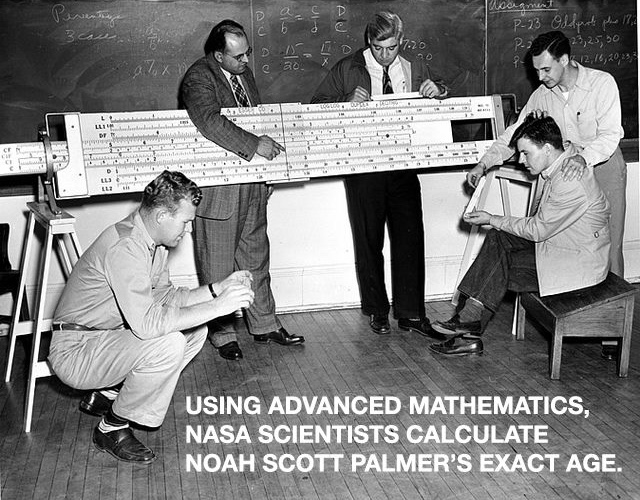
That big gadget in the photo is called a slide rule. Slide rules are non-electronic calculators that were used until the 1970s. NASA even used them to do calculations for the moon landings in the Apollo missions. You can multiply, divide, take square roots, calculate trigonometric functions, and all kinds of other things. There were also specialized slide rules for engineering, electronics, and other fields.

I collect slide rules, though it’s been a while since I found a new one. I looked far and wide for a large demonstration slide rule like the one shown in the photo, but I could never find one outside of a museum. I think they used to be pretty common in college classrooms, since STEM majors needed to learn how to use slide rules. Here’s part of my collection:

About 15 years ago, I was taking a pharmacology class — just for entertainment — and the professor gave us a pop quiz. I didn’t have a calculator with me, but by chance, I had a pocket slide rule in my shirt pocket. So I pulled it out and started doing calculations. After a minute, it dawned on me that the room had become very quiet. I looked up, and all the other students were watching me. They had no idea of what I held in my hands. The professor just laughed, since he had used slide rules when he was a student. After class, I showed the other students how it worked.

In the 1970s, of course, easier-to-use electronic calculators replaced slide rules. Today, increasingly powerful phone apps are replacing electronic calculators. Who knows what will come next: brain implants? We’ll see, I guess.

Here’s an incredibly good movie about something we did with slide rules. If you miss it in the theatre, be sure to get the Blu-Ray or watch it online. It’s amazing:


Posted in Life | Tagged , , , , | 2 Comments

Don’t Mistake Hate for Logic

We’ve probably all made the error of mistaking hate for logic.

Of course, we didn’t realize it at the time. But that’s what we were doing.

Yesterday’s blog post got me thinking about the problem.

On my “Top 10” list of great people in history, I included the Byzantine Empress Theodora (497-548 CE). Most current historians think she was a remarkable woman. But in her own time, one writer had a burning hatred for her and her husband, Emperor Justinian.

That writer was Procopius, an aide to Justinian’s most important general, Belisarius.

It’s easy to guess why Procopius hated the imperial couple. General Belisarius had saved both them and their empire several times, but they treated him badly.

Misled by his own aides into suspecting Belisarius of disloyalty, Justinian often shorted him on troops and repeatedly sent him into nearly-impossible battles — all of which he won. Only Belisarius’s genuine loyalty to the emperor prevented him from seizing power when he could easily have done so. Procopius saw that. He blamed Theodora most of all, since she was born a commoner like Belisarius and should have been his defender.

About other aspects of the Byzantine Empire, historians consider Procopius a valuable source of information. George Ostrogorsky calls him “the outstanding historian of the age of Justinian.”

But anonymously, Procopius also wrote a book called The Secret History. In that book, warns Ostrogorsky, he acted as “a malicious pamphleteer” who tried to blacken the reputations of Theodora and Justinian. He devoted an entire chapter to “The Crimes of Theodora,” claiming for example that:

“Her animosity was ever ready to be aroused to the destruction of other people, and no power on earth could mitigate it.”

Let’s stipulate that running an empire is at times a brutal business. Mister Rogers would not be up to the task. Both Justinian and Theodora were up to it. As a result, the Byzantine Empire (the eastern half of the former Roman Empire) survived for 1,000 years after the fall of Rome. Justinian and Theodora were no worse than other imperial rulers, and they were better than most.

Why would a usually sane and reliable person like Procopius tell hateful lies about them? Well, he was human. Humans do that. Sometimes we mistake hate for logic.

Here are two arguments that look similar. The first is logically valid. The second is a rationalization for hate:

Argument 1 (Modus Ponens) Argument 2 (Logical Fallacy)
1. If people do evil things, I hate them. 1. If people do evil things, I hate them.
2. Person X does evil things. 2. I hate Person X.
3. Therefore, I hate Person X. 3. Therefore, Person X does evil things.

Hate is usually a waste of time and energy. It keeps us from seeing things clearly. It sometimes misleads us into committing wrongs that we later recognize and regret.

But in spite of all that, Argument 1 at least makes sense. It’s logically valid. If the premises (1 and 2) are true, then the conclusion (3) must be true.

Argument 2, on the other hand, doesn’t make sense.

If we hate someone, it proves nothing about that person. But it does motivate us to look for something — anything — that we can twist into “evidence” as justification for our hatred.

We believe that we’re good people — and most of us are, at least when we’re thinking straight. We like to believe that we wouldn’t hate someone without a good reason.

So we think that if we hate someone, there must be a good reason. We just need to find it. If we look and don’t find it, we need to keep looking. If we still can’t find it, we need to look some more. It must be there. It must be. Otherwise, we would be hating someone without reason. We’d feel embarrassed and ashamed.

Let’s not be too hard on ourselves. We’re not infallible. Our emotions sometimes cloud our judgment. That applies whether we’re smart or not; rich or not; good, bad, or indifferent.

But if we care about truth and doing the right thing, then we sometimes need to check our thinking.

Are we applying Argument 1 that makes sense? Or Argument 2 that rationalizes hate?

It makes a big difference. Be a thinker, not a hater.


Check out my new book Why Sane People Believe Crazy Things: How Belief Can Help or Hurt Social Peace. Foreword Reviews called it “intriguing and vital to living.”

Posted in Epistemology, Human Relations, Life, Philosophy, Political Science, Psychology | Tagged , , , , , , , , , , , , , , , , , | Leave a comment

Do Great Individuals Shape History?

Great People

Is human history driven mainly by the actions of “great men”?

It’s called the great man theory of history.

Of course, the problem is that word “mainly.” Lots of things cause historical events. To say that a specific person was a “main” cause is quite a leap.

But it got me thinking about who I might choose as the great people of history.

In turn, that got me thinking about how to make such choices.

Who gets on the Top 10 List, and why?

Would it be people who were extraordinarily good? That should be a factor, but there are many good people of whom nobody’s ever heard. My religious tradition (Judaism) says that in every generation, there are at least 36 “hidden righteous people” whose meritorious lives earn God’s support for the world. Even so, if nobody knows who they are, then there’s no practical way to put them on a Top 10 List.

Would it be people whose actions had large effects on historical events? That gets us into two other problems, one moral and one logical.

The moral problem is that the list would include some very evil people. Adolf Hitler is everyone’s go-to example, but he’s got lots of company: Lenin, Stalin, Mao Zedong, and so on. They had large effects on historical events. But our conscience revolts at the idea of including them on such a list.

The logical problem is that hardly any effect has only one “cause.” Would the list claim that such people, by themselves, caused great effects on history? That’s absurd. No matter how evil Stalin was (and Russians seem to be reassessing that issue), he could not have done the evil things he did without thousands of accomplices and a boatload of circumstances that made his actions possible. The same applies to Hitler.

Consequential people might be necessary conditions for the events they “cause,” but they’re not sufficient conditions.

I’m not even convinced that they’re necessary conditions: does the man make history, or does history make the man? Probably a little of both. I’ve toyed with the idea of writing a science fiction novel about a man who travels back in time to 1890s Vienna. He befriends the young Adolf Hitler and turns him from evil to good. But he discovers that history is not thwarted so easily. By the 1930s, another man has become der Führer and Hitler becomes a freedom fighter. I’m probably never going to write it, so if you’ve got the interest and talent, you’re welcome to do it yourself.

But the bottom line is that any list of history’s great people is subjective and incomplete.

If I were forced to give a Top 10 list, it would be this or something like it. It’s based on my evaluation of the people themselves as well as their historical influence. The order does not indicate priority; it’s more or less based on the timeline:*

Adam and Eve; Gilgamesh

Metaphors, since the people themselves are legendary. Adam and Eve were the first people to be self-aware and morally conscious. Gilgamesh was the first person to realize his own mortality. They were, arguably, the first people to be truly human.

Hammurabi

Ancient Babylonian king (ca. 1750 BCE) who usually gets credit for the first written legal code, and whose code might have influenced the Bible. As far as I know, Hammurabi was actually the fourth Babylonian king to produce a written legal code, with earlier codes produced under the kings Lipit-Ishtar, Bilalama, and Ur-Nammu, who lived in the three centuries before Hammurabi.

Moses

Might be legendary: his birth story parallels the earlier story of the Sumerian King Sargon. In any event, he was the first person known to advance the idea of a single, moral God who defined a transcendent moral order by which even He would be bound.

Aristotle

Influenced almost every area of Western thought that came after him. Economics has been described as “a set of footnotes to Adam Smith.” Similarly, Western civilization can be described at least partly as a set of footnotes to Aristotle. From politics to physics, biology to religion, Aristotle’s influence is visible.

Gautama Buddha; Confucius

Founded the religious and philosophical traditions of China and much of Asia. Buddhism emphasizes spiritual development to cope with a world that is often hostile and cruel. Confucianism also emphasizes spiritual development but is somewhat less pessimistic about the world; it emphasizes the social order as a way to maximize human happiness.

Jesus

Whether or not he was Divine, as Christians believe, Jesus inspired the religious tradition that shaped Western civilization. Little is known for sure about “the historical Jesus.” However, the Jesus of the Christian Gospels taught an enlightened morality that, even in human hands, has done more good than harm.

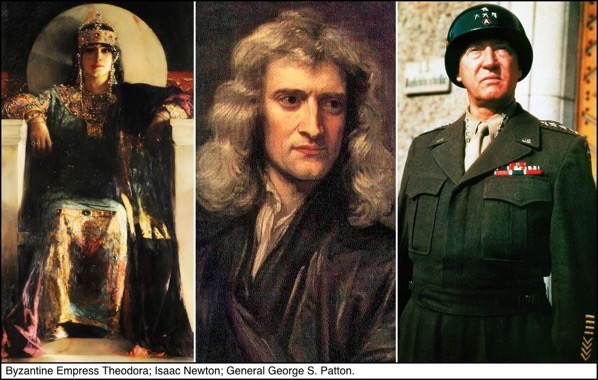
Theodora (Byzantine Empress)

Theodora was an improbable savior of the Byzantine Empire. Since she was both a commoner and an ex-actress, the Emperor Justinian had to change the law to marry her. But they were well-matched, both of them brilliant and usually courageous. When Justinian lost his nerve during the Nika revolt of 532 CE and prepared to flee the capital, historian George Ostrogorsky says that “he was prevented by the indomitable courage of the Empress Theodora.” Pop historian Lars Brownworth wrote a fictionalized version of the incident that gave her a good speech: “Every man who is born must sooner or later die; and how can an Emperor allow himself to become a fugitive? If you, my Lord, wish to save your skin, you will have no difficulty in doing so. As for me, I stand by the ancient saying: royalty makes the best shroud.” They defeated the revolt and neither of them ended up needing the shroud.

Isaac Newton

One of the greatest geniuses in human history, he pioneered the science of optics, discovered much of what is still taught in undergraduate physics courses, and invented calculus. He justly gets credit for calculus, though the German philosopher Gottfried Leibniz invented calculus at about the same time and the two men were bitter rivals. That wasn’t unusual for Newton: he was an unpleasant and rather paranoid person who suspected Leibniz of stealing his ideas. Newton developed calculus from earlier ideas of Isaac Barrow, one of his teachers at Cambridge University. In a rare moment of humility, Newton told the truth when he said that if he saw further than others, it was because he “stood on the shoulders of giants.”

Albert Einstein

Einstein is best known for his theories of special and general relativity, which changed our ways of looking at space, time, light, and gravity. Less widely known is that his 1905 paper on Brownian motion convinced many scientists for the first time that atoms really existed and were not merely a useful assumption. He also wrote extensively about philosophy and religion.

Winston Churchill

Churchill was a soldier, Nobel prize-winning writer, statesman, and an inspiring leader without whom Great Britain might not have survived World War II. Most of all, he was an English patriot and an unapologetic imperialist who loved his country and believed in its values. Those qualities made him a great man but, like all people, he had many flaws.

Footnote

  • It’s hard to identify great women: not because they don’t exist, but for two other reasons. First, feminists are right that women have often been denied opportunities and historians have neglected their contributions. Second, and I think more important, is that women typically affect history in less obvious and direct ways than men. They are more likely to be “the power behind the throne,” with the result that few people realize the extent of their influence. Women such as Hypatia, Joan of Arc, Sophie Germain, Harriet Taylor Mill, Hedy Lamarr (no, it’s really not “Hedley”), Rosalind Franklin, Hannah Arendt, and Ayn Rand could easily go on the list, but there are only 10 slots. To my dismay, the top 10 format also required me to omit Srinivasa Ramanujan, who is one of my favorite people.

Posted in Judaism, Life, Philosophy, Psychology, Society | Tagged , , , , , , , , , , , , , , , , , , | Leave a comment

Don’t Pass Over History

Who are you? What are you?

The answers define your identity and give you a sense of place in the universe.

The “who” question has a simple answer: your name.

But the “what” question has many answers. You are a son or daughter. You might be a lawyer, homemaker, software engineer, or painter. Some of the answers touch your soul more deeply than others. Those are important ones. Many of them come from history.

People often think that history is just about facts. Facts are part of it, but only a part. History weaves facts into an intellectual and emotional tapestry that tells us who we are, what our lives are about, and what kind of people we should strive to be. History:

  • Helps us understand the past by telling us what happened and when.

Even if the “why” is often ambiguous, some explanations are more consistent with the evidence than others.

  • Helps us understand the present by comparing it with the past.

The same problems tend to recur in different societies and historical periods. We can learn from what worked or didn’t work in past situations.

  • Helps us be good people by telling us stories of heroism and villainy.

Morality depends on both reason and feeling. No matter how sophisticated we get, our moral sense begins partly with “I want to be like him / her.” History provides examples that help us develop both the rational and emotional sides of morality.

  • Helps us maintain a strong sense of personal and group identity.

Inspiring historical stories encourage us to identify with our group’s heroes and to feel a personal connection to events in our group’s history.

  • Helps us maintain successful communities by legitimizing the social order.

To survive, any group or society must believe that it is good (even if it’s imperfect), and that it deserves to survive. Inspiring historical stories about the group’s origin, leaders, and ideals provide that foundation.

History’s various jobs sometimes conflict with each other.

For example, tonight is the first night of Passover, a Jewish holiday that celebrates freedom by commemorating the ancient Israelites’ exodus from Egypt. But it does more than that. In the Passover seder (meal), families ritually affirm their identity as Jews, their people’s relationship to God, and the moral ideals they should follow. Historical evidence is scant, but factual accuracy isn’t relevant to the stories’ main jobs of supporting morality while reinforcing personal and group identity.

The stories associated with Christianity’s Easter holiday are similar. Historical evidence is scant, but the stories’ most important jobs are moral and spiritual.


Check out my new book Why Sane People Believe Crazy Things: How Belief Can Help or Hurt Social Peace. Kirkus Reviews called it an “impressively nuanced analysis.”

Posted in Christianity, Judaism, Political Science, Psychology, Society | Tagged , , , , , , , , , , , | Leave a comment

Two Views of Life — and Government

Your parents lied to you. So did mine.

They told us:

“You can do anything if you make up your mind to do it.”

Nope. Not true.

Don’t be too hard on parents. It’s a well-meaning lie. It’s arguably even a justified lie. Children shouldn’t prematurely limit their aspirations in life.

We can do a lot of things, often more than we believe we can. Positive thinking is helpful. Determination and persistence make a difference. There’s an adage I like:

“You never know how strong you are until being strong is your only option.”

Even so, what we can actually accomplish is limited, both by our circumstances and by ourselves.

For example, I was on the cross-country running team in high school. I’m an unlikely runner, since I’m short, stocky, and barely on speaking terms with the bathroom scale. But the school required sports participation, and cross-country was the only sport that didn’t require calisthenics, which I hate.

At the first practice, I set a record for the longest it had ever taken anyone to run the cross-country course. At the end of the season, I got a varsity letter on my jacket for only three reasons: I worked hard, I always showed up, and I always finished. Not everyone did. Some of the better runners coasted on their natural ability, and they got letters, too. They won cross-country meets, so they earned them. On the other hand, at final exam time, they crowded into my dorm room in the evenings because academic subjects are where I had the natural ability.

So two factors both affect what we accomplish:

  • What we do, and
  • What we are.

The same applies to systems of government. Many of our political problems arise from grabbing one alternative and denying the other.

If government is just something that we make up — a rationalistic social contract — then we can make it any way we want. But if it grows naturally from the history, values, and traits of a specific group of people, then our options are more limited.

That’s why, for example, imposing “democracy” on Iraq at the point of a bayonet was always a fool’s errand. Democracy is a Western value, derived from our long history that goes back to Ancient Athens. It has no roots in the history or character of most Middle Eastern peoples or the rest of the world, for that matter. Iraq and Middle Eastern countries other than Israel are undemocratic because that’s what’s natural for them. We can try to persuade them that greater civic participation and individual freedom are good ideas, but such ideas do not survive easily in their soil.


Check out my new book Why Sane People Believe Crazy Things: How Belief Can Help or Hurt Social Peace. Kirkus Reviews called it an “impressively nuanced analysis.”

Posted in Life, Philosophy, Political Science, Psychology | Tagged , , , , , , , , , | Leave a comment

Cher Channels Ambrose Bierce

Cher, a pop singer who I loved for her 1990s music video featuring the animated characters Beavis and Butt-Head, has a new talent.

Her April 14th statement channels the spirit of the 19th-century American writer Ambrose Bierce. His book The Devil’s Dictionary includes this definition:

“CHRISTIAN: One who believes that the New Testament is a divinely inspired book admirably suited to the spiritual needs of his neighbor.”

Cher wants migrants as long as she and her city don’t have to deal with them.

Well-meaning individuals can support a policy of open borders or oppose it.

But it’s hypocritical to support open borders as long as it only affects other people.

That attitude is common, but it isn’t particularly Christian (or Jewish). We can do better. So can Cher.


Check out my new book Why Sane People Believe Crazy Things: How Belief Can Help or Hurt Social Peace. Foreword Reviews called it “intriguing and vital to living.”

Posted in Christianity, Judaism, Political Science, Psychology, Society | Tagged , , , , , , , | Leave a comment

Don’t Wait: Be Happy Now

Empiricism is the idea that beliefs should be based on observable evidence. It’s one of the main reasons that our civilization has been successful.

Empiricism has given us science, medicine, and technology. It’s given us choices and luxuries that people in previous centuries couldn’t even imagine. It’s enabled us to reduce extreme poverty around the world.

Even so, you can take it too far. Philosophers sometimes joke that “empiricists never have a nice day.” Empiricists can’t know if their day is nice until they get all the evidence. But by that time, their day is over and they don’t have it anymore.

The Ancient Greek historian Herodotus told a more serious version of the joke. In his Histories, he wrote about an encounter between the great Athenian lawgiver Solon and the Lydian King Croesus, who was the richest man of that era.

Croesus asked Solon who he thought was the happiest man in the world. Obviously, he expected Solon to answer “you are.”

But Solon surprised him by saying the happiest man was Tellus of Athens, an obscure person. When Croesus asked why, Solon replied:

“Because his country was flourishing in his days, he had good sons, he lived to see children born to each of them, and these children all grew up. And further because, after a life spent in comfort, his end was surpassingly glorious. He defended his country and died on the field most gallantly. The Athenians gave him a public funeral on the spot where he fell, and paid him the highest honours.”

Croesus wasn’t too pleased by that answer, so he asked about the second-happiest man in the world. Solon replied that the second-happiest men were the brothers Cleobis and Bito.

He explained that their mother had to travel to a religious festival six miles away, but the family’s oxen weren’t available. Cleobis and Bito yoked themselves to her carriage and pulled it to the festival as fast as they could run. Once inside the temple, the mother prayed to the goddess to bestow on her sons “the highest blessing to which mortals can attain.” And then:

“Her prayer ended, they offered sacrifice and partook of the holy banquet, after which the two youths fell asleep in the temple. They never awakened, but so passed from the earth. The Greeks, looking on them as among the best of men, caused statues of them to be made, which they gave to the shrine at Delphi.”

Croesus was furious. Here he was, the richest man on earth, and he didn’t even make the top two? He demanded an explanation. Solon replied:

“Human life is subject to the vagaries of chance. The longer the span of one’s existence, the more certain he is to see and suffer much that he would rather have been spared. Right now, you are fabulously rich and king of a great number of people. And yet for all that, I will not be able to say [that you were happy] until I have learned that you died contentedly.”

So it’s true: there are some things we can’t know until all the evidence is in hand.

But at other times, we need to get out ahead of the evidence.

We can’t control “the vagaries of chance,” but we can control how we handle them. We can choose to be as happy as our circumstances permit. We can look for ways to turn adversity into advantage. We can work to improve ourselves. And most of all, we can have faith in the essential goodness of the universe. Even if we don’t see how, things will work out.

Don’t always be an empiricist. Make the right choice. Be happy now.


Check out my new book Why Sane People Believe Crazy Things: How Belief Can Help or Hurt Social Peace. Foreword Reviews called it “intriguing and vital to living.”

Posted in Life, Philosophy, Psychology | Tagged , , , , , , , , , , | Leave a comment