Two Beliefs That Don’t Conflict

Some beliefs are inconsistent with each other. If you hold one of the beliefs, then you can’t hold the other. For example:

  • The number 5 is less than the number 10.
  • The number 5 is not less than the number 10.

But people often think that beliefs conflict when they really don’t conflict.

In a moment, we’ll get to a case that’s done great harm to society. But here are a couple of simpler examples to illustrate the point about beliefs that don’t conflict:

  • This apple is red.
  • This apple is round.

Those two beliefs are different, but they don’t conflict because they’re about different qualities of the apple. One belief is about its color, the other about its shape. And how about this pair of beliefs:

  • John is wearing a hat.
  • John is an accountant.

Again, there’s no conflict. Wearing a hat has nothing to do with being an accountant. Both beliefs can be true, even though they’re different.

Now consider the harmful case. Many people think that these beliefs conflict:

  • All people are equal in human dignity and human rights.
  • People vary widely in their character, behavior, and abilities.

Most people know that the second belief is true, but they’re reluctant to say so because they think it conflicts with the first belief.

That’s why they pretend to believe that any disparities between identifiable social groups must be caused by something nefarious. They’re afraid that if they admit any differences between people, they’re denying that some people have human dignity and human rights.

But if they think about it, which they hardly ever do, it’s obvious that the beliefs not only do not conflict, but cannot conflict. The reasons are simple:

  • They are different kinds of beliefs, and
  • They are about different things.

The second belief is about facts, just like “John is wearing a hat.” You can see John, you can see the hat, and you can see the hat on John’s head. Likewise, you can see that people do in fact differ from each other — both individually and, on average, in social groups. The fact that generalizations are sometimes false doesn’t mean that they’re never true.

But the first belief isn’t about facts, at least not in the same way as “John is wearing a hat.” You cannot find any physical thing or event corresponding to “human dignity” or “human rights.” Those are not facts. They are choices we make about how to treat other people.

To say that someone has human dignity and human rights is to say that you intend to treat him or her in a certain way, more carefully than you would treat things that do not possess human dignity and human rights.

To say that all people are equal in human dignity and human rights is to say that you don’t intend to treat anyone differently based on irrelevant characteristics.

Of course, that qualifier “human” will probably cause trouble someday. We might discover that dolphins are just as smart as we are. We might develop robots that can pass a rigorous Turing test and can behave exactly like human beings. We might encounter space aliens. None of them would be human, but they would be intelligent, self-conscious beings like us.  How could we argue that they lack “human” rights?

Like I said, it’s not about facts. It’s about choice. How do we choose to treat other living beings, and why? It’s worth thinking about.


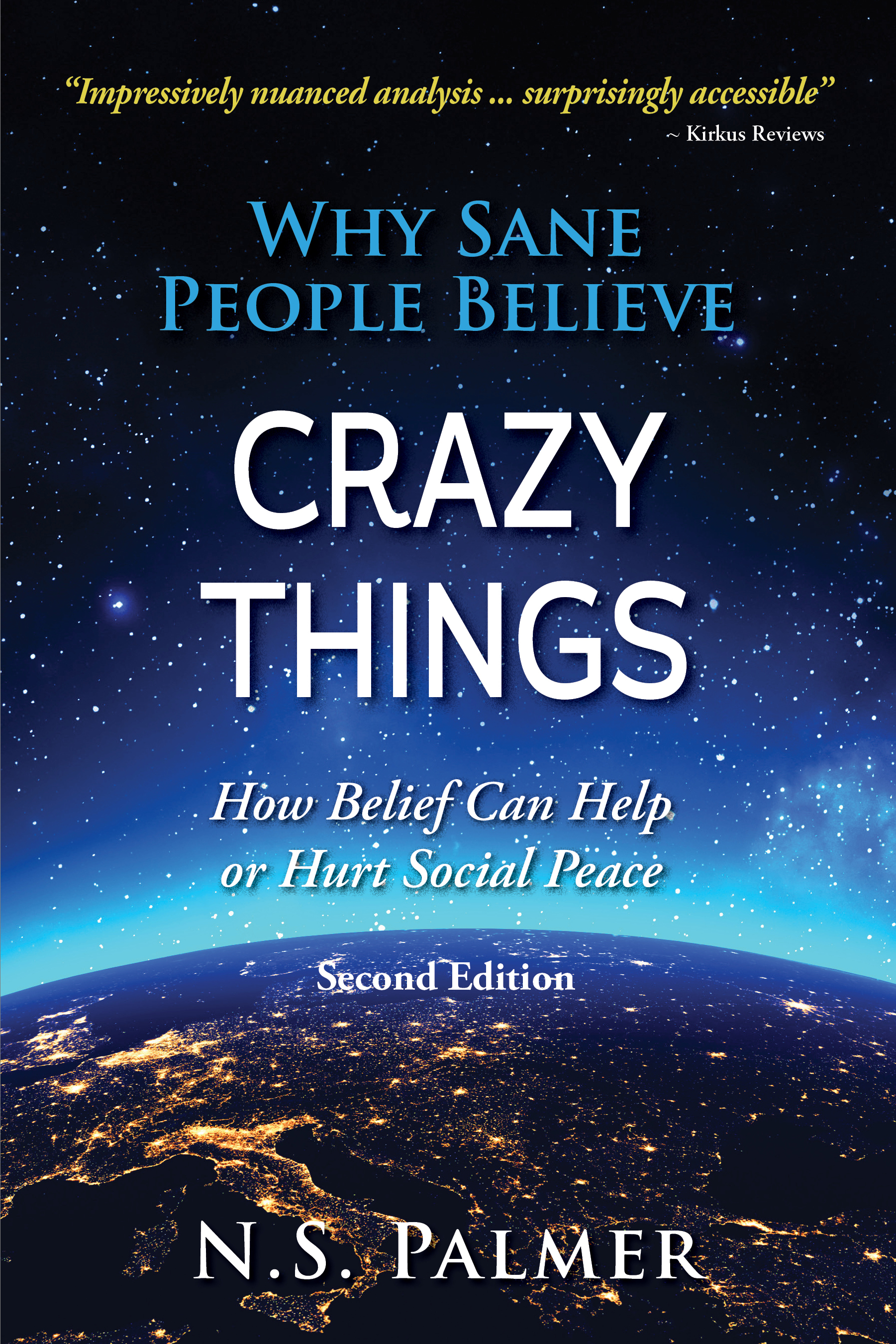
Check out my book Why Sane People Believe Crazy Things: How Belief Can Help or Hurt Social Peace. Kirkus Reviews called it an “impressively nuanced analysis.”

Posted in Human Relations, Philosophy, Psychology | Tagged , , , , , | Leave a comment

Memorial Day 2020

This is a beautiful video celebrating Memorial Day.

I’m proud to be an American. I’m grateful to those who founded our country and fought for it. May it always endure.

Posted in Life | Tagged , , , , , , , , | Leave a comment

Lockdown Imitates Art as “They Live”

“We are living in an artificially-induced state of consciousness … They have created a repressive society, and we are their unwitting accomplices.” — Scientist in “They Live”

As countries around the world struggle to recover from the Covid-19 pandemic, and as America struggles to recover from a terror-driven lockdown, it’s easy to see parallels with the 1988 dystopian movie “They Live.”

Think about it. Mindless obedience is the order of the day. People are terrified of going anywhere, doing anything, or interacting with anyone. Just as in the movie, they’re “in an artificially-induced state of consciousness.” They’ve learned helplessness:

  • Do social distancing, but it won’t really help since the virus floats in the air for hours.
  • Wear a mask. Don’t wear a mask. It won’t help, unless it does.
  • Don’t touch anything. Forget that, it’s safe to touch things. We might change our minds again tomorrow. We’ll let you know.
  • The virus kills three percent, no, five percent, seven percent, no, maybe zero point one percent or zero point zero one percent. But mainly, you should be afraid.
  • If you’re exposed to the virus, then you’re as good as dead, unless you don’t get infected, get infected but don’t get sick, or get only somewhat sick like a case of flu.
  • There are no treatments except some that will kill you, like the one that wasn’t in the fish tank cleaner that a woman apparently used to murder her husband. Society can’t re-open until there’s a vaccine, which might be never.
  • President Trump is taking one of the deadly treatments, which makes his critics sad because they love him so much.
  • Everyone is in danger. Well, mainly the elderly, people who are already sick, and nursing home residents in New York. Healthy people under 50 are in almost no danger, but you wouldn’t want to get infected and then kill granny, would you?

The Garcettis, Whitmers, and De Blasios send police to arrest people for opening small businesses, walking in the park, sitting on the beach, or exercising their Constitutional right to free speech. You vil obey! Ve have vays of making you comply! Tech monopolies back up the new dictators by censoring arguments that contradict the ruling narrative or that question the danger. The censorship alone makes me smell a rat: truth has nothing to fear from the free exchange of ideas.

Politicians know that the best lies are based on a grain of truth. Yes, Covid-19 is a real illness and you really don’t want to get it, especially if you’re in a high-risk group. Beyond that point, all of the 24/7 terror is mainly panic and propaganda.

Let’s be fair: in the beginning, nobody was sure about the danger. The crisis in Italy, where hospitals were overwhelmed, was scary as hell. It was totally reasonable to warn people to take precautions. It was debatable but not totally insane to lock down society for a couple of weeks, then see what happened.

And now we know what happened.

It’s a bad virus, to be sure, but it poses little threat to people outside of specific risk groups such as the elderly, the obese, and the chronically ill.

At the same time, people who need treatment for other illnesses aren’t getting it. The lack of social interaction causes mental illness and “deaths of despair.” The economic damage might take years to fix even if business and government do everything right, which almost never happens.

We need to accept the fact that life involves risk, and to tell the Covid Commissars what to do with their un-American, un-Constitutional diktats. High-risk people should continue to be careful, and nobody should behave recklessly. But even the CDC’s Dr. Anthony Fauci agrees that most of us need to get back to work. It’s time.


Check out my book Why Sane People Believe Crazy Things: How Belief Can Help or Hurt Social Peace. Kirkus Reviews called it an “impressively nuanced analysis.”
Posted in Political Science, Psychology, Society | Tagged , , , , , , , , , | 4 Comments

Is Cosplay the Same as Reality?

You might think it’s a joke, but I have a few serious questions. To me, the answers are obvious, but they’re obviously not obvious to everyone.

“Cosplay” (costume play) means dressing up as a fictional character. Some people earn a living at it. They perform at conventions and parties, but they seem to make most of their money by selling their cosplay photos on the internet. It is probably not a coincidence that most cosplayers are attractive young women.

Suppose that I decide to cosplay as Wonder Woman. I make an elaborate costume, wear a wig, put on makeup, and study the character so that I know how to act the part. I immerse myself in “Wonder Woman” lore, make videos in character as Wonder Woman, and start wearing the costume all the time instead of wearing my normal clothes.

Here are my questions:

  • Is everyone else required to pretend that I’m really Wonder Woman?
  • If they speak to me, must they address me as “Diana Prince”?
  • If they talk about me, are they required to refer to me as “she”?
  • Is it hateful and immoral if they don’t?

My questions are prompted by a fuss this week about the Twitch website, which features live video streams of people playing computer games. To its “trust and safety council” (i.e., ideology and censorship council), Twitch has added a person who it says is a “trans-deer girl.” All the articles about the event refer to this individual as “she.”

Regardless of our opinions about pronoun usage, the idea of a “trans-deer girl” presents some problems in itself. Are we supposed to believe that it is:

  • A man who thinks he’s a woman who thinks she’s a deer,
  • A woman who thinks she’s a deer,
  • A woman,
  • A deer,
  • An insecure person who desperately craves attention,
  • A cosplayer who’s really committed to the role, or
  • A crazy person who really needs to be committed?

Some combination of insecure and crazy seems most likely to me. The person wants to advise a gaming website about what to censor, and has opined that:

“Why bring it up? You don’t know the race of the people you are playing against … However, you know that this person actually does not believe that gamers are white supremacists, because of this massive, sh*t-eating grin. She can barely contain her joy at telling you that you are white supremacists. Now, you have to somehow justify that you’re not a white supremacist … When someone makes wild and ridiculous allegations like this, with a huge grin on their face, that’s a person having fun at your expense. This is not a person you should be taking seriously, and it’s certainly not a person that Twitch should bring onto a safety advisory council, because they are not an honest actor.”

Posted in Philosophy, Psychology | Tagged , , , , , , , , , , , | 7 Comments

Free Yourself and Live


“You have at least nine months. Perhaps as much as eighteen.”

“The first doctor gave me from one to two years.”

“I hope he’s right. What are you going to do?”

“Well, I have no family. I haven’t taken a day off since law school. I guess I’ll try to squeeze thirty years of living into one. Or two.”

Many people consider the 1950s to be “the golden age of television.” I just don’t see it.

It was the final decade in the golden age of radio, which started in the 1930s. But as far as I can tell, most 1950s television programs were pretty bad. Comedians Sid Caesar and Lucille Ball were wildly popular, but I’ve seen their clips and they don’t make me laugh. Toward the end of the decade, a few new shows got it right. “Perry Mason” became a long-time hit, and “The Rifleman” was so popular that foreign heads of state wanted to meet its star when they visited America.

Many of the better television programs were transplanted from radio, such as The Jack Benny Show, “Dragnet,” “Gunsmoke,” and “The Lone Ranger.” There were even political thrillers like a retitled version of “I Was a Communist for the FBI,” which was the 1950s counterpart of “I Was a Congresswoman for the Bronx.”

But for me, the golden age of television spanned the 1960s to the 1990s.

After fumbling around in the 1950s, Hollywood in the 1960s finally knew how to do television. Shows included “Star Trek,” “The Twilight Zone,” “The Fugitive,” and other series that were both entertaining and thought-provoking. In the 1970s, there were “M.A.S.H.,” “The Mary Tyler Moore Show,” and “The Six-Million Dollar Man.” The 1980s had “The A-Team,” “Magnum P.I.,” and “Hill Street Blues.” The 1990s brought “Seinfeld,” “Quantum Leap,” more “Star Trek,” and a couple other shows near and dear to me.

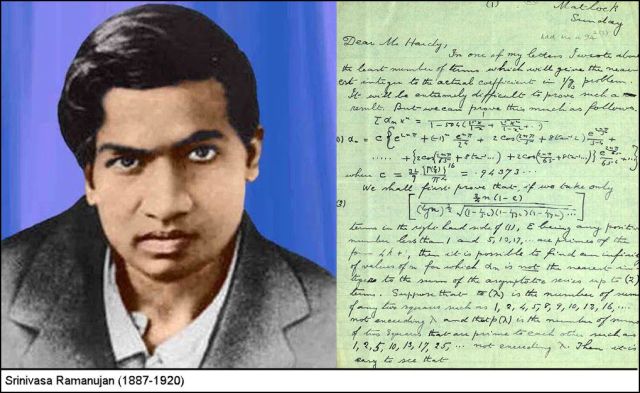
Which brings us back to the 1960s, and the television series “Run for Your Life” (1965-68).

The main character, lawyer Paul Bryan, had a terminal illness. The clock was ticking. Each episode featured a death-defying adventure of some kind. When hoodlums pointed guns at him, he laughed in their faces. He knew he was going to die anyway.

Ironically, that knowledge freed him to live, because he lost his fear of death.

And if the first half of the year 2020 has a motto, it’s “Fear of Death.” It’s a motto that has not served us well.

Everyone must make his or her own decisions about life. Every sane adult has that right. Some people whom I deeply respect think that Covid-19 lockdowns should continue, and that we’re doing too much too fast. I think that a year from now, we’ll look back on these months as a time of madness, when lockdowns did more harm to our country and to us as individuals than Covid-19 could ever have done. But we’ll see. I have no crystal ball.

I wouldn’t advise anyone to act recklessly. But we shouldn’t spend our lives being afraid. That’s not living, it’s only existing. Rocks can do that. We are meant for better things.

Our lives are limited in time and space: we can’t change that fact. What we can change is how we use the time we’ve been given. We should live our lives to the fullest — looking for the joy and beauty of each day, doing good things, and sharing time with our loved ones.

And getting haircuts. That’s definitely on my list.


Check out my book Why Sane People Believe Crazy Things: How Belief Can Help or Hurt Social Peace. Kirkus Reviews called it an “impressively nuanced analysis.”
Posted in Life, Philosophy, Political Science, Psychology, Science, Society | Tagged , , , , , , , | 8 Comments

How to Beat the Social-Isolation Blues

Are you discouraged? Depressed? Fearful? Confused? Unmotivated?

Then I’ve got a cure for you.

It’s guaranteed. It costs nothing. And it will pay dividends for the rest of your life.

You need to know three things. The first two are scientific facts. The third is outside the scope of science, so science has nothing to say about it.

First: Your body affects your emotions

Humans evolved not as solitary individuals, but in groups. As a result, we are biologically adapted for that environment. We need to interact with other people. If we can’t, then it affects us physically: we feel lethargic or depressed.

But there’s good news: The parts of our brains that get depressed by loneliness are the old parts. They evolved in our prehistoric ancestors countless ages ago, when photos and video didn’t exist.

In prehistoric times, if we saw someone in front of us, it could only be an actual person. As a result, the primitive parts of our brains can’t distinguish very well between realistic video and real people. Even if we know intellectually that it’s video, our brains react the same as if the people were there with us. That means we can use apps like FaceTime and Zoom for video chats to “fool” our brains. It’s not quite as good as the real thing, because it’s not 3-D and it lacks a few sensory cues that operate below our conscious awareness. But it helps reduce the impact of social isolation.

Another way to fool our brains is for us to act like we feel happy and energetic. From past experience, we associate those feelings with actions like smiling, standing up straight, and walking briskly. As a result, simply doing the actions can create some of the feelings that go with them. The neuroscience is a little more complicated, but the basic point is that it works. Scientists found that:

“a happy facial expression led to the subjects’ experiencing ‘happiness,’ an angry facial expression to their experiencing ‘anger,’ and so on.” (Anthony Damasio, Descartes’ Error, p. 148)

And don’t forget the great outdoors. Our ancestors lived in natural surroundings: sky, trees, fresh air, and ground under their feet. If you can, get out of the house and take a walk. Enjoy the beauty around you. Your body will enjoy it too. And you’ll feel better.

Second: You are unique

No one else on earth has exactly your combination of abilities, skills, and knowledge. No one else on earth has your life experiences. As a result, no one else on earth can do what you can do exactly as you do it.

You have a unique contribution to make to the world. Nobody else can substitute for you. Without you in the world, your contribution is lost. Whether you’re famous or unknown, whether your contribution is great or humble, you are irreplaceable.

Whether or not you realize it, your life matters. You are one of the most important people on earth.

Third: You’re on a mission from God

This is the speculative part of the remedy. It might be true, or it might not. Logic and evidence can’t tell us.

So I’ll tell you: You are here on earth for a reason. If you’re still here, then the reason still applies.

Can I prove it? No.

Can anyone disprove it? No.

Is it a helpful belief that might be true? Yes.

You’re here in this life to do the things that only you can do. You’re here to love, help, and connect with people. You’re here to make a difference.

Whether you believe you were put here by God, fate, karma, or the natural order, you’re still here. Make yourself useful. And that, too, will make you happier.


Check out my book Why Sane People Believe Crazy Things: How Belief Can Help or Hurt Social Peace. Kirkus Reviews called an “impressively nuanced analysis.”

Posted in Life, Science | Tagged , , , , , , , | 3 Comments

Ramanujan and Me

Tomorrow, April 26, is notable for two reasons.

First, it’s my birthday. I’ll be 39. Again. That’s my story and I’m sticking to it.

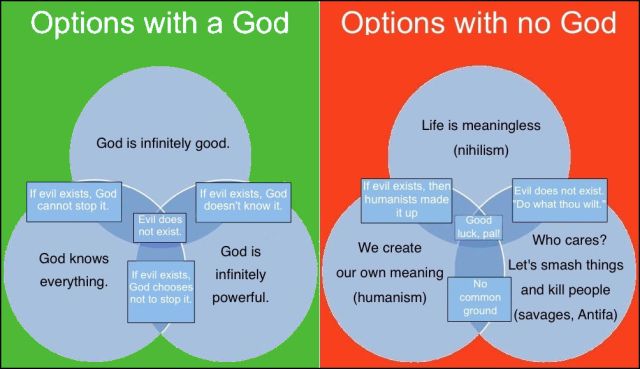
Second, it’s 100 years since the death of Srinivasa Ramanujan, one of the greatest mathematical geniuses of all time.

Ramanujan was born in India in 1887. He got a basic high school education, but was expelled from college because he ignored everything except mathematics. Eventually, he ended up at Cambridge University in England.

His mentor at Cambridge was G.H. Hardy, a famous number theorist. Hardy wrote about visiting Ramanujan in the hospital in 1917:

“I had ridden in taxi-cab No. 1729, and said that the number seemed to me a rather dull one. ‘No,’ he replied, ‘it is a very interesting number: It is the smallest number expressible as a sum of two cubes in two different ways.'”

Say what?!

Ramanujan didn’t need to think about it. He could just see it. Hardy, in amazement, went back to his office and worked it out on paper. Ramanujan was right.

That kind of insight was actually a point of contention between Hardy and Ramanujan. In mathematics, it’s not enough just to know something: you must be able to prove it. It was so easy for Ramanujan to see things that he wasn’t accustomed to proving them. He could prove them, and he did, but only after Hardy nagged him to do it.

Tragically, Ramanujan died at 32 of a liver infection for which we now have a cure.

Since he mostly worked on number theory, his discoveries are too esoteric for most people to appreciate. I studied them for my mathematics degree, but even I only understand one of them (his work on continued fractions) really well. Number theory is widely used today in computer science, especially in computer security.


Check out my book Why Sane People Believe Crazy Things: How Belief Can Help or Hurt Social Peace. Kirkus Reviews called it an “impressively nuanced analysis.”
Posted in Philosophy, Science | Tagged , , , , , | Leave a comment

What I Think Happened with Covid-19

After over a month of lockdown in most American states, people are starting to ask questions about it.

Why did this happen? How did it happen? Was it really necessary?

Here’s how the situation looks to me. This is not a medical analysis. It’s a personal viewpoint:

First, yes, Covid-19 is a real thing and it’s worse than the flu. We still don’t know exactly how much worse. But it’s definitely something to avoid. The lack of reliable information is starting to seem a little odd.

Second, what frightens people the most isn’t the disease itself, but the uncertainty. If you get Covid-19, you might never even feel sick — especially if you’re under age 50. Or you might get the sniffles. Or you might feel like you have the flu. Or you might suffer terribly and then die. You just don’t know. It’s a little like living next door to a nuclear power plant. You’ll probably be fine, but if there’s a meltdown, you could be in big trouble.

Third, I think that events unfolded like this:

  • The virus got started in China. How, I don’t know. It doesn’t matter at this point.
  • It started at the worst possible time. It was the Chinese New Year, when people traveled all over China to celebrate. Others traveled abroad. The virus traveled with them. And it spread.
  • As on the Diamond Princess cruise ship, most people who were exposed to the virus didn’t get infected (that’s my best guess based on what I’ve seen).
  • Of those who got infected, some didn’t get sick at all. Others got moderately sick. A small percentage got extremely sick and required hospitalization. Some died. It was ugly. It was frightening.
  • Italy had so many sick and dying people that its health care system was overwhelmed. That scared the hell out of everyone, including medical professionals.
  • Based on almost no data, a few epidemiologists cooked up worst-case scenarios that turned worldwide fear into worldwide panic. After decades of watching movies about a zombie apocalypse, people were ready to imagine the worst. And they did.
  • News media hyped the danger to get views and clicks. A headline like “School Board Approves Funding” gets much less attention than “Everyone’s Going to Die!” So we were treated 24/7 to variations on “Everyone’s Going to Die!” We still are.
  • A few countries handled the situation well, or at least effectively. China clamped down hard to quarantine affected areas, using all of the authoritarian muscle at its command. South Korea and Taiwan contained the spread via contact tracing. Sweden imposed few restrictions and had a few more deaths, but voluntary precautions seem to have worked without the need to wreck the country’s economy.
  • In the United States, sadly, politics infects everything. A booming economy and Americans’ rekindled optimism were President Trump’s most powerful arguments for re-election in November. The Covid-19 panic smashed both of those, and Trump-haters want them to remain smashed until after the election. Their strategy is to continue the lockdown for as long as possible, do as much damage as possible, while blaming Trump for all of it. Medical experts will tend to go along with the lockdowns because they think only of medical risks; economic and social risks aren’t part of their brief.
  • Meanwhile, millions of newly-unemployed Americans are becoming impatient. They aren’t going to wait much longer. Covid-19 is a risk. So are power-mad government officials, economic ruin, and starvation. A lot of people will roll the dice and take their chances. They have no desire to be the new Kulaks in AOC’s socialist paradise.

Political and social leaders should support carefully re-starting the economy, while protecting people who are most at risk (mainly the elderly) and encouraging everyone to continue sensible safety practices.


Check out my book Why Sane People Believe Crazy Things: How Belief Can Help or Hurt Social Peace. Kirkus Reviews called it an “impressively nuanced analysis.”
Posted in Life, Political Science, Psychology, Science | Tagged , , , , , | 4 Comments

The Wisdom of James Bond

“You only live twice:
Once when you are born,
And once when you look death in the face.”
     — James Bond

“James Bond” is now a movie franchise, just like “Star Wars” was. But it started out as a series of novels by British author Ian Fleming (1908-1964).

Fleming had been a Naval intelligence officer during World War II, after which he was assigned to Moscow. James Bond was Fleming’s alter ego: a bit of what he was, and a lot of what he wanted to be.

Fleming’s first James Bond novel, Casino Royale (1952) was a huge best-seller. After that, he wrote one James Bond novel per year until his death in 1964.

But even as the novels gained worldwide popularity — boosted by praise from President John F. Kennedy — Fleming was getting bored with the character. He planned to write You Only Live Twice as Bond’s final adventure.

In the previous book, On Her Majesty’s Secret Service, the hard-edged Bond had fallen in love and married Tracy Draco. On their honeymoon, Tracy was murdered by one of Bond’s enemies.

At the beginning of You Only Live Twice, Bond is an emotional wreck. He’s on the verge of getting fired. His boss decides to give him one last chance: a mission that is crucial but considered impossible. Eventually, the villain of the story turns out to be (you guessed it) Tracy’s murderer. Bond completes his mission, but at the cost of his own life:

“What was it all about? Bond didn’t know or care. The pain in his head was his whole universe. Punctured by a bullet, the balloon was fast losing height. Below, the softly swelling sea offered a bed. Bond let go with hands and feet and plummeted down towards peace, towards the rippling feathers of some childhood dream of softness and escape from pain.”

Both fans and Fleming’s publisher were aghast at Bond’s death. They persuaded Fleming to add a final chapter in which Bond survived. But the novel originally ended with Bond’s obituary in The Times newspaper:

“A senior officer of the Ministry of Defence, Commander James Bond, C.M.G., R.N.V.R., is missing, believed killed, while on an official mission to Japan … May I suggest these simple words for his epitaph? Many of the junior staff here feel they represent his philosophy:

‘I shall not waste my days in trying to prolong them. I shall use my time.'”

That’s a dilemma we all face every day: the tradeoff between living safely and just plain living. As James Bond knew, human life is more than just having a pulse, even if a pulse is a very nice thing to have.

It’s a dilemma that we’ll need to solve in the next few weeks, both as individuals and as societies. How we solve it will depend on — and will reveal — who we are.


Check out my book Why Sane People Believe Crazy Things: How Belief Can Help or Hurt Social Peace. Kirkus Reviews called it an “impressively nuanced analysis.”

Posted in Life, Philosophy, Psychology, Society | Tagged , , , , , , | 1 Comment

Why Evil Exists

Today is Easter 2020, when Christians in Western countries celebrate (where permitted by law) the resurrection of Jesus. Eastern Orthodox Christians in Greece, Turkey, Russia and thereabouts celebrate it next week.

Today is also the middle of Passover, when we Jews celebrate our ancestors’ escape from slavery in Egypt. Passover started last Wednesday evening and ends next Thursday. We are making do, just like the Christians, using Facetime or Zoom for Passover Seders.

Both holidays include beliefs that help people lead happy, moral, productive lives. To the extent that they succeed, they can be justified on that basis alone. I’ll leave the theological arguments to the theologians.

But whether religious or not, most people wonder why evil exists.

If they believe in God, then they wonder why He lets bad things happen. Even if people don’t believe in God, evil still bothers them because they have a moral sense.

So why does evil exist?

I can only give you my answer:

Because without it, a universe like ours is impossible.

Goodness exists for the same reason, but that doesn’t bother anyone.

One or many?

A universe can either have just one thing, or it can have multiple things. Those are the only choices. There is no third option.

Just one thing was what our universe had before the big bang if you like science, or before the tzimtzum if you prefer mysticism.

Either way really amounts to mysticism. Neither time nor space existed before the big bang, at least in the way we experience them. Therefore, to talk about “before” the big bang is nonsense. But our language developed to handle life on earth, so it breaks down when we talk about how the universe began.

If a universe has multiple things, then it must be possible to distinguish between them. If two things A and B are the same in every way, then A = B. They’re the same thing.  Then you’re back to having just one thing in your universe. So the multiple things must all have specific properties that distinguish them from each other.

Suppose that your universe has four dimensions, as we perceive in ordinary life:

  • Left-right (X)
  • Up-down (Y)
  • Front-back (Z)
  • Earlier-later (T)

If things in your universe are distinct, then they can’t be infinite. They must be limited. Otherwise, each of them would occupy the entire universe. And then you’d be back to having just one thing in your universe. The same principle applies no matter how many dimensions your universe has.

Therefore, everything in our universe must be limited in space (along the X,Y, and Z axes) and in time (along the T axis). Things must also be smaller than the universe itself along each of those axes. As a result, things can move along those axes unless they collide with another thing.

A universe might also have some default values, such as (in our universe) the speed of light. Some things might have default limits along particular axes:

  • Height (Y)
  • Lifespan (T)

Boosters and blockers

As it moves through time and space, a thing C might collide with another thing D. Depending on their properties, D might help C keep moving or stop it.

For example, some bacteria help people digest their food, while other bacteria are deadly. Both types affect our ability to keep moving along the time (T) axis.

Adding conscious things

If some things in the universe are conscious, that adds another dimension because consciousness is a matter of degree. Even plants and micro-organisms exhibit a primitive form of consciousness, behaving differently based on what’s happening around them. Animals take it up a notch from plants, and humans take it up a notch beyond that.

When a conscious thing C collides with another thing D that stops it, then C is aware of the collision. If C doesn’t care about colliding with harmful things, then the harmful things are more likely to stop its progress. Therefore, reality tends to eliminate C-things that don’t care. What’s left are C-things that do care. They try to avoid collisions with harmful things.

If things are self-conscious, they are not only attracted by helpful things and repelled by harmful things, they are aware of themselves reacting in the way that they do. They might put the label “good” on helpful things and the reactions they produce, and put the label “evil” on harmful things and the reactions they produce.

Therefore, if a universe (1) has multiple things in it, (2) where the things interact, and (3) some of the things are self-conscious, then evil is unavoidable. It’s baked into the system. On the bright side, so is goodness.


Check out my book Why Sane People Believe Crazy Things: How Belief Can Help or Hurt Social Peace. Kirkus Reviews called it an “impressively nuanced analysis.”
Posted in Bible, Christianity, Jewish Philosophy, Judaism, Philosophy, Science | Tagged , , , , , , , , , | Leave a comment