How Captain Marvel Got Mary-Sued

How did blonde Hollywood actress Brie Larson end up getting cast as Captain Marvel?

And why do so many movie fans seem to hate her?

I hold no brief for or against Ms. Larson. I don’t know her. I’ve never seen her in a movie. I’ve only seen her in a couple of video interviews. She seemed rather unpleasant, which itself is a bit strange because an actress should be able to fake being nice even if she isn’t. Other videos by movie fans harshly criticize Larson, both as an actress and as a person.

The biggest complaint seems to be that Larson’s Captain Marvel is a “Mary Sue.” She can’t improve as a person because she’s already perfect. She can’t learn anything new because she already knows everything. People make the same complaint about the character of Rey in the recent “Star Wars” movies. I don’t know if they’re right, because I haven’t seen those movies. “Star Wars” is dead to me.

Criticizing Larson’s Captain Marvel is unfair in one way, but fair in another way.

It’s unfair because in the 1941 movie serial, the original Captain Marvel was a male Mary Sue. But there was a reason: even in the story, he wasn’t an actual person. That’s the fair part of the criticism. They’re both Mary Sue characters, but at least he has an excuse.

In the story, nerdy explorer Billy Batson was trapped in an ancient tomb. He encountered a spirit named “Shazam” who gave him the power to turn into Captain Marvel to fight evil.
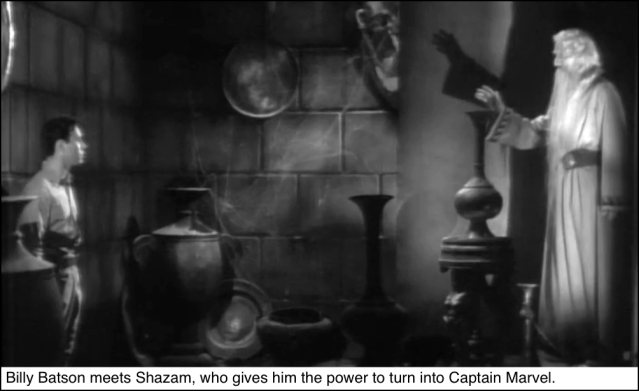
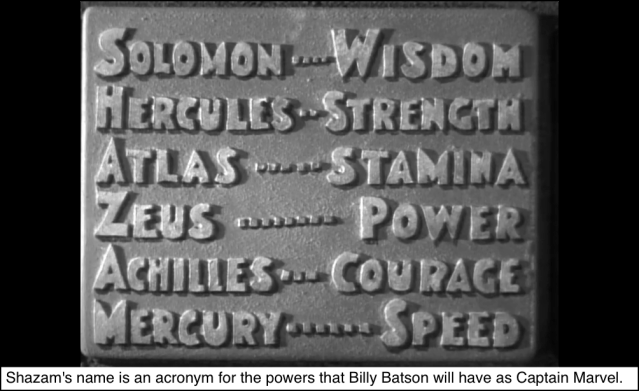
But who was Captain Marvel? Like the character of Mongo in “Blazing Saddles,” Captain Marvel was less a “who” than a “what.” He was the embodiment of abilities from Solomon, Hercules, Atlas, Zeus, Achilles, and Mercury: names whose first letters spell “Shazam:”
Of course, Larson didn’t write the character she plays, so she can’t be blamed for it. But she does seem to hate the kind of people who would normally go to superhero movies — i.e., boys and men. Assuming that theatres still exist when the next Marvel superhero movie comes out, that could be a problem. Hatred doesn’t sell tickets.

Posted in Society | Tagged , , , , , , , | Leave a comment

The Day After the Fire

Yesterday, of course, my apartment building caught fire. When I posted a photo of the fire, there was no way for me to know how the situation would turn out.

The good news: nobody was killed or seriously injured. Most of the roof to the east of my apartment was burned away, but thanks to the firefighters — may God bless them! — the fire didn’t spread much farther than that.

My apartment was untouched by the fire, but the building’s structure was damaged so it’s  boarded up. Nobody can move back in until the building inspector declares that it’s safe.

It’s funny what you grab when you learn that the building is on fire. I grabbed my laptop, my iPad, my Chinese class notebook, a framed photo of my father and me, and a framed photo of my philosophical mentor, Prof. Blanshard. Just on instinct, those were the things that I most wanted to save in case my apartment got burned up.

Standing out in the parking lot, I got to know my neighbors a little better. Next door lives an ex-Navy IT guy. Upstairs is a nice Chinese woman, but I didn’t get to practice my Chinese with her because she’s from Hong Kong and speaks the Cantonese dialect. I’m studying Mandarin. The two dialects are written the same way but pronounced differently.

After the fire stopped, the firefighters let us go back into our apartments to get things that we’d need while we were staying elsewhere. That’s when I got my second-tier items: shirts, clean laundry, two framed degrees, a framed drawing by a lady I like, and a framed set of medals that I got in high school (yes, I know it sounds silly). I also got a toothbrush, floss, comb, bar of soap, and a towel. It’s a scary universe, and a man’s got to know where his towel is. Anyway, I wasn’t yet sure where I was going to spend the night, so a towel and soap weren’t totally crazy.

I wish I’d thought to take a second pair of pants, because it wasn’t until later that I realized how smelly and sooty my clothes had become. I can go to a laundromat without wearing a dress shirt, but not without wearing pants.

I decided to drive five miles north to my office parking lot and decide where to go from there. After I’d parked, I my cell phone revealed a 4.5-star hotel about a half-mile away. And that’s where I am now. It’s not ruinously expensive and my renter’s insurance covers it. My hotel room window has a view of sorts — mostly office buildings, apartments, and some retail stores that died from the lockdown (though their death certificates will say it was from Covid-19). On the bright side, I can get to my office in five minutes.

I drove back to the apartment complex today to take the photo shown at the top of this blog post. The area still smelled smoky. As long as I was there, I took the opportunity to do my daily “power walk” — I could call it just a “walk,” but “power walk” sounds much more impressive. From my apartment to the Jewish Community Center and back is just over two miles. It’s not a hard workout, but if you go fast enough, you at least work up a sweat.

The JCC’s fitness center is open again after shutting down for the CoronaDoom, but I enjoy the walk outdoors. Today there were other people out walking, dressed better than me because they were going to the Orthodox synagogue down the same street. I respect the daylights out of the Orthodox because their way takes incredible dedication and seriousness of mind. But I once went to one of their services and I had almost no idea of what was going on. What matters is that they’re good people and it works for them.

Posted in Life | Tagged , , , | 4 Comments

Priorities, Priorities

A little Friday evening surprise

Priorities, priorities. I am fine. I am sitting in my car in the carport across from my apartment building. The roof caught on fire for reasons that are yet to be determined. The fire department got here with four firetrucks, and seems to have contained the fire.

Someone told me that the firemen had to break down my door to get into my apartment, but if that’s the only damage to my apartment, I will count myself — once again — as a very lucky guy.

P.S. The fire trucks just left, and I do indeed count myself as a very lucky guy. So I think things worked out as well as they could have.


Posted in Psychology | Tagged , , | 2 Comments

Why “My Truth” Isn’t “The Truth”

Why is “my truth” not “the truth”?

My friend Rachel Fulton Brown will on Sunday at 2pm EST participate in a webinar titled “Dialogue with Dignity: Across Liberal-Conservative Divides.”

The goal is admirable: people with different viewpoints will engage in a civil and respectful exchange of ideas. Several of the panelists are psychotherapists, but in a society that’s gone nuts, it’s a plausible lineup. It should be an interesting discussion.

To keep the conversation on track, the panel agreed on three ground rules:

  • “To speak for ourselves and from our own experience, using ‘I,’ not ‘you,” when expressing our thoughts.”
  • “To refrain from criticizing each other or attempting to convince each other that our viewpoint is correct.”
  • “To listen with resilience when we hear something that we find hard to hear.”

To those three rules, I suggested a fourth rule:

  • Phrases such as “my experience,” “my sense,” and “my viewpoint” are fine. However, use of the phrase “my truth” is forbidden since it implies the non-existence of “the truth” (whatever the truth might be).

One of the panelists posed a fair question, amounting to “What’s wrong with using the phrase ‘my truth’?”

“How might these two people speak to one another? Can they get beyond the particular phrase to a more substantive conversation?”

The short answer is this: If they merely want to say how they feel, and how the world looks to them, then they can indeed have a substantive conversation. There is value in simply being heard and acknowledged by other people. But in that case, the phrase “my truth” is both superfluous and misleading.

It’s superfluous because it’s just a fancy way of saying “my experience,” “my feeling,” or “my viewpoint,” all of which are explicitly allowed.

It’s misleading because it suggests that they are talking about truth, which involves a reality beyond their subjective feelings and perceptions.

What Is Truth?

Just for fun, let’s start with a quote that many people think is from the Bible but which actually isn’t:

“’What is truth?’ said jesting Pilate, and would not stay for an answer.”

That’s actually from Francis Bacon’s (1561-1626) essay “On Truth” in his book Essays or Counsels Civil and Moral. Bacon, in turn, was riffing on the New Testament’s Gospel of John 18:38:

“Pilate saith unto him, What is truth? And when he had said this, he went out again unto the Jews, and saith unto them, I find in him no fault at all.”

Pilate probably meant “What is the truth,” asking about the facts of the situation. If Jesus answered Pilate’s question, the Bible doesn’t tell us.

But here, we’re interested in what truth is, itself. What is it that makes some beliefs true and other beliefs false?

Philosophers have various theories about it. However, they all agree on one thing: Truth is a relation between a belief and the reality to which it refers:

  • You believe that “there is a pencil on the desk.”
  • In fact, there is a pencil on the desk.
  • Therefore, your belief is true.

If “my truth” means something other than “my viewpoint” or “my deeply-held feeling,” then it is either:

  • Useless because it’s entirely subjective and solipsistic. It refers only to the speaker’s private experience of the world. People cannot even “agree to disagree,” since nobody can know what anyone else is talking about.
  • False because it seems to refer to a fact beyond the speaker’s private experience, but it does not. There’s “no there, there” to which “my truth” can be true.
  • Something other than truth, which leads us inexorably back to “my viewpoint” and similar expressions.

Sure, it’s quite possible to have a conversation with the phrase “my truth.” But it’s like eating spaghetti with a hammer: it’s inefficient and you’ll get a lot of it on your shirt.

With spaghetti, your goal is to eat, and your choice of utensils makes a difference. With discussion, your goal is to communicate, and the same principle applies. If you use phrases that are ambiguous or misleading, it’s inefficient and you’ll get a lot of it on your shirt.

Posted in Psychology | Tagged , , , , , , | Leave a comment

Normies Don’t Care About Ideology

Politically-aware people of all stripes often think about how to talk to “normies:” that is, normal people who don’t pay much attention to politics or other social issues.

Normies don’t read The New York Times or Breitbart. They don’t spend every waking hour worrying about who’s president. They don’t care what race you are. They don’t have strong beliefs about social justice (whatever it is) or gender ideology (as long as it doesn’t come for their kids). They don’t riot or, as the media would call it, “engage in peaceful protest.” They’re a little scared of Covid-19 but are vague about the details.

Normies don’t want any trouble. They’ve been told that America is an awful place where minorities are persecuted, but they’ve never seen that first-hand. All the minority people who they know are doing fine. They’ve been told that police are killing black people for no reason at all, but they have a hard time believing it. They’ve been told that they and their ancestors are to blame for everything that’s wrong with the world, but they know it isn’t true so they don’t worry about it very much. If Rachel Maddow and Jerrold Nadler stood side by side, normies couldn’t tell you which was which.

Normies just want to live their lives, provide for their families, and not bother anyone. Is that too much to ask? It seems like it shouldn’t be.

Posted in Life, Psychology, Society | Tagged , , , , , | 3 Comments

A Visit with Esther and Joe

Did you ever wish you could thank some people from your past who helped you when you needed it?

For me, two of those people were Esther and Joe. They owned a little “mom and pop” grocery store around the corner from where I lived.

After my original parents divorced, I was living with my mother. Well, the word “with” is slightly inaccurate. She had won me in the divorce, so I was theoretically in her care. But she felt that she had more important things to do than look after a kid. She was gone most of the time, which left me on my own. If I hadn’t beaten Roe v. Wade to the finish line, I probably wouldn’t have been there at all.

In her defense, at least abstractly, she might indeed have had some important things to do. As an off-the-charts genius (no joke), she did a lot of good for a lot of people — just not for anyone in her family. But kids don’t really understand those kinds of abstractions. It took me a while to get there. As Oscar Wilde said:

“Children begin by loving their parents; as they grow older, they judge them; sometimes, they forgive them.”

People are what they are. Their ability to change is limited. That applies to parents, too. We can either like it or not like it: it will still be true.

But a kid has to eat. I got a lot of my food from Esther and Joe’s little grocery store. They let me buy the food “on account,” so I didn’t have to pay for it. The assumption was that my mother would pay the monthly bill. I don’t know if she did. But I knew Esther and Joe. Looking back, it wouldn’t surprise me if they never got paid for any of it.

Anyway, here’s where it gets weird. I’m going to tell you about a dream I had last night. Feel free to tune out if that kind of stuff bores you.

In the dream, I was living in a hotel. I wanted something to eat, but the restaurant was closed. So from the lobby, I went down a back staircase to the basement, where I found a short staircase leading back up, with a door at the top. I went up the staircase, opened the door, and there was Esther and Joe’s old store. They were standing behind the counter.

They hadn’t changed, and neither had their store. But I was my current, adult self. I thanked them for taking care of me when I was a kid, and I apologized for not appreciating it properly at the time. They said not to worry about it. And then they had questions.

Esther wanted to know if I’d married “a nice Jewish girl.” I said that I had, and that she was a fine person but that it had ended. Joe wanted to know if I’d bought a Toyota, and seemed thrilled when I said that I had.

In the dream, I didn’t remember that two nights earlier in real life, I’d had another dream — strangely realistic, quite torrid, and involving the aforesaid “nice Jewish girl.” Maybe she was dreaming about me, too.

At any rate, it was good to see Esther and Joe again, and finally to thank them for their kindness. Even if it was only in a dream.

Posted in Life, Psychology | Tagged , , , , , , , , | 2 Comments

Utopia’s Biggest Problem

Blogger Marcus Ampe has written a thoughtful essay about utopianism. But he’s realistic about the impossibility of creating a perfect society. He wants, instead, to think about ways we can make society better. That’s a practical goal for which we should always strive.

But striving for improvement is not the same as striving for perfection. A simple example shows the essential problem.

Can you draw a circle? Of course you can.

But can you draw a perfect circle? A perfect circle is a geometric object in a plane. All of the points on the line forming the circle are exactly the same distance from the center of the circle.

And that means you can’t draw a perfect circle. You need to have the idea of a perfect circle even to draw an imperfect one. However, any circle you draw will have minor flaws in it. You can’t draw a perfect circle: you can only draw a better circle.

If you set your mind on drawing a perfect circle and nothing less, then you’ll waste hours drawing one imperfect circle after another. If your friends try to dissuade you, you’ll get angry at them. You might start to think that the reason for your repeated failures is that your friends are sabotaging your efforts.

The same thing happens when people try to create a perfect society. No society ever has been or ever will be perfect. But utopians waste their time and cause great harm by rejecting possible goals and pursuing an impossible goal.

Because their goal can never be achieved, nothing will ever be enough. They think we should keep doing the same things, just do them harder. Spend more money. Take away more freedom. Police more speech.

The word “utopia” was coined by Sir Thomas More as the title of his novel Utopia. It comes from two Ancient Greek words that translate as “no place.” More knew very well that there was “no place” on earth you can find a perfect society. You can only try to make a better one.

Posted in Philosophy, Political Science, Society | Tagged , , , , , , , , , , | 1 Comment

Self-Esteem Versus Self-Respect

“Self-esteem” means feeling good about ourselves.

And it’s nice to feel good about ourselves. It’s a cheap and easy pleasure.

But it’s better if we have reasons to feel good about ourselves.

That’s an important difference between self-esteem and self-respect.

American President Abraham Lincoln (1809-1865) knew the difference. In 1832, he ran for the Illinois State Legislature. His campaign supported infrastructure improvements, public education, and limiting interest rates.

His reason to run for office was a personal desire to improve society. Although he used the word “esteem,” it’s clear that he was talking about respect:

“Every man is said to have his peculiar ambition. I have no other so great as that of being truly esteemed of my fellow men, by rendering myself worthy of their esteem.”

He didn’t just want to feel good about himself. He wanted other people to respect him because he had done things worthy of their respect.

Unlike mere self-esteem, self-respect has to be earned. It requires hard work, courage, and commitment.

In passing, Lincoln’s argument about the purpose of education was notable:

“Education seemed to him the most important question a people could consider, for every man should have sufficient education to read the history of his own and other countries, ‘by which he may duly appreciate the value of our free institutions … to say nothing of the advantages and satisfaction to be derived from being able to read the scriptures and other works.’”

— Abraham Lincoln: A Biography by Benjamin P. Thomas

In 2020, we see all around us the results of mis-education. Many Americans know hardly anything that’s true about their own country’s history. Their schools taught them only vicious lies about it. As a result, they fail to “appreciate the value of our free institutions.”

Posted in Life, Psychology | Tagged , , , , , | Leave a comment

Things to Know and See

In the famous words of Emil Faber, “knowledge is good.”

That’s because it helps us to live successfully and happily.

It’s no guarantee. And it’s not always what we want to hear. But in general, it’s better to know the truth than not to know it.

Things to know

So here are some truths that it’s good to know:

  • We’re all going to die someday, of something.
  • It probably won’t be today, and it probably won’t be of Covid-19.
  • For healthy people under 60, it very probably won’t be of Covid-19.

The Christian Saint Augustine said that “we live by faith, not by sight.” And in many ways, that’s true. We need to take a lot of things on faith: that the world will be here tomorrow, that we deserve to live, and that eventually justice will be done. That last one keeps a lot of politicians awake at night.

Something to see

But sometimes, it can help to see things. Like this:

Notice that Covid-19 deaths peaked in the middle of April and have been declining ever since. That’s much the same graph you’d see in any epidemic, with or without lockdowns.

Notice also that even at the peak, people under 45 were at relatively low risk. And now, the death count has dropped so much that it almost vanishes into statistical noise.

The noise is louder because of over-counting. Did you know that according to the official autopsy report, the famous George Floyd had Covid-19? If not for a video, he might have been counted as a Covid-19 death, though he was also suffering from a fentanyl overdose and severe heart disease. (The official autopsy report is a public record and was available on the website of the Hennepin County Medical Examiner, but has now been removed.)

So those are things I think you should know and see.

How you choose to apply that knowledge is up to you.


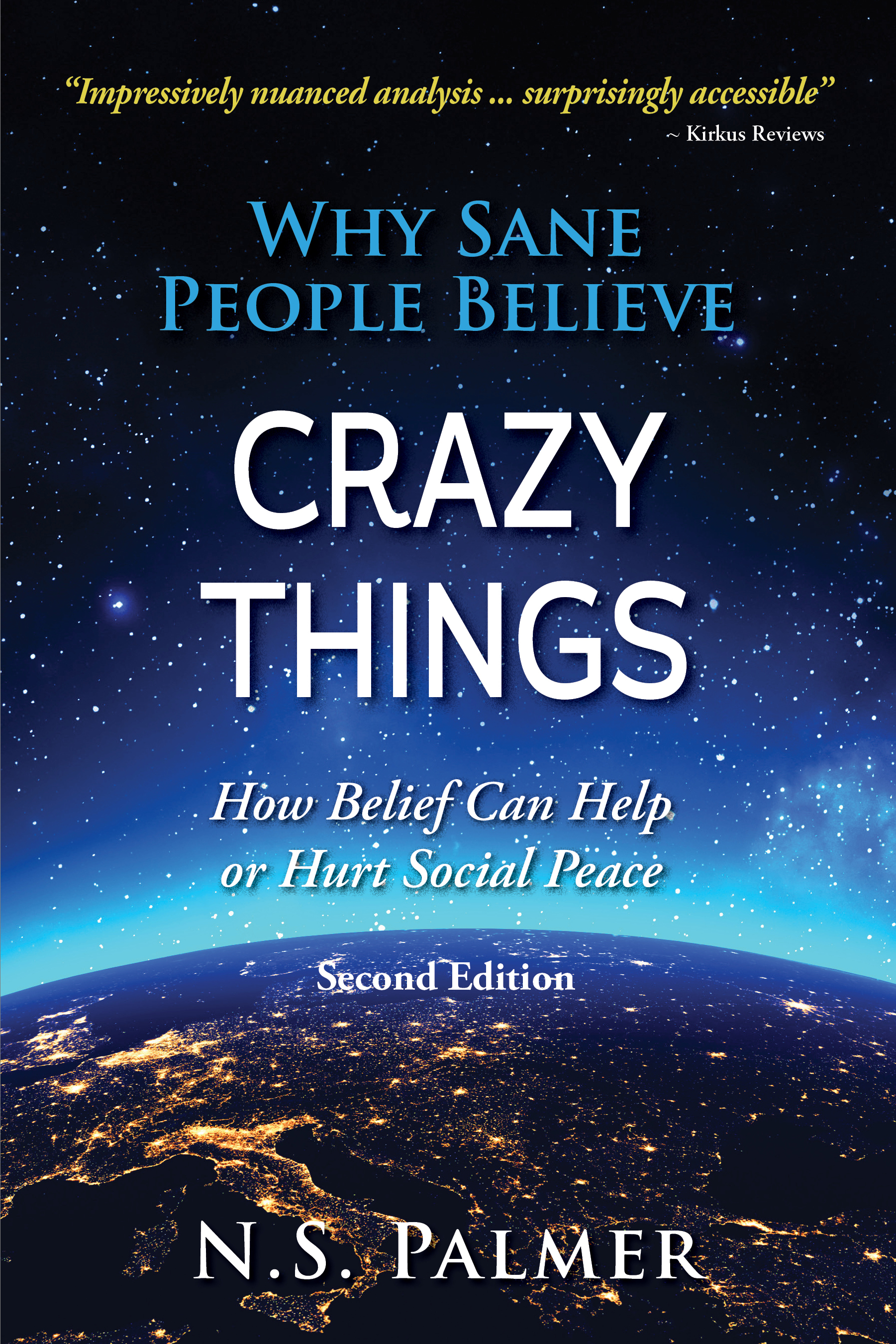
Check out my book Why Sane People Believe Crazy Things: How Belief Can Help or Hurt Social Peace. Foreword Reviews called it “intriguing and vital for living.”

Posted in Life, Political Science, Psychology, Science | Tagged , , , , , , , | Leave a comment

America Will Be (More) Authoritarian

History is full of surprises, but this prediction is a pretty safe bet:

In the next 10 years, America will become even more authoritarian.

It probably won’t be called “America,” though that change might take a little longer. The continent was named after Amerigo Vespucci, who was one of them. And you know who they are: the cause of every evil since the beginning of the universe.

I’m one of them. You probably are, too. Even if America is cleansed of every trace that we were ever here (e.g., no electricity, antibiotics, or running water), the name would still have to change. “Bedlam” is available.

But as for why it’s such a sure thing that America will become more authoritarian, I’ll let Edmund Burke tell you:

“Society cannot exist, unless a controlling power upon will and appetite be placed somewhere; and the less of it there is within, the more there must be without.

It is ordained in the eternal constitution of things, that [people] of intemperate minds cannot be free. Their passions forge their fetters.”

Their passions forge their fetters.

In order for society to exist, people must cooperate. That requires them to follow the rules and to control their own actions.

If they can’t follow the rules and control their own actions, then:

  • Either society will disintegrate into anarchy, a war of all against all; or
  • Government (or its equivalent) will impose control so that society can survive.

There’s no third option. If America exists at all, it will be more authoritarian.

Posted in Political Science, Society | Tagged , , , , , , , , , , , | Leave a comment