Turning Around Spinoza’s Challenge

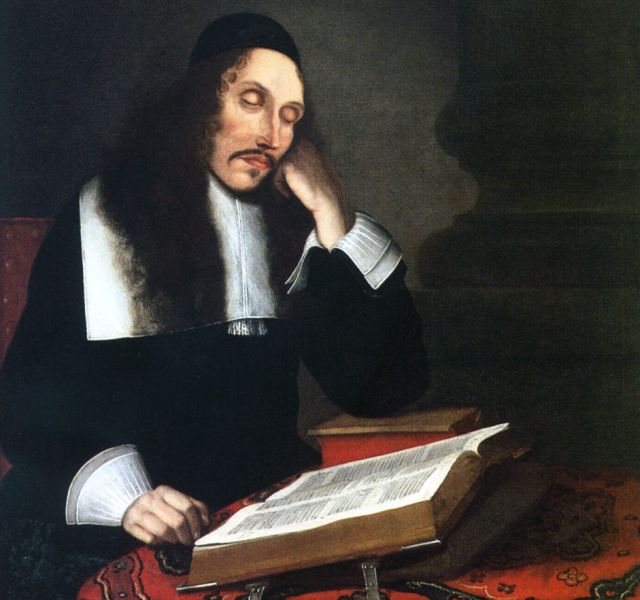
Baruch_Spinoza_-_Franz_Wulfhagen_-_1664-01cr1By N.S. Palmer

Spinoza meant it as a taunt. But it might hold one of the keys to Jewish survival.

Depending on where you sit, Baruch de Spinoza is either the founder of modern Jewish philosophy or Judaism’s deadliest critic.

Born in Amsterdam in 1632, Spinoza grew up in a tolerant Dutch society. He went to synagogue and observed Jewish law. His curiosity, however, led him outside of our tradition to the ideas of French philosopher Rene Descartes. He became known as an expert on Descartes.

Then, for reasons that even today are uncertain, synagogue leaders condemned and excommunicated him:

“… having long known of the evil opinions and acts of Baruch de Spinoza, they have endeavored by various means and promises, to turn him from his evil ways. But having failed to make him mend his wicked ways, and, on the contrary, daily receiving more and more serious information about the abominable heresies which he practiced and taught and about his monstrous deeds … they have decided … that the said Espinoza should be excommunicated and expelled from the people of Israel. By decree of the angels and by the command of the holy men, we excommunicate, expel, curse, and damn Baruch de Espinoza, with the consent of God, Blessed be He …”1

That’s pretty intense stuff, especially directed at someone who was observing the law and participating in the community. What could have prompted it?

Spinoza probably fell into the same snare that later caught Moses Mendelssohn, though the results for Mendelssohn were merely embarrassing, not cataclysmic.

In conversation, two students begged Spinoza to tell them his real beliefs. They promised to keep what he said confidential. Spinoza told them that he found nothing in the Bible about God being incorporeal or human souls being immortal. The students then broke their promise and told the Jewish leadership. Condemned for believing what he thought was the truth, Spinoza must have felt especially bitter about the students’ betrayal of his trust.

That pushed him away from Judaism. But at the same time, he was finding his way toward something else: a relentlessly logical, rationalistic view of the world. He was turning into “Maimonides on steroids.”

Spinoza pursued rationalism with fanatical zeal. He sounded at times like someone who had a religious conversion and “got saved.” In his Treatise on the Emendation of the Intellect, he wrote of his disillusionment and redemption:

“After experience had taught me that all the things which regularly occur in ordinary life are empty and futile … I resolved at last to try to find out if there was anything which would be the true good … if there was something which, once found and acquired, would continuously give me the greatest joy for eternity … I would be giving up certain evils for a certain good.”2

Can I get a “hallelujah”?

Spinoza’s worship of reason, and the fact that he saw it as something that “would give him the greatest joy for eternity,” accounts for some of the aggressiveness with which he attacked the Jewish tradition.

But back to Spinoza’s taunt.

Spinoza thought the Bible was a book of myths and fables used by the religious hierarchy to control people: “ancient words which may well have been adulterated with malicious intent.”3

He struck a pose of taking the Bible seriously, but only for sarcastic exegesis to find inconsistencies and absurdities. In the end, he claimed that the Biblical text is “erroneous, mutilated, corrupt and inconsistent, that we have only fragments of it, and that the original text of the covenant which God made with the Jews has perished.”4

And then he made what he thought was his clincher argument: that to take the Biblical text seriously was to worship the words themselves. He said that his adversaries

“… are converting religion into superstition, indeed verge, unfortunately, on adoring images and pictures, i.e. paper and ink, as the word of God.”5

Let’s ignore Spinoza’s inflammatory rhetoric. Instead, let’s ask what function is served by the text itself, independent of its interpretation. A few things are relevant:

  • Jewish sages such as Saadia Gaon and Maimonides tell us that we cannot comprehend God or form any mental concept of Him.
  • Since our minds cannot comprehend God, our beliefs about Him are formed mainly of speech and action: What we say, what we write, and how we behave.
  • We cannot know how anyone else mentally interprets the Biblical text. We can only know what they say and how they behave.
  • When we speak of God, we have words but we can have no mental concept that corresponds to His reality. When all we have are words and behavior, then it is the words and behavior that matter.

We can turn around Spinoza’s taunt by embracing the text and tradition as our own. Spinoza thought it was a devastating criticism, but it wasn’t: It’s how a transcendent and loving Creator communicates with His own people.

Our text, our tradition, and our history — however we interpret them — are part of what binds us together as a people and as a faith. We need not “worship” those things to find that they, themselves, are important. They are the visible signs of our commitment to God and to each other.

Works Cited

Della Rocca, M. (2008), Spinoza. Routledge Publishing, London.

Israel, J., editor (2007), Spinoza: Theological-Political Treatise. Cambridge University Press, Cambridge.

Shirley, S., translator (1992), Spinoza: Ethics, Treatise on the Emendation of the Intellect, and Selected Letters. Hackett Publishing Company, Indianapolis.

Footnotes


  1. Della Rocca, M. (2008), p. 20. 
  2. Shirley, S. (1992), p. 233. 
  3. Israel, J. (2007), p. 188. 
  4. Ibid, p. 163. 
  5. Ibid, p. 164. 
Posted in Jewish Philosophy, Judaism, Philosophy | Tagged , , , , , , , | Leave a comment

Mendelssohn and Missionaries

Mendelssohn

By N.S. Palmer

How should we as Jews respond to Christian missionaries?

Many Jews see Christian evangelism as a threat. Even though staunch Christians are our strongest defenders, their motives are obvious. They believe that the return of Jews to Israel presages the second coming of Jesus, whom they wrongly identify as the Jewish Messiah and (in our view) blasphemously identify as God.

Often in our history, our Gentile supporters have assumed that if they were nice to us instead of persecuting us, we’d abandon our faith and convert to Christianity. We got that treatment a lot in 18th and 19th-century Poland, Austria, and Russia.

The German Jewish philosopher Moses Mendelssohn (1729 -1786), hailed as “the Socrates of Berlin,” had the same problem. On two occasions, well-meaning Gentiles who admired his writing publicly challenged him either to refute their Christian arguments or convert.

Mendelssohn felt he had to respond to the challenges, lest his silence be taken as agreement. He replied by changing the subject, since he wanted to avoid criticizing Christian beliefs and antagonizing the non-Jewish majority.

Most relevant to our situation, he also saw that even incorrect beliefs could have good results, supporting moral behavior and social tolerance. He argued that we should not attack such beliefs if we can avoid it:

“Whoever cares more for the welfare of mankind than for his own renown will keep a rein on his opinions concerning prejudices of this sort … I am obliged to remain silent if these [religious] errors … are accidentally connected to promotion of the good.” 1

Christian missionaries can be annoying, but they mean well and are misinformed about Judaism. In particular, they misunderstand the idea of the Jewish Messiah and early Christianity’s relation to Judaism. Early Christians fell into three groups:

  1. Those who saw Christianity as a Jewish sect like the Essenes. This group of Christians believed that to be Christian, you had to be Jewish and had to follow the Jewish law.
  2. Those who saw Christianity as opposed to Judaism, even to the extent of having a different God. Marcion of Sinope and his followers were in this group. They wanted to have nothing to do with Judaism.
  3. Those who saw Christianity as the universalistic successor to Judaism. They wanted to establish their historical credentials by finding Jewish antecedents for their faith. Claiming that Jesus was the Jewish Messiah fulfilled that wish.2

However, Jews thought of the Messiah as a human leader who would restore their possession of the land of Israel and make peace with the nations of the world. A few Jews thought he might work miracles, but the idea that he was Divine would never have entered their minds.

The Christian Messiah concept starts with the Jewish idea, but then overlays the pagan idea of a god who comes to earth and dies for the sins of humankind.

That was a common myth in Biblical times: a notable example was Hercules, who in Seneca‘s play “Hercules Oetaeus,” suffers and dies for humanity. In his last moment, he cries out “Consummatum est!” (It is finished!) — the same words that the Gospel writer later put into the mouth of the dying Jesus.

Missionaries are often annoying and usually misinformed. We should not be taken in by their specious arguments. At the same time, however, we should recognize that they are often good people who draw moral and spiritual support from their beliefs. Our complaint is that they want to take away our faith: we should avoid trying to do the same to them.

Take a tip from Moses Mendelssohn: Don’t engage missionaries’ arguments. Be nice, be respectful, and wish them well. Then wish them goodbye.

Works Cited

Gottlieb, M. editor (2011), Moses Mendelssohn: Writings on Judaism, Christianity, and the Bible. Brandeis University Press, Waltham, MA.

Footnotes


  1. Gottlieb, M. (2011), p. 12. 
  2. Another motivation was that the Romans respected ancient institutions. One  reason that Jews were persecuted less than Christians was that Judaism was much older than Christianity. For practical reasons, early Christians might have wanted to adopt Jewish history as their own. 
Posted in Christianity, Jewish Philosophy, Judaism | Tagged , , , , , , , , , | 3 Comments

Is the Messiah Coming?

Kaplan-on-Rambam

By N.S. Palmer

Is the Jewish Messiah coming?

Yes.

But it’s complicated.

Belief in a Messiah is central to the Jewish tradition. Maimonides listed it as a key principle of Judaism:

“I believe with perfect faith in the coming of the Messiah. No matter how long it takes, I will await his coming day.” 1

In his book Maimonides’ Principles, Rabbi Aryeh Kaplan (1934-1983) summarized Maimonides’s comments on the subject:

  • We do not know when the Messiah will come.
  • He will be a righteous King of Israel.
  • He will bring about world peace and enable all Jews to return to Israel.
  • “Nothing will change in the Messianic age, however, except that the Jews will regain their independence.”
  • “Rich and poor, strong and weak, will still exist in the Messianic Age. It will be very easy for people to make a living, however, and with very little effort they will be able to accomplish very much.”
  • “Man’s lifetime will be vastly extended. Worries and troubles will no longer exist, and therefore people will live much longer.” 2

Those comments seem inconsistent. World peace is a noble aspiration. Unfortunately, history shows it is impossible without changing human nature or the nature of reality. But another comment says that neither will change, only that “the Jews will regain their independence.”

Maimonides could not have missed the inconsistency. What could he have meant by making the Messiah a central belief?

It’s worth considering how different Jewish philosophers might resolve the paradox. Maimonides was a rationalist, but committed to Judaism and the welfare of the Jewish people. Spinoza was a rationalist, but was hostile to both. Moses Mendelssohn was a pragmatist and, like Maimonides, he was loyal to Judaism and the Jewish people.

Suppose that Maimonides, Spinoza, and Mendelssohn are each given an apple and told that it is a duck.

Maimonides assumes that the statement must be true even though it seems false. He reinterprets it metaphorically in a way that makes it true. He says that even though the apple looks like an apple, in some non-obvious and morally instructive way, it’s really a duck.

Spinoza will have none of that. He says the apple is obviously an apple, so the statement is false and is trying to manipulate people by playing on their hunger. He does not assume that the statement must be true, so he sees no need to reinterpret it metaphorically.

Mendelssohn says that it doesn’t matter if it’s an apple or a duck. What matters is how we can use it as a guide for our conduct. The apple/duck question is a purely academic issue. What’s important is that we can eat either one of them.

I can’t tell you what Maimonides really believed about the Messiah. However, because of his rationalism, it’s unlikely he believed in the future arrival of a Jewish king who would perform miracles. What might he have believed, in the privacy of his own thoughts?

He might have believed that “the Messiah” is a metaphor for Yetzer HaTov, the impulse to goodness that exists in every human soul.

As Rabbi Joseph Telushkin has remarked,

“The messianic idea has long elevated Jewish life, and prompted Jews to work for tikkun olam (perfection of the world).” 3

The Messiah comes whenever we perform an act of loving kindness; when we support our community; when we turn enemies into friends; when we forgive; when we do a mitzvah; and most of all, when we turn our thoughts, our wills, and our lives to God.

Works Cited

Kaplan, A. (1975), Maimonides’ Principles: The Fundamentals of Jewish Faith. National Conference of Synagogue Youth / Union of Orthodox Jewish Congregations of America, New York.

Telushkin, J. (2010), Jewish Literacy. Harper Collins, New York.

Footnotes


  1. Quoted in Kaplan, A. (1975), p. 89. 
  2. Ibid, p. 90. 
  3. Telushkin, J. (2010), p. 616. 
Posted in Jewish Philosophy, Judaism, Modern Orthodoxy | Tagged , , , , , , , , , , | Leave a comment

Is It Reason or Revelation?

Phil-of-Scripture

By N.S. Palmer

Apart from goofy statements made by individual philosophers, philosophy has a pretty good reputation. It uses logic, cites evidence, and presents comprehensible arguments that you can accept or reject on their merits.

On the other hand, religious revelation has a pretty bad reputation. Most modern people think it’s just a lot of myths about supernatural beings, told by ancient savages who didn’t understand the world and were afraid of lightning. You either believe in the supernatural beings, or you don’t.

But that distinction is misleading. In his book The Philosophy of Hebrew Scripture, Yoram Hazony points out that works of philosophy often describe appearances by supernatural beings. He also shows that the Bible has philosophical content. He asks:

“Is it true that in confronting a text that depicts God as speaking and acting, we really have no choice but to classify it as revelation; and, consequently, to rule it out as a work of reason?”*

Hazony argues that we don’t.

Parmenides

Consider Parmenides, a pre-Socratic Greek philosopher who was one of the founders of Western philosophy. He referred to gods, but his writings are considered works of reason:

“The goddess received me kindly, and took my right hand with her hand, And uttered speech and thus addressed me: ‘Youth attended by immortal charioteers … you should learn all things, both the steadfast heart of persuasive truth, and the beliefs of mortals, in which there is no true trust.” **

Consolation-of-Philosophy

Or consider The Consolation of Philosophy, written by the 6th-century philosopher Boethius while he was in prison awaiting execution. It describes his dialogue with the Goddess of Philosophy, who visits him in his prison cell:

“She was of awe-inspiring appearance, her eyes burning and keen beyond the usual power of men. She was so full of years that I could hardly think of her as of my own generation, and yet she possessed a vivid colour and undiminished vigour … I saw that it was my nurse in whose house I had been cared for since my youth: Philosophy. I asked her why she had come down from the heights of heaven to my lonely place of banishment.

‘Why, my child,’ she replied, ‘should I desert you? This is hardly the first time wisdom has been threatened with danger by the forces of evil. In olden times, too, before the time of my servant Plato, I fought many a great battle against the reckless forces of folly. And then, in Plato’s own lifetime, his master Socrates was unjustly put to death — a victorious death, won with me at his side.'”***

Jewish-Study-Bible

Passages in the Bible, though stylistically less direct, are similar. Genesis 12:1-3, for example:

“The Lord said to Abram, ‘Go forth from your native land and from your father’s house to the land that I will show you. I will make of you a great nation, And I will bless you; I will make your name great, And you shall be a blessing. I will bless those who bless you And curse him that curses you; And all the families of the earth Shall bless themselves by you.'”****

Hazony reads that passage as being partly historical explanation and partly moral instruction: “Be a blessing to all the families of the earth.”

He doesn’t claim that all of the Biblical text is philosophical. However, he makes a solid case that if we interpret explicitly philosophical texts’ supernatural references as a stylistic device, we have no good reason to apply a different and harsher standard to the Bible.

“Reason or revelation” is a false dilemma. Clearly, the Bible is both.

Footnotes

* Hazony, Y. (2012), p. 6.
** Gallop, D. (1984), loc. 1191.
*** Watt, V. (1991), p. 11.
**** Brettler, M. (2014), loc. 1656.

Works Cited

Brettler, M. et al, editors (2014), The Jewish Study Bible, second edition. Oxford University Press, Oxford, UK.

Gallop, D., (1984), Parmenides of Elea. University of Toronto Press, Toronto, Canada.

Hazony, Y. (2012), The Philosophy of Hebrew Scripture. Cambridge University Press, Cambridge, UK.

Watts, V., translator (1991), The Consolation of Philosophy by Boetius. The Folio Society, London, UK.

Posted in Bible, Jewish Philosophy, Judaism, Philosophy | Tagged , , , , , , , , , , , , , | Leave a comment

Is Jewish Philosophy Bad for the Jews?

Mendelssohn-Jerusalem

By N. S. Palmer

Is Jewish philosophy bad for the Jews?

I think it has to do with apple pie.

Whatever it has to do with, it’s not an idle question.

Moses Mendelssohn, the 18th-century philosopher who led the Jewish Enlightenment, tried to straddle the border between sacred and secular. He had six children. Four of them converted to Christianity.

Moses Maimonides, the 12th-century philosopher who codified Jewish law and defined the basic principles of the Jewish faith, warned against teaching Jewish philosophy to the majority of people:

“We should adhere to parables and to concealment of what ought to be concealed.”*

Samson Raphael Hirsch, the 19th-century philosopher who helped found Modern Orthodoxy, said that even the Torah avoids esoteric teaching and sticks to the basics:

“The Torah, too, discloses only what the created world is to you, what you are to the created world, what God is and ought to be for you, for your activities and the performance of your task in life. Whatever lies beyond this, it does not disclose to you … “**

Much of modern Judaism has ignored that advice. We see the results in soaring rates of Jewish assimilation, intermarriage, and — perhaps worst of all — indifference.

I have a simple attitude about apple pie. I don’t want a recipe. I don’t want it explained. I don’t want to make it myself. I want someone else to make it, give it to me, and let me eat it.

What’s bad for the Jews is not philosophy or apple pie. What’s bad is giving inappropriate answers to important questions.

When most people ask, “What’s important? What’s right? How should I live?”, they don’t want a philosophical discussion. They don’t want “maybe this, maybe that,” and they don’t want “on the other hand.” They can’t make decisions based on that kind of information.

Most of all, they don’t want “science says it doesn’t matter, so do whatever feels good.” That’s no help at all.

They want guidance. They want rules and rituals, inspiration and sacred pageantry, shared by a community of people who support each other. That’s what they need.

Cults give it to them. So do fanatic “social justice” crusades: No shades of gray. No doubts. No ambiguities. There’s good, there’s bad, and you are on the good side. Period.

It would be better for them to get what they need within Judaism, but intellectuals are very uncomfortable giving direct, pragmatic answers to complex questions. They don’t realize that clarity, structure, and community are vital needs for most people. It’s why they don’t understand the appeal of Orthodoxy, any more than expert bakers understand my lack of interest in learning how to make apple pie.

You can’t live your life by a philosophy seminar any more than you can pay your bills with a column of numbers. To pay your bills, you need the totals. To live your life, you need the answers. That applies even if you can do the math and figure out the answers on your own. The “bottom line” is what you can use in your life.

Just as people need physical security for their bodies, they need spiritual security for their souls. Mere abstractions can’t provide it. They need to know where they fit in the universe and in their community. Even more do they need to live that knowledge. They need to see it reflected back to them by the people around them, by their culture and institutions.

To make Jewish philosophy helpful, we should pay attention to who’s asking about it — and to what they’re really asking. It might not be the same question as we’d ask in their place.

If we don’t, then in a few more generations, they might not ask at all.

Footnotes

* Twersky (1972), loc. 3086.

** Grunfeld (1960), p. 11.

Works Cited

Arkush, A., translator (1983), Moses Mendelssohn’s Jerusalem. Brandeis University Press, Waltham, MA.

Grunfeld, I., translator (1962), Horeb: A Philosophy of Jewish Laws and Observances by Samson Raphael Hirsch. Soncino Press, New York.

Twersky, I., editor (1972), A Maimonides Reader. Behrman House, Springfield, NJ.

Posted in Jewish Philosophy, Judaism, Modern Orthodoxy | Tagged , , , , , , , , | Leave a comment

Where You Stand Depends on Where You Start

Horeb

By N.S. Palmer

We like to think that we base our beliefs only on logic and evidence, but we don’t.

Don’t worry. It’s not just you. Or me. Nobody does.

If we start with different assumptions, we interpret evidence differently. Based on those different interpretations, we reach different conclusions.

It’s essentially a simple point. Will driving west get you to California? It depends on where you start. If you start in Nevada, then yes. But if you start in Hawaii, then no; you’ll need a swimming suit and shark repellant.

Spherical-Geometry

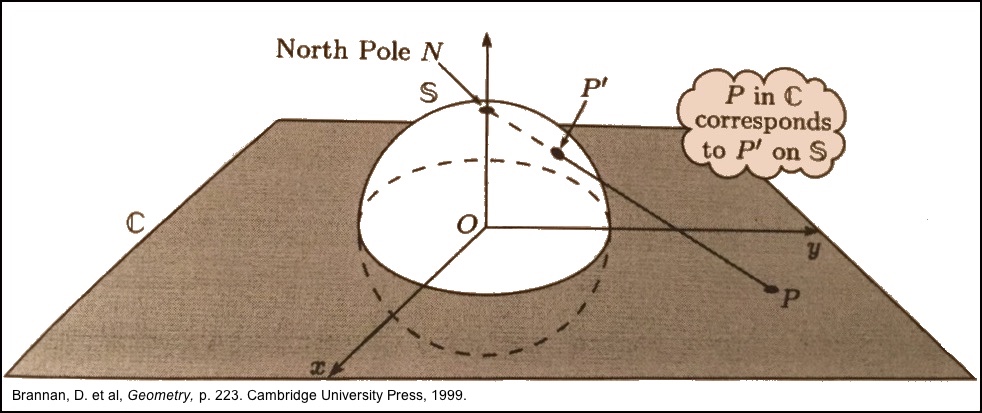
Likewise, do parallel lines intersect? If you start with the assumptions of Euclidean geometry — what you learned in school — then they don’t. But if you start with the assumptions of spherical geometry, then they do.*

Samson Raphael Hirsch (1808 – 1888), one of the founders of Modern Orthodox Judaism, was keenly aware of the problem. Our basic ideas and assumptions determine how we see the world. We can’t really test them because they’re so basic. We just have to take them or leave them.

Most people in Western countries hold vaguely scientific assumptions. They think that logic and experimental evidence are the only valid tests of truth. Even though most of their own beliefs don’t meet that standard,** they use it to assess religious claims such as the truth of the Torah.

As a result, Hirsch said, they evaluate the Torah in terms of the secular world instead of evaluating the secular world in terms of the Torah. It makes a difference where you start:

“Within the circle of Judaism the Divine law must be the soil out of which your intellectual and spiritual life is to grow, not vice versa. You must not from your own intellectual and spiritual life produce the basis on which to establish a Divine law.”***

One thing that Hirsch does not contemplate is that we might adopt different world-views for different aspects of life. To repair a car engine or hunt for quarks, we might adopt the assumptions of secular science. On the other hand, to decide how we should live or what we should do, we might adopt the assumptions of the Jewish tradition.

But they don’t conflict unless we try to substitute one for the other where it doesn’t belong.


Footnotes

* That is, spherical geometry has no parallel lines in the same sense as Euclidean geometry has them.

** The philosopher F.H. Bradley defined metaphysics as “the finding of bad reasons for what we believe on instinct.”

*** Horeb, p. 11.

Works Cited

Brannan, D. (1999), Geometry. Cambridge University Press, Cambridge, UK.

Grunfeld, I., translator (1962), Horeb: A Philosophy of Jewish Laws and Observances by Samson Raphael Hirsch. Soncino Press, New York.

Posted in Epistemology, Jewish Philosophy, Judaism, Modern Orthodoxy, Philosophy | Tagged , , , , , , , | Leave a comment

You’re Doing It Backward

Saadia-Beliefs-and-Opinions

By N.S. Palmer

You’re doing it backward.

Well, maybe not you, but a lot of people. They’re doing it backward, according to Saadia Gaon (882 – 942 CE), the Jewish philosopher who updated Aristotle for the 10th century.

Most people first decide what they want to believe, and then only afterward look for evidence to support it. They consider their belief so obviously true that evidence is a mere formality.

Because their belief is so obviously true, nobody could be mistaken about it. Those who deny the belief must simply be evil, so consumed by hatred that they intentionally reject the truth.

Pick almost any contested issue: Gay marriage, pro or con. Abortion. God’s existence. The truth of the Bible. The purpose of government. The male-female pay gap. Climate change. Barack Obama’s birth certificate. The BDS movement. People make up their minds first, then pick the evidence they like and ignore the rest (called “confirmation bias”).

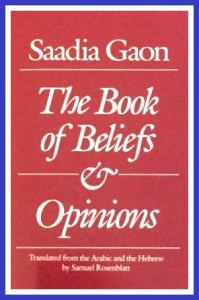
Saadia knew better. In his Book of Beliefs and Opinions, he laid out the correct order. Start with the evidence: What you see, what you hear, and so forth. Add self-evident logical principles (from “the intuition of the intellect”), such as: If whatever is A is B, and X is A, then X is B. Use the principles to deduce your conclusions:

[These] are the bases of truth: Knowledge gained by direct observation, the intuition of the intellect, and knowledge which is inferred by logical necessity.*

The conclusions come at the end of the process, not at the beginning:

The data with which [we] start are concrete, whereas the objectives that they strive for are abstract.**

Saadia used different words, but reached the same conclusions as modern cognitive psychology. According to psychologist Jonathan Haidt in his book The Righteous Mind, people usually make moral judgments in two steps:

  1. “Seeing that:” What pattern does this situation match, and how do I feel about the people involved?
  2. “Reasoning why:” What reasons can I find to justify what I’ve already decided to believe?***

In contemporary America, the most popular pattern is victimization: “Someone’s being mean to someone.” And sometimes, people really are mean to each other.

But as Saadia would have advised, it’s good to look at the evidence before making up your mind.


Footnotes

* Rosenblatt, S., p. 16
** Rosenblatt, S., p. 87.
*** Haidt, J. p. 49.

Works Cited

Haidt, Jonathan (2012), The Righteous Mind: Why Good People Are Divided by Politics and Religion. Pantheon Books, New York.

Rosenblatt, Samuel, translator (1948), Saadia Gaon: The Book of Beliefs and Opinions. Yale University Press, New Haven.

Posted in Jewish Philosophy | Tagged , , , , , , , , , | Leave a comment