
What Is Humanity?

Back in the 1960s, the great rabbi Abraham Joshua Heschel wrote Who Is Man? based on lectures he gave at Stanford University.

But to ask “who is man?” assumes that we’ve’ previously answered the question “what is man?”

If humans are merely physical objects like chairs and tables, then the question “who is man” makes no sense. A human person is not just a what, but is also a who: a living consciousness with self-awareness, thoughts, feelings, and moral rights. As Heschel said:

“Human being in distinction from all other beings is endowed with consciousness of its own being, not only with awareness of the presence of other beings.”1

One of the most dangerous mistakes we can make is to see other people only as whats instead of as whos.

Even if we know better, it’s hard to avoid. When we order coffee in a restaurant, it’s impractical to engage the server in a discussion of his or her life: we just want our coffee. That applies in many other situations. We ignore the humanity of the other.

It’s reasonable to make a distinction. When we order our coffee, we ignore the server’s humanity — but we don’t deny it.

On the other hand, if we choose to harm people without respect for their welfare, rights, or personal dignity, then we do implicitly deny their humanity. We act as if they are no more important than chairs and tables, to which we may do whatever we wish.

That’s why it’s troubling to read paragraphs such as the following, which appeared in a review of Francis Fukayama’s book Identity: The Demand for Dignity and the Politics of Resentment:

“Modern science robs us of any illusions we may have about our dignified place in the cosmos. Physics teaches that everything is matter in motion. And biology teaches that human beings, like all living organisms, are the result of an arbitrary evolutionary process. As the French Nobel Laureate in Medicine Jacques Monod once observed: ‘Man knows at last that he is alone in the universe’s unfeeling immensity, out of which he emerged only by chance.'”

Many educated people today believe that the human race is just mud with delusions of grandeur. But they’re wrong. Their belief rests on two key errors:

First, modern science tells us no such thing.

Physics studies the workings of the physical universe. It has nothing to say about other subjects. Biology teaches that living organisms evolved, but the arbitrariness of the process is not a biological question. And expertise in medicine confers no special knowledge of whether we are alone, whether the universe is unfeeling, or whether the human race emerged “only by chance.” Those beliefs might be true or false, but they are not scientific beliefs. They are philosophical or religious beliefs.

Second, even if science did tell us that, people would still matter more than mud.

Suppose the worst-case scenario is true, and that we are just a sophisticated cocktail of organic chemicals, mixed and served by blind chance. We live a little while and then we’re dead, dead, dead. End of story.

But wait: what about the story itself? While we are alive, we are conscious. We love, hate, suffer, and rejoice. Even if those things have no value to the universe at large, they’re important to us. Our lives are the stage upon which we find things to value, things to learn, and people to love. Do those things become worthless during our lives simply because they might be worthless after our lives? Of course not.

Our lives matter. Do they matter eternally, and to God? Maybe. Believe what you want. But they certainly matter temporarily, and to the people who live them.

People are not a what. They are always a who.

Footnote

  1. Who Is Man? pp. 7-8.

Check out my book Why Sane People Believe Crazy Things: How Belief Can Help or Hurt Social Peace. Kirkus Reviews called it an “impressively nuanced analysis.”

Posted in Jewish Philosophy, Judaism, Life | Tagged , , , , , , , , , , , , | Leave a comment

Grokking Our Disagreements

I finally got around to reading Robert Heinlein’s science fiction novel Starship Troopers.

When I was growing up, I read two or three science fiction novels a week. How I missed Starship Troopers, I don’t know.

And one of my brothers worked on the 1997 movie. His work appears in a lot of the scenes. Let’s just say that if not for him, the giant alien bugs would still be attacking earth.

So I’ve seen the movie at least a dozen times. Now that I’m reading the book, Heinlein impresses me even more.

That got me thinking about some of the ideas in Heinlein’s other books. The ideas were only incidental to the stories, so I didn’t give them much thought when I was a kid.1 In retrospect, however, they seem pretty profound.

One of his ideas can help us understand and transcend our disagreements.

The upper limit of knowledge

Heinlein’s most famous book is Stranger in a Strange Land, published in 1961. The story is set in the United States, presumably the 21st century. The world seems like what people in 1961 expected the future to be: essentially, it’s just the 1950s plus space travel and a few new gadgets.

The “stranger” is a man who was raised from infancy by Martians on Mars. He was born in space during the first manned mission to Mars. He is biologically human but he knows only Martian concepts and culture. As one character says, he is “more Martian than man.”2

When he comes to earth for the first time, he tries to understand the people around him. He calls it “grokking” them.

The other characters eventually figure out what “grok” means. To grok something is to understand it intimately and completely, inside and out, both as a matter of logic and as a matter of feeling:

“‘Grok’ means to understand so thoroughly that the observer becomes a part of the observed …”3

So we might say that grokking is the upper limit of knowledge. If we grok something fully, then we understand it as much as it can be understood.

The lower limit of knowledge

Heinlein also demonstrated the lower limit of knowledge. I’m not sure that he did it on purpose, but it’s there in the book.

His example shows how sane, rational people can look at the same facts and disagree completely about what they mean.

In Heinlein’s story, some people get special training for the job of “Fair Witness.” They have perfect and complete memory of anything they experience. In theory, they report exactly what they witness, without making assumptions or adding interpretation.

As Ambrose Bierce joked about realism, a Fair Witness’s job is to report events “as they are seen by toads.” For example:

“Jubal called out, ‘That house on the hilltop—can you see what color they’ve painted it?’ Anne looked, then answered, ‘It’s white on this side.’ Jubal went on to Jill, ‘You see? It doesn’t occur to Anne to infer that the other side is white, too. All the King’s horses couldn’t force her to commit herself unless she went there and looked — and even then she wouldn’t assume that it stayed white after she left.'”4

I call it “the lower limit” of knowledge because it you went much lower than what Anne says, you wouldn’t be making a statement: you’d just be saying “white!” You wouldn’t be asserting anything that could be true or false.

Notice some things about Anne:

  • She’s calm and clear-headed.
  • She’s not emotionally agitated.
  • She’s not trying to make a point.
  • She’s not trying to win an argument.
  • She has special training as a Fair Witness to report only what she sees, without assumptions or interpretation.

In spite of all that, she still makes assumptions and interprets what she sees:

  • She assumes that what she sees is a house.
  • She assumes that houses have sides.
  • She assumes that her vision is working properly.
  • She assumes that the light shining on the house isn’t making it seem white when it really isn’t.
  • She interprets her pattern of visual sensations as being the white side of a house.

Just like the rest of us when we look at the Ames room, Anne interprets what she sees. She relies on countless unconscious beliefs, assumptions, ideas, and previous experiences. If the situation matches the mental patterns she applies, then she perceives it correctly. If it doesn’t match her mental patterns, then she perceives it incorrectly.

And if two honest people apply different mental patterns to the same situation, then they’ll disagree about it — especially if they’re not “fair witnesses,” which almost nobody is. But if they’re sane and sensible, they can still figure out how to live together peacefully.

Footnotes

  1. Nor did I give much thought to the books’ kinky sexual ideas, which went completely over my head. I was a late bloomer.
  2. Stranger in a Strange Land, p. 7. Heinlein seemed to have a bad case of “blank-slate-ism.” At the time he was writing (1960), the blank-slate view of human nature was still defensible.
  3. Ibid, p. 241.
  4. Ibid, p. 112.

Check out my book Why Sane People Believe Crazy Things: How Belief Can Help or Hurt Social Peace. Kirkus Reviews called it an “impressively nuanced analysis.”

Posted in Epistemology, Human Relations, Life, Philosophy, Political Science, Psychology, Society | Tagged , , , , , , , , , | Leave a comment

Life is a Judgment Call

The bar patron asked the bartender, “Is life worth living?”

The bartender replied, “It depends on the liver.”1

In other words, it’s a judgment call.

Most of us crave simple patterns to explain life. We crave simple rules to guide our behavior. We often don’t get them.

I encountered an example on the road after lunch today.

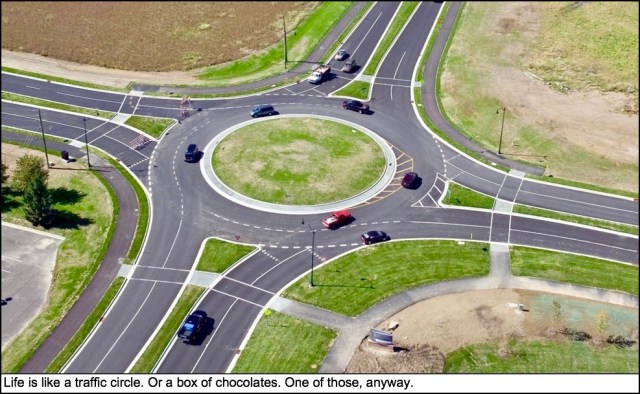
In the last few years, our city government has gone on a binge of replacing stop signs with traffic circles. The theory is that they speed up commuting. The reality is that many drivers still don’t know how to navigate them.

As a result, even simple traffic circles are accidents waiting to happen. Multi-lane traffic circles, because they’re more complex, are even more accident-prone.

Today after lunch, I was on a two-lane road approaching a one-lane traffic circle. My lane, on the left, led into the traffic circle. The other lane, on the right, was a right-turn lane.

I had a feeling that the driver on my right would cut in front of me and enter the traffic circle from the wrong lane, so I hit my brakes. And he did exactly as I’d expected. If I hadn’t braked, we would have crashed, with the front of my car hitting the driver’s side of his car. Not good, especially not for him.

Apparently oblivious to what had happened, he zoomed through the traffic circle. I followed behind him.

About a half-mile down the road, we came to another traffic circle. He zoomed into it and barely escaped being hit by a truck. I waited for the truck to pass and then drove through.

He either wasn’t paying attention to his driving, didn’t know how to use traffic circles, or was prone to taking unreasonable risks.

On the other hand, he hadn’t actually caused an accident and I’ve seen lots of incompetent driving. He did manage to avoid the truck.

So I thought, “what should I do?”

Call the cops? That seemed a little excessive. I’d witnessed a couple of traffic violations but no harm was done.

Catch up with him, stop him somehow, and explain his driving errors? Oh, yeah, that would work. Unsolicited criticism from strangers is always appreciated.

I finally made a judgment call: If he stopped somewhere and I was still within sight of him, I would pull over. As gently as possible, I’d try to explain how close he had come to causing two traffic accidents in two minutes. I didn’t expect him to react with anything but anger, but I would at least have done something.

He turned off the road at the next intersection, and I had to get back to work, so I didn’t chase him.

I hope that his driving improves, and that he doesn’t hurt anyone in the meantime.

I made a judgment call.

Footnote

  1. In case you didn’t get the joke, excessive drinking can damage the drinker’s liver.

Check out my new book Why Sane People Believe Crazy Things: How Belief Can Help or Hurt Social Peace. Kirkus Reviews called it an “impressively nuanced analysis.”

Posted in Human Relations, Life, Psychology | Tagged , , , , , , , , , | Leave a comment

The Lowered Expectations Dating Service

Utopian schemes try to create a perfect society. They usually cause more suffering than they cure. It’s a bad bargain.

Moreover, people seldom agree on what a perfect society would be like. No matter how good it is or in how many ways, somebody will still think it’s awful and unjust.

And no matter how good people’s lives are, they always feel that things could be better. Taken in moderation, that feeling is helpful. It motivates us to improve ourselves and our societies. But taken to extremes, it’s destructive, leading to despair, anger, and anarchy.

So I’m inclined to accept a certain amount of imperfection in life: as Voltaire advised, “the perfect is the enemy of the good.”

But am I accepting imperfection too easily? Have I needlessly signed up for “The Lowered Expectations Dating Service”?

I don’t think so, but mainly because the question has no clear answer.

We, our lives, and our societies are inevitably imperfect. Therefore — at least, short of Heaven or the Messianic era — our choice is never between perfect and imperfect. It’s always between various imperfect situations. We have to choose which imperfections we can tolerate and which we feel are intolerable.

I’ve seen enough of life by now to be pretty sure that:

  • Some people always oppress some other people. The only things that change are the people, the reasons, and the details. As economist John Kenneth Galbraith said, “Under capitalism, man exploits man; under Communism, it’s just the opposite.”
  • Some people always think they have it bad and society is unfair. In some ways, they probably do and it probably is. Welcome to real life. You can still get hot chocolate and fluffy bunnies to relieve stress, but you’ll have to pay for them.
  • Order is usually better than chaos, but it depends. Life is dynamic, so too much order is as bad as no order at all. Where do you draw the line? Like I said, it depends — on the people, the situation, and what’s reasonably possible.

Check out my book Why Sane People Believe Crazy Things: How Belief Can Help or Hurt Social Peace. Kirkus Reviews called it an “impressively nuanced analysis.”
Posted in Life, Philosophy, Political Science, Psychology, Society | Tagged , , , , , , , , , , | Leave a comment

Truth, Lies, and Bullsh-t

“I am lying,” said Epimenides the Cretan. So if he was lying, then he was telling the truth. And if he was telling the truth, he was lying.

Epimenides also made the Statue of Liberty disappear. Sorry. That was a lie.

Lying is wrong. But how wrong? And is it always wrong? Is it sometimes right?

Damon Ashworth ponders those questions in his latest blog post, which I recommend. He covers most of the answers. The short version is that it’s better to tell the truth unless you have a morally legitimate reason to lie.

The rub is that “morally legitimate” can mean different things. Most people’s moral sense is attuned to the norms of their society or group. Social life would be impossible unless most people told the truth (to other group members) most of the time. Ironically, social life would also be difficult unless most people lied occasionally — usually to prevent hurt feelings or to smooth over social situations.

Lying and social norms

Ricky Gervais’s 2009 movie “The Invention of Lying” gives a little-noticed demonstration of how social norms influence our perception of lying. The story takes place on a planet just like earth except that people have no concept of lying. They always tell the exact factual “truth.”1 But for them, it’s what’s been proven as true. If something is unproven, they don’t say it. Gervais discovers lying and uses it to his advantage.

I’ll confess to one of my own lies: I’m not really allergic to mushrooms. I just dislike them. When I pick them out of my food, my lie helps me avoid offending whoever cooked dinner because I don’t have to express dissatisfaction with the food.

Unfortunately, a minority of people are indifferent to morality. They are not necessarily evil in the sense of getting pleasure by hurting others. But they simply don’t care. They’ll lie, tell the truth, or bullsh-t as needed to get what they want.

Lying and bullsh-t

Bullsh-t, by the way, really is a separate thing. Lying and truth-telling both acknowledge the truth, though in opposite ways. Bullsh-t simply doesn’t care about it at all. Politicians and cable news pundits are often world-class bullsh-tters.

Whether you love him or hate him, Bill Clinton is a world-class bullsh-tter. Come to think of it, so are Barack Obama and Donald Trump. Hillary Clinton lacks the personality for it. George W. Bush seems too direct to be any good at it.

But back to Bill. When he was president, he ended up having to testify under oath about one of his extramarital affairs. Yes, it was a cynical attack by his political adversaries, just like the current establishment’s frenzied hunt for something — anything — of which to accuse President Trump. When President Clinton’s accusers asked him about his affair with White House intern Monica Lewinsky, he replied:

“I did not have sexual relations with that woman.”

As soon as I heard the words come out of his mouth, I knew exactly what he was doing. He was using the phrase “sexual relations” in a specific sense, to mean sexual intercourse and only sexual intercourse. He was under oath, so to avoid perjury, he said something that was misleading but technically true. He was bullsh-tting.

If nobody will believe you

There’s one other odd thing about telling the truth. I got my first hint of it during my senior year in high school. For the school yearbook, all of the graduating seniors listed their school activities. But the yearbook editor deleted about half of my list because he didn’t believe I could really have done everything I claimed. He thought I was lying.

A few years later, another event made the lesson crystal clear. During President Reagan’s second term, he denied knowing anything about a scandal in his administration. As far as I can determine, he was telling the truth. But everyone thought he was lying.

From that, I concluded:

If you tell the truth and nobody believes you, they’ll think you’re lying.

Sometimes, there’s a good reason to tell the truth and be considered a liar. When there isn’t a good reason, it’s prudent to think twice about doing it.

Footnote

  1. Because they have no concept of lying, they have no explicit concept of truth. But “factually proven” is pretty close.

Check out my new book Why Sane People Believe Crazy Things: How Belief Can Help or Hurt Social Peace. Kirkus Reviews called it an “impressively nuanced analysis.”

Posted in Human Relations, Life, Political Science, Psychology, Society | Tagged , , , , , , , | 3 Comments

You See What You Expect

Why do smart, sane, honest people sometimes disagree no matter how hard they try to find the truth?

Name an issue:

  • Abortion
  • Feminism
  • Immigration
  • Islam
  • President Trump
  • Racism

My friends and I often have stark disagreements about those issues. But we’re all decent, reasonable people trying to stick to the facts. Why do we see things so differently?

This blog’s photo demonstrates one of the most important reasons. It shows the Ames room illusion.

The photo is a composite of two other photos. One shows a woman standing on the left side of the room. The other shows the woman standing on the right side of the room.

It’s the same woman. She’s the same size. It’s the same room. If you watched her walk from left to right, you’d see her appear to get bigger.

Is it a computer trick? Nope. It’s the room. The floor and ceiling are slanted toward each other, so they’re closer on the right than on the left. The windows aren’t rectangular, but trapezoidal (slanted rectangles).

Since infancy, we’ve seen rooms in which:

  • The floors are parallel to the ceilings.
  • The walls are at right angles to the floors and ceilings.
  • The windows are rectangular.

Our minds instantly, automatically, and unconsciously interpret the Ames room based on that prior experience.

Even if we know about the Ames room, we still can’t help being fooled by the illusion.1

I’ve looked at that photo a dozen times, trying to keep the distortions in mind. The woman on the right still seems bigger.

What’s significant about the Ames room is not that our assumptions affect what we see. We knew that already.

What the Ames room shows is how difficult it is to break free of our assumptions.

And the Ames room is a very simple situation. Our prior assumptions can fool us even there — even when we know we are being fooled.

So it’s no surprise if we have trouble agreeing on complex social and moral issues, as well as the facts surrounding them.

We can be trying our very best to see things clearly, but our unconscious assumptions still end up fooling us.

We can’t always find our way out of the Ames room.

But if we discuss things calmly, openly, and in a spirit of goodwill, we’ve got a much better chance.

Footnote

  1. Primitive tribal people with no exposure to civilization are not fooled by the Ames room. They see it as it actually is.

Check out my new book Why Sane People Believe Crazy Things: How Belief Can Help or Hurt Social Peace. Kirkus Reviews called it an “impressively nuanced analysis.”

Posted in Human Relations, Life, Philosophy, Political Science, Psychology | Tagged , , , , , , | 1 Comment

History Bends Toward Chaos

Many people say that “the arc of history bends toward justice.”

Pardon my French, but ce n’est pas vrai: It’s not true. It’s the opposite of the truth.

If there is going to be justice in our world, we have to make it happen — and we also have to get lucky. Very lucky.1

Sure, everyone wants to believe that justice will prevail. And once in a while, it does.

But there’s a reason why most countries today and throughout history have been s-holes. There’s a reason why Western countries are now headed in that direction.

What’s the reason?

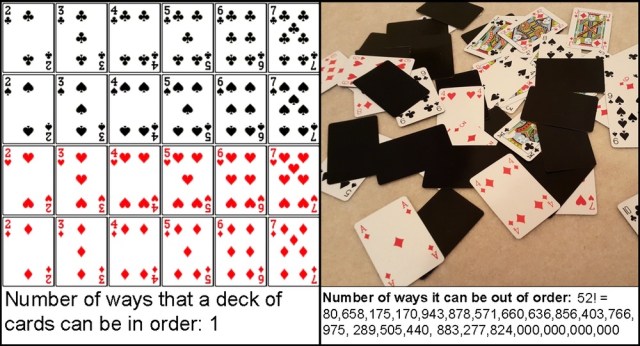
Consider a deck of 52 playing cards. If you throw the cards onto the floor, there is only one way for them to fall so they’re in order by suit and number. But there are 52! (52 factorial) ways for them to fall out of order. How big a number is that? It’s this:

80, 658, 175, 170, 943, 878, 571, 660, 636, 856,
403, 766, 975, 289, 505, 440, 883, 277, 824, 000,
000, 000, 000

So if you had to make a $10 bet on how the cards would fall, which way would you bet? Unless you wanted to lose your money, you’d bet on the cards falling out of order. That’s as close to a “sure bet” as you’re ever likely to see.

You could improve the odds a little — but not much — if you had a trick to increase the probability of the cards falling in order. Then you would be applying intelligence and knowledge to reduce the chance of a chaotic result.

But your trick itself would face the same problem: there are more ways for it to go wrong than to go right. If the trick could work, and you did it perfectly, and there wasn’t an unlucky gust of wind, and the carpet wasn’t uneven, and a million other factors that depend on pure luck — then maybe you’d have a chance. It could happen.

Most likely, however, you’d still end up with the cards out of order. Your best hope would be for them to be a little less disordered than if you hadn’t used your trick.

If you take countries as analogous to decks of playing cards, then you might say that:

  • The Russian Revolution (1917) applied mostly-incorrect beliefs ruthlessly and made the Russians worse off.
  • The French Revolution (1789) applied mostly-correct beliefs fanatically and made the French worse off.
  • The American Revolution (1776) applied mostly-correct beliefs correctly, got very lucky, and made the Americans better off.

In the real world, every country will have flaws. That’s inevitable. But if its people are lucky, it might be less disordered — and more just — than most other countries.

People who want to tear down America and replace it with an imagined utopia need to ask themselves a question: “Do I feel lucky?

Footnote

  1. Defining justice is a book-length project, so I won’t try it here. Justice should at least include a stable and predictable social order such that (1) People know what to expect in various situations; (2) they know what is allowed or forbidden; (3) they know what they are expected to do for each other; (4) they know what they are expected to get from each other, and (5) they usually do it and get it. Another problem is that groups of people define justice differently, depending on their histories, dominant personalities, and genetic proclivities.

Check out my book Why Sane People Believe Crazy Things: How Belief Can Help or Hurt Social Peace. Kirkus Reviews called it an “impressively nuanced analysis.”
Posted in Philosophy, Political Science, Society | Tagged , , , , , , , , , , , | 3 Comments

Trick or Treat

Is it okay to “trick people” for their own good?

That question comes up early in John Staddon’s book The New Behaviorism. I’ve just started reading it, and it’s a thought-provoking analysis.

Behaviorism is a psychological approach that, true to its name, focuses on how people act instead of how they feel. It also looks at how to encourage people to act in specific ways. (It doesn’t focus only on people, but that’s what’s relevant here.)

From Facebook to Fake News, from computer games to popular entertainment, much of what we see in daily life uses behaviorist ideas to get us to do or believe certain things.

For example, a key technique is variable reinforcement. If you give people a reward whenever they perform action X, you can motivate them to do it. But if you unpredictably reward them only some of the time instead of all of the time, you can addict them to doing it. That’s almost the entire science of online clickbait. Sometimes you get a reward, and sometimes you don’t. You just keep clicking. And suddenly it’s two o’clock in the morning.

Behaviorism was pioneered by John B. Watson (no relation to the Sherlock Holmes character), a Columbia University psychologist. Columbia fired him for cheating on his wife — what a different era that was! — and he went to work in advertising. He was a big success at getting people to buy things. That gave some evidence for his ideas.

His most famous successor was the Harvard psychologist B.F. Skinner, who not only extended the science of behaviorism but popularized it as a philosophy. That’s what raised the question about tricking people for their own good.

Skinner believed government should use behaviorist ideas to make people act in socially desirable ways and to discourage them doing things that were socially harmful.

Of course, the devil is in the details of defining “desirable” and “harmful” — and in who gets to define them.

But it raises the question that Staddon posed in response to Skinner. Is it “okay to use science to trick the citizenry as long as it gets them to do the right thing”?

I haven’t read far enough yet to know Staddon’s answer, though I expect it to be some version of “no, it’s not okay.”

The more general question is whether or not people in power should deceive the population for its own good. Using science just makes the deception more effective. The moral issue is the deception itself.

I’d answer that as a practical matter in the real world, the deception is almost always wrong. It assumes that the people in power “know best” what’s good for people in general.

Occasionally it’s true, but usually it’s not. And when it’s not true, people in power still try to impose their harmful or mistaken beliefs on everyone else.

That’s much worse than giving people the freedom to believe and act as they wish, as long as they don’t attack or coerce others. Some people will still be mistaken, but their mistakes won’t be forced on the rest of us.


Check out my new book Why Sane People Believe Crazy Things: How Belief Can Help or Hurt Social Peace. Kirkus Reviews called it an “impressively nuanced analysis.”

Posted in Human Relations, Life, Philosophy, Political Science, Psychology, Society | Tagged , , , , , , , , , , , , , , | 2 Comments

America and China Can Work It Out

Tensions between America and China are as predictable as they are, well, stupid.

Their tensions are predictable for two reasons:

  • The United States and China are rival world powers, vying with each other for status and influence in the world.
  • Some of their economic conflicts are zero-sum games. If one side wins, the other loses.

Stop acting like chimpanzees

The first reason amounts to a chimpanzee-level dispute: Who’s going to be the alpha chimp in the neighborhood? It’s a real factor that’s hard-wired into human nature. We ignore it at our peril, but it’s still stupid.

The Chinese — meaning the Han, who make up 91.6 percent of China’s population — are a distinct ethnic group. Like almost1 all such groups, they are inclined by evolution to help other members of their group and to oppose non-members.2

Non-members include not only Americans, but the 50 or so minority groups in China. To the Chinese, we are the outsiders to be opposed. Conversely, we perceive the Chinese as the outsiders to be opposed.

Group bias is a well-known problem in human relations. Intelligent people should be able to work around it. Human history is not encouraging, but we should at least try.

Resolve zero-sum games for mutual benefit

The second reason is rationally defensible but not insoluble. China has gained economically at America’s expense.3

Advocates of unlimited international trade often argue that we give China dollars and they give us consumer goods, so we are the winners of the exchange. They get paper and we get actual stuff. But after we pay China for all the stuff we buy, China uses the money to buy up American companies and productive resources. We’ve been selling long-run control over our country for short-run enjoyment of cheap consumer goods. That’s unsustainable.

It’s not hopeless

I don’t claim to be a China expert, but I know a little. I read their media and watch their television shows. I meet twice weekly on Skype with a language tutor who lives in China. We don’t talk about politics, but the Chinese are proud of their country and their people.

They don’t hate America, but they think that China is better than America and they intend to beat us. They’ll take the best deal they can get from us and then try to get a little more. In competition, that’s perfectly normal. We need to be just as competitive as they are. It’s in China’s best interests to get along with us, and our best interests to get along with them.

Mutually beneficial compromise is at least possible. Even if we’ve all got a little bit of crazy, we can act rationally if we try. It can be done.

Footnotes

  1. It’s very unusual for groups to hate their own people and their own country. As Zach Goldberg observed in Tablet Magazine, “white liberals [are] the only demographic group in America to display a pro-outgroup bias — meaning that among all the different groups surveyed, white liberals were the only one that expressed a preference for other racial and ethnic communities above their own.”
  2. America had a similar advantage until 1965, when it had an 88 percent majority of highly assimilated European-Americans. The 1965 Immigration Act changed things by encouraging immigration of unassimilable people from incompatible cultures.
  3. As developed by economists such as Adam Smith and David Ricardo, the idea that “free trade” is always mutually beneficial has several flaws. First, it assumed that trade was only between countries with similar cultures and legal systems. Second, it assumed that capital investment would not move between countries, so companies would not “offshore” jobs and production. Ricardo, who identified comparative advantage, explicitly stated that assumption. Third, it did not consider how trade would affect inequality within the trading countries. In the United States, it has enriched the richest people and (in relative terms) lowered the incomes of everyone else.

Check out my new book Why Sane People Believe Crazy Things: How Belief Can Help or Hurt Social Peace. Kirkus Reviews called it an “impressively nuanced analysis.”
Posted in Human Relations, Political Science | Tagged , , , , , , , , , , , | Leave a comment

Too Centralized to Fail?

Google Cloud went down yesterday, and it took a big piece of the internet down with it.

Large areas of the United States, Europe, and South America lost internet services until Google fixed the problem.

But Google is just one company. How could it take down such a big portion of the internet?

After all, the internet was designed to survive a nuclear war. The Defense Advanced Research Projects Administration (DARPA) created it in the 1960s so that the government could still communicate even if most of America’s infrastructure had been destroyed.

It now turns out that the internet is nuclear-war-proof but not Google-proof. Why?

The short answer: Google has become a single point on which a complex, worldwide system depends. If that point fails, then all the other parts of the system that depend on it will fail along with it.

Like big New York banks after the crash of 2008, Google has become “too big to fail.” After 2008, the Obama administration bailed out the banks instead of letting them fail. Then, instead of breaking up the big banks to reduce the risk of future crashes, the government let the big banks buy smaller banks and get even bigger. You don’t need to be a genius to know it was a bad idea.

But back to Google. What now? Yesterday’s internet outage showed that Google is a point of vulnerability for all the systems, companies, and people who depend on it. Yesterday’s outage was fixed quickly enough to avoid causing huge damage. But what about next time?

Do we make the same mistake with big tech companies in 2019 as we did with big banks in 2009? Or do we break them up to reduce the systemic risk?

There used to be something called “antitrust law” that promoted competitive markets by keeping companies from getting too big and too powerful. Actually, antitrust law is still on the books but it’s barely enforced anymore. Maybe it’s time to get serious about it again.


Check out my book Why Sane People Believe Crazy Things: How Belief Can Help or Hurt Social Peace. Kirkus Reviews called it an “impressively nuanced analysis.”
Posted in Political Science, Society | Tagged , , , , , , , , , , , , , , , | Leave a comment