
Do you have free will?
That’s an easy question. Of course you do.
Here’s a harder question: What is free will?
That’s where most of us get into trouble. Common sense tells us that we have free will, but doesn’t tell us what it is. We have only a vague idea of what it means to act freely.
And it’s a pretty important concept. If people can’t freely choose what they do, then they aren’t morally responsible for their actions. If we hold them responsible anyway, then we had no choice about it. Just like Alex in A Clockwork Orange, we are helpless automatons, not morally rational beings.

Our common-sense idea of free will is something like this: You go out for ice cream. You like chocolate and strawberry, but today you decide to get chocolate. You could have picked strawberry. Your will was free.
The problem is what we mean by “free.” Can a free choice be influenced by prior circumstances? You like chocolate and strawberry, so you choose one of them and ignore the vanilla. Could you have chosen the vanilla? Sure, but why would you? You felt like having chocolate ice cream.
For example, suppose when you go out for ice cream, your spouse teases you about always ordering chocolate. So you order strawberry — that is, unless you’re really annoyed, in which case you order Rocky Ripple. Your choice was still free, but both your taste preferences and your spouse caused you to make it a certain way.
That fits very well with how causation works. Events are almost never caused by a single thing. Normally, a whole context of causes makes things happen. In this case, the context included your spouse’s teasing, your ice cream preferences, and you. Which one of those things we choose to call “the cause” of your ice cream choice depends on the kind of story we’re telling and for what purpose. Since we’re talking about free will, in this discussion, you’re the cause. You made the choice.
What about Divine knowledge of the future? If God knows what we’re going to do, does it mean our actions are pre-determined, and therefore not free?
I’ll tell you a secret: It often occurs that months before I know what I’m going to do, my mother knows what I’m going to do. She doesn’t make me do it: I still choose freely. She just knows me very well, so she can predict what I’ll freely choose. However, even she doesn’t know me as well as God does.
God’s knowledge of the future doesn’t mean that our choices aren’t free. It only means that God knows us infinitely well, is outside of time, and therefore can “predict” our actions.




 The Thousand-Year View
If you did or didn’t have free will would you do anything differently? Answer: No, because if you didn’t have free will you couldn’t do anything differently. So I conclude the question is meaningless.
LikeLiked by 1 person
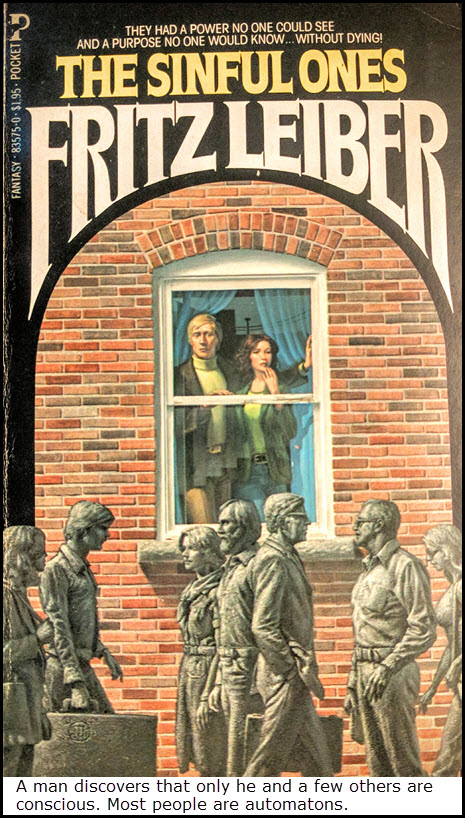
Yeah, I guess, on one level, sure. Everyone would act the same. In fact, one of my favorite fantasy novels explores a variation on that theme: The Sinful Ones by Fritz Leiber.
That said, we do believe we act freely. There are ways it’s true, and ways it isn’t true. I was mainly trying to clarify things a little bit. My blog for this week was going to be about racism, but The Jewish Journal postponed a public forum that I was going to use as a lead-in. So I came up with something else on the fly.
LikeLike
Freewill is a function of time. Hence we only have freewill, when we are in the present moment, and are aware of choice in that moment and have an understanding of why we make a choice. When we say that God knows our choice, we mistake the idea that linear time construct is how God is looking at our lifes, however God looks at the world without time.
LikeLiked by 1 person
Vieome, I agree. That’s why I put “predict” in scare quotes. 🙂
LikeLike
Pingback: Trinitarians making their proof for existence of God look ridiculous #5 – Unmasking anti Jehovah sites and people