
“We are all Keynesians now.”
— U.S. President Richard M. Nixon, 1971
If you took geometry in school, then you probably know the Pythagorean theorem: “in a right triangle, the square of the longest side equals the sum of the squares of the other two sides.”
What you might not know is that Pythagoras inspired a cult called the Pythagoreans. They believed they could explain everything in the world by whole numbers (1, 2, 3, etc.) and ratios of whole numbers (1/2, 3/4, etc.). Even whole numbers themselves could be written as ratios: 1 = 1/1, 25 = 25/1, and so on.
As a result, the Pythagoreans believed that the world was rational (based on ratios).
But early on, they ran into a devastating problem. In a right triangle whose shorter sides are length one, the sum of their squares is two, so the square of the longest side is two. And the length of the longest side is the square root of two, which is not a ratio of whole numbers: in other words, it’s irrational.
They had based their entire philosophy of life on a belief that everything was rational. And there, right in front of them, they saw an example of something that was not rational.
So what did they do? Did they say “oops,” and abandon their philosophy?
Of course not. They still insisted that everything was rational. But they quietly acknowledged that there was this “other thing,” irrational numbers, and they tried not to think about it too much.
We’re all a little like that. We have a mental picture of what the world is like, what people are like, and how things work. We believe in all kinds of things that cynics would say are not true. We believe that people are good more often than not. We believe in obeying the law. We believe that our institutions might be flawed but that they are fundamentally sound. We know there are plenty of cases where our beliefs are wrong, but we’re not giving up on our beliefs.
And there’s good news: We’re luckier than the Pythagoreans. Nobody has to be a decent person, act honestly, and treat other people fairly. But if enough of us hold on to those beliefs and live according to them, we can make them true. A good society is just a society in which most people, most of the time, choose to be good. It’s called an “emergent” property of a society.
The Pythagoreans couldn’t make the world totally rational. That’s impossible. And we ourselves can’t make the world totally good: that’s also impossible. But we can still make it pretty good. Just keep believing in the good and try to live by it.
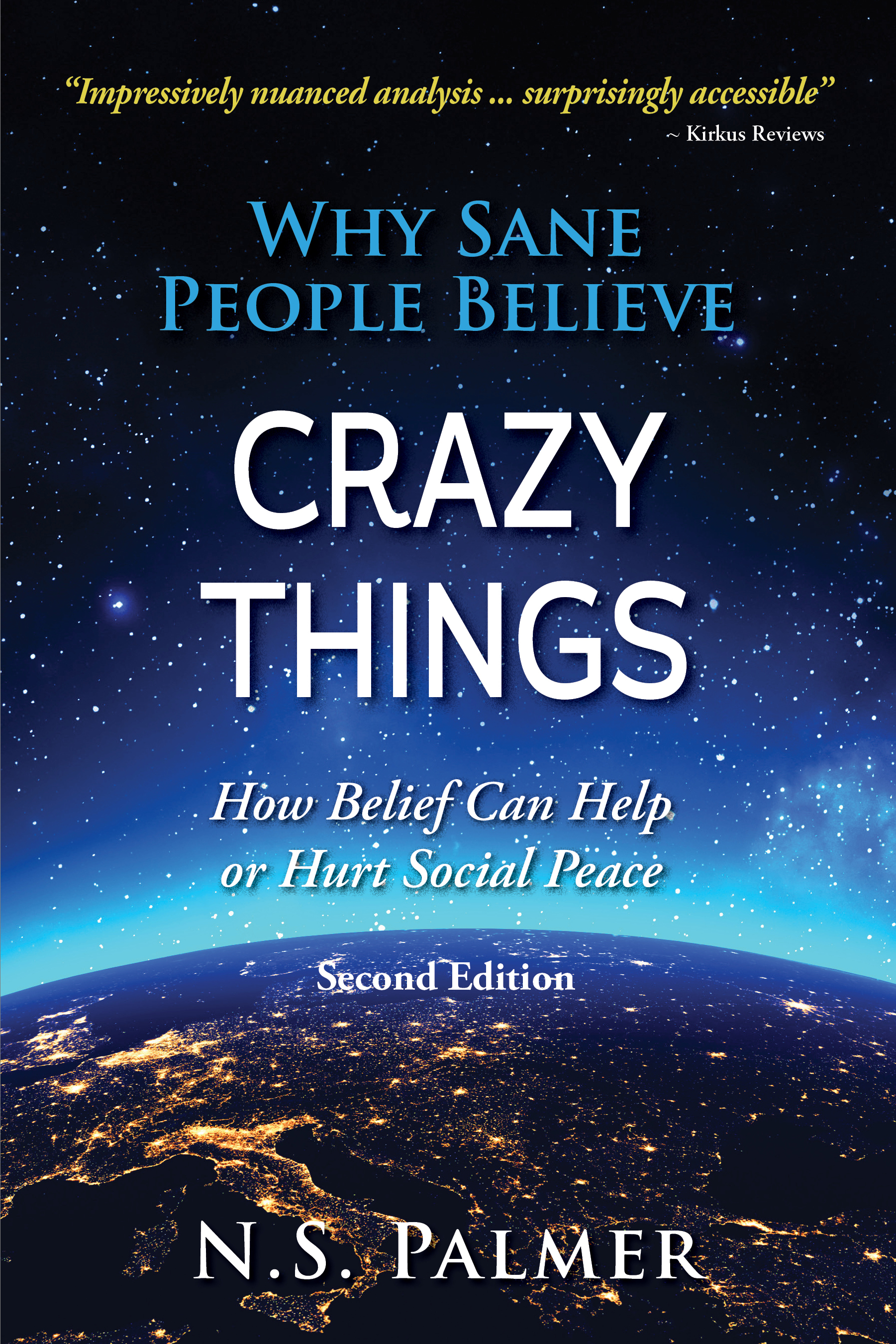
Living rationally and justly is a key theme of my book Why Sane People Believe Crazy Things Second Edition: How Belief Can Help or Hurt Social Peace. Get your copy today!




 The Thousand-Year View